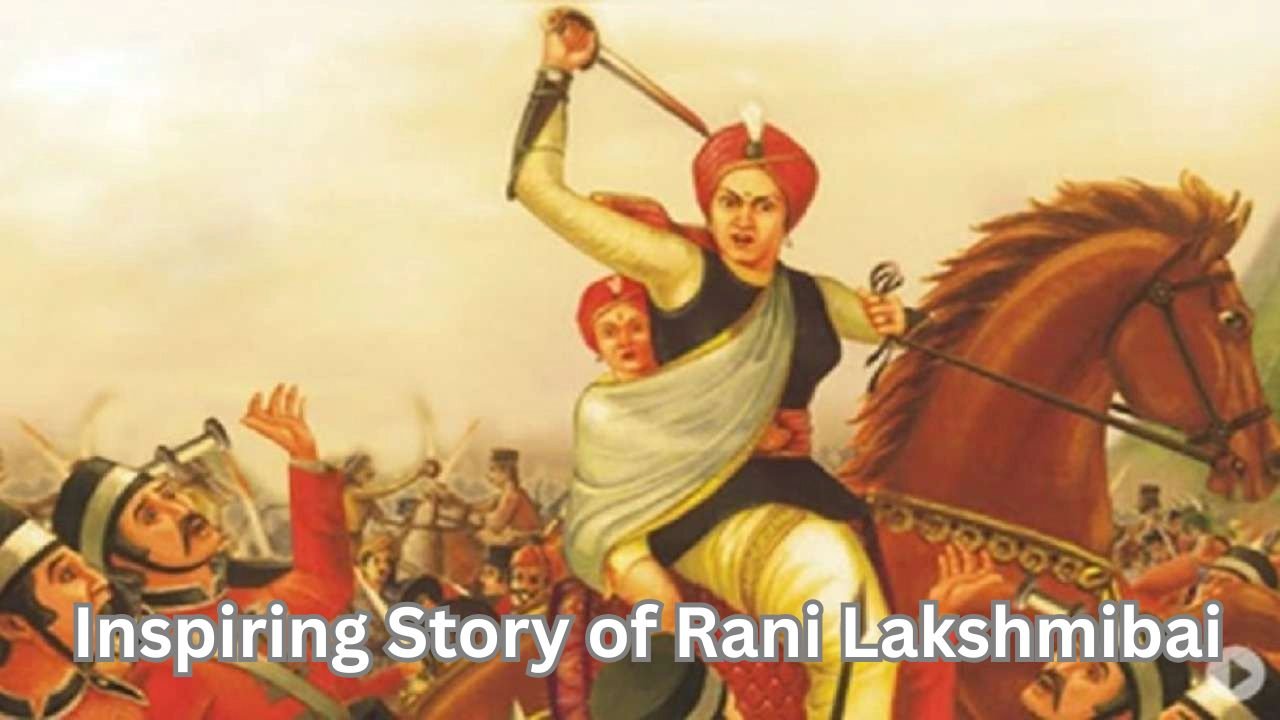
Inspiring Story of Rani Lakshmibai is one of the most inspiring heroes of India’s freedom struggle. She is remembered for her courage, leadership, and strong spirit in the face of British rule.
Early Life of Rani Lakshmibai
Rani Lakshmibai was born on November 19, 1828, in Varanasi, India. Her childhood name was Manikarnika, and people lovingly called her Manu. She was raised in a simple family but received a good education.
From a young age, she learned horse riding, sword fighting, and archery. These skills later helped her become a fearless warrior.
Growing Up in Bithoor (1830s)
After her mother’s death, Manu moved to Bithoor with her father. There, she grew up in the court of Peshwa Baji Rao II.
In Bithoor, she was raised like a strong and independent child. She played with boys and was never treated differently because she was a girl. This helped her develop confidence and courage.
Childhood and Education of the Queen (1830–1840)
Unlike many girls of her time, Manu received a good education. She learned:
- Reading and writing
- Basic knowledge of Sanskrit and Marathi
- Religious texts and moral values
Her education was not limited to books. She also learned life skills that made her strong and fearless.
Training in Martial Arts (1835–1842)
One of the most unique parts of her childhood was her training in physical activities. Manu was trained in:
- Horse riding
- Sword fighting
- Archery
- Self-defense
She became an expert rider and had famous horses like Sarangi, Pavan, and Badal. Her training made her ready for future battles.
Personality and Character Development
From a young age, Manu showed qualities of a leader. She was:
- Brave and fearless
- Intelligent and quick learner
- Strong-willed and determined
These qualities later enabled her to become one of India’s greatest freedom fighters. Inspiring Story of Rani Lakshmibai
Marriage to the King of Jhansi (1842)
In 1842, Manu married Maharaja Gangadhar Rao, the ruler of Jhansi. After marriage, she became known as Rani Lakshmibai.
She moved to Jhansi and started her life as a queen. She quickly adapted to royal duties and earned respect for her intelligence and strength. Inspiring Story of Rani Lakshmibai
Life in Jhansi (1842–1853)
As the Queen of Jhansi, Rani Lakshmibai played an important role in managing the kingdom. She focused on:
- Welfare of her people
- Administration of the state
- Maintaining peace and order
The queen was loved by her people because she was kind, fair, and dedicated to her responsibilities.
Personal Challenges (1851–1853)
Rani Lakshmibai and Maharaja Gangadhar Rao had a son in 1851, but sadly, he died in infancy. This was a very difficult time for the royal family.
In 1853, they adopted a son named Damodar Rao to continue the royal lineage. However, the same year, Maharaja Gangadhar Rao passed away, leaving Rani Lakshmibai to rule Jhansi alone.
Growth into a Strong Leader
Between 1828 and 1853, Rani Lakshmibai transformed from a young girl into a powerful queen. Her childhood training, education, and life experiences prepared her to face future challenges.
She showed courage, wisdom, and leadership even before her famous role in the freedom struggle.
Why Rani Lakshmibai Became a Freedom Fighter
Rani Lakshmibai is one of the most famous freedom fighters in Indian history. But why did she choose to fight against the British?
Death of the King and a Turning Point (1853)
In 1853, her husband, Maharaja Gangadhar Rao, died. Before his death, they adopted a son named Damodar Rao. Inspiring Story of Rani Lakshmibai
Rani Lakshmibai wanted her son to become the next ruler of Jhansi. However, this did not happen because of British policies.
Doctrine of Lapse and British Decision (1854)
In 1854, the British East India Company applied the Doctrine of Lapse, a policy that allowed them to take control of kingdoms without a natural heir.
The British refused to accept Damodar Rao as the rightful successor and decided to annex Jhansi. This decision deeply hurt Rani Lakshmibai and her people.
Refusal to Give Up Jhansi
Rani Lakshmibai strongly opposed the British decision. She clearly said,
“I will not give up my Jhansi.”
This moment became the beginning of her resistance. She decided to defend her kingdom at any cost.
Preparation for Battle (1854–1857)
Between 1854 and 1857, Rani Lakshmibai started preparing for war. She:
- Strengthened her army
- Trained soldiers, including women
- Improved the defense of the Jhansi fort
She showed great leadership and determination during this time.
Role in the Revolt of 1857
In 1857, the First War of Indian Independence began. Rani Lakshmibai became one of its leading figures.
She fought bravely against British forces and inspired many others to join the fight. Her courage made her a symbol of resistance across India.
Role in the Indian Rebellion of 1857
Rani Lakshmibai’s bravery and leadership made her a central hero of the Indian Rebellion of 1857, inspiring many with her actions during India’s freedom struggle.
Background of the Revolt (Before 1857)
Before the revolt began, the British had already taken control of Jhansi in 1854 under the Doctrine of Lapse.
Rani Lakshmibai was unhappy with this decision because her adopted son, Damodar Rao, was not accepted as the ruler. This injustice became the main reason for her involvement in the rebellion.
Beginning of the Revolt (1857)
In 1857, Indian soldiers and leaders across the country started a rebellion against British rule. When the revolt reached Jhansi, Rani Lakshmibai took charge of the situation.
She organized her army and prepared to defend her kingdom from British forces.
Defense of Jhansi (1857–1858)
Rani Lakshmibai showed great courage while defending Jhansi. She:
- Led her army from the front
- Protected Jhansi Fort from British attacks
- Motivated her soldiers to fight bravely
Even in difficult situations, she did not lose hope. Her leadership made Jhansi strong during the siege.
Battle Against British Forces (1858)
In 1858, British forces attacked Jhansi with full strength. Rani Lakshmibai fought fiercely to protect her kingdom.
When the situation became critical, she escaped from the fort with her son and continued the fight.
Alliance and Fight in Gwalior (1858)
After leaving Jhansi, she joined other freedom fighters like Tantia Tope. Together, they captured Gwalior in 1858.
Rani Lakshmibai continued to fight bravely against the British army in Gwalior.
Martyrdom and Sacrifice (1858)
On June 18, 1858, Rani Lakshmibai died in battle near Gwalior. She fought like a true warrior until her last breath. Her sacrifice made her a symbol of courage and patriotism.
Challenges Faced by the Queen of Jhansi
Rani Lakshmibai faced many challenges, including the loss of her husband, the British annexation of Jhansi under the Doctrine of Lapse, a lack of strong support, constant attacks, and leading her army during war while protecting her kingdom and young son.
Legacy and Contribution to India’s Freedom
Rani Lakshmibai remains a celebrated hero of India’s freedom struggle, with her legacy inspiring generations even after her death in 1858.
Her Sacrifice and Immediate Impact (1858)
In 1858, Rani Lakshmibai sacrificed her life while fighting against British forces. Her bravery during the Indian Rebellion of 1857 made her a symbol of resistance.
Her martyrdom inspired many Indians to continue the fight for freedom.
Inspiration for Freedom Fighters (1858–1947)
After her death, many leaders in India’s freedom movement were inspired by her courage. Between 1858 and 1947, her story motivated revolutionaries and nationalists to stand against British rule.
She became a powerful symbol of bravery, especially for women who wanted to take part in the struggle.
Role in Women’s Empowerment (19th Century–Present)
Rani Lakshmibai proved that women can be strong leaders and warriors. From the 19th century to the present, she has inspired women across India to be confident and fearless.
Her life broke social barriers and encouraged equality.
Honors and Recognition (1947–Present)
After India gained independence in 1947, Rani Lakshmibai received great respect and recognition.
- Statues and memorials were built in her honor.
- Schools, roads, and institutions were named after her.
- Her story is taught in textbooks across India.
She remains a national icon of courage and sacrifice.
FAQS
1) What were Lakshmibai’s last words?
Rani Lakshmibai’s exact last words are not clearly recorded in history. It is believed she asked her companions not to let the British capture her body. Her final actions showed bravery, self-respect, and deep love for her country.
2) Whose daughter is Rani Lakshmibai?
Rani Lakshmibai was the daughter of Moropant Tambe and Bhagirathi Bai. Her father was a respected official, and her mother was a religious woman who raised her with strong values and discipline.
3) Did Rani Laxmibai’s son die?
Rani Lakshmibai’s biological son was born in 1851 but sadly died in infancy. After this loss, she and her husband adopted a child named Damodar Rao, who later became her only surviving son and legal heir.
4) How many years was Rani Lakshmibai when she died?
Rani Lakshmibai was born on November 19, 1828, and died on June 18, 1858. She was about 29 years old at the time of her death, though some sources say she was around 30 years old.
Read More: