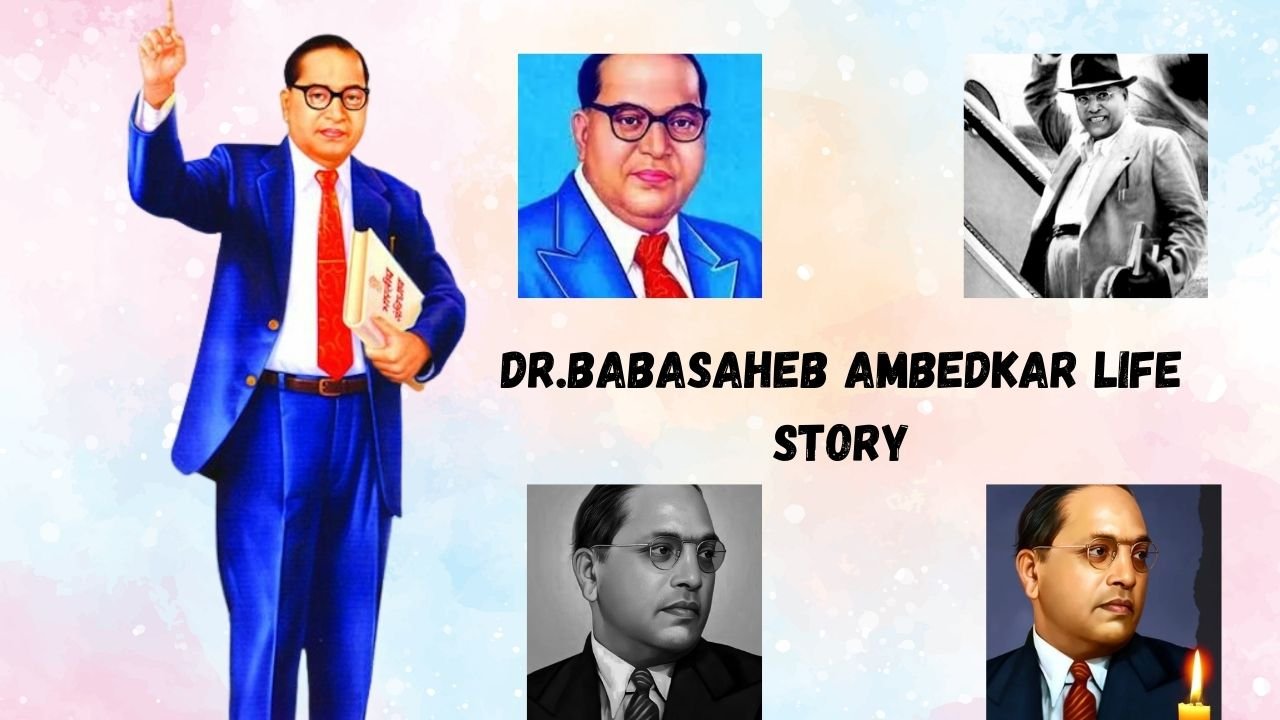
Babasaheb Ambedkar life story, also known as Dr. Bhimrao Ramji Ambedkar, was that of a great Indian leader, social reformer, and the principal architect of the Indian Constitution. He worked for equality, justice, and the rights of poor and backward people in India.
Babasaheb Ambedkar Early Life
Dr. B.R. Ambedkar was born on April 14, 1891, in Mhow, in Madhya Pradesh. He was born in a poor Dalit family. From childhood, he faced discrimination and many difficulties in school and society. But he was very intelligent and hardworking.
Birth and Family (1891)
- Father: Ramji Maloji Sakpal (worked in the army)
- Mother: Bhimabai Sakpal
He was born into a poor Dalit family and faced social discrimination from a young age.
Siblings Details
- He had many siblings (around 14 children in the family)
- Only a few survived into adulthood
- Some known siblings include:
-
- Anandrao Ambedkar (elder brother)
-
- Balaram Ambedkar (brother)
-
- Manjula (sister)
-
- Tulasa (sister)
Because of poverty and health issues, the family faced many difficulties in raising all its children.
Mother’s Death and Family Hardships (1896)
In 1896, Ambedkar’s mother, Bhimabai, passed away.
- This was a very difficult time for the family
- The children were raised with great difficulty
- His aunt helped take care of the family
Marriage Life (1906)
In 1906, at a young age, Ambedkar married Ramabai Ambedkar.
- It was a traditional child marriage
- Ramabai supported him during his difficult times and studies
Later Family Life (After 1948)
After the death of his first wife, Ramabai, in 1935, Ambedkar later married Savita Ambedkar in 1948.
- She supported him in his later life and health.
How Many Children Did Ambedkar Have?
Dr. B.R. Ambedkar had 5 children with his first wife, Ramabai Ambedkar.
Children Details
- He had four sons and one daughter
- Most of his children died at a young age due to poor health
Only Surviving Child
- Yashwant Ambedkar
- He was the only child who lived to adulthood
- He followed his father’s path and worked for society
Childhood Struggles (1896–1900)
Between 1896 and 1900, Ambedkar lost his mother at a young age. His family faced many financial and social problems. In school, he was treated unfairly because of his caste. He was not allowed to sit with other students or drink water freely.
Dr. Babasaheb Ambedkar Education
School Education (1900–1907)
From 1900 to 1907, Ambedkar studied in schools in Satara and later in Mumbai.
- He was a bright student and loved learning
- Despite discrimination, he continued his studies
- In 1907, he passed his matriculation exam, which was a big achievement for someone from his background
Graduation Degree (1912)
- In 1912, Dr. Ambedkar completed his Bachelor of Arts (B.A.).
- He studied at the University of Bombay
- His subjects were Economics and Political Science
Who gave a scholarship to Dr. B.R. Ambedkar
DR. Ambedkar received an important scholarship that helped him continue his higher education abroad.
Scholarship Provider
- Sayajirao Gaekwad III gave the scholarship
- He was the ruler of Baroda State
Master’s Degree (1913–1916)
DR. Ambedkar studied at Columbia University in the USA from 1913 to 1916. During this time, he completed around 60 courses in just 3 years.
He studied many subjects like economics, sociology, history, philosophy, and politics. This shows his strong interest in learning and knowledge.
Ambedkar was a very hardworking and intelligent student. His education at Columbia University helped him gain global knowledge and ideas about equality, democracy, and human rights.
This learning played a big role in his future work as a social reformer and the maker of the Indian Constitution.
PhD Degree (1917)
- In 1917, he completed his PhD in Economics
- From Columbia University
- His research was on India’s economic system
Law Degree (1923)
- In 1923, Dr. Ambedkar completed his Bar-at-Law
- He studied law in London
- He became a qualified lawyer
Doctorate in Economics (1923)
- In 1923, he also completed a D.Sc. (Doctor of Science in Economics)
- From the London School of Economics
- His research focused on finance and economic problems in India
Career and Work
DR. Ambedkar was a great leader, lawyer, and social reformer. His career and work helped create equality, justice, and rights for all people in India.
Early Career (1917–1920)
- In 1917, Dr. Ambedkar returned to India after studying abroad
- He worked as a professor of Political Economy in Mumbai
- He also started working as a lawyer
- He began speaking against social discrimination
Social and Legal Work (1920–1935)
- In 1924, he founded the Bahishkrit Hitakarini Sabha
- He worked for Dalit rights and social equality
- He led movements for access to water and temples
- He became a strong voice against caste discrimination
Political Career (1936–1947)
- In 1936, he founded the Independent Labour Party
- He worked for labour rights and poor people
- In 1942, he became a member of the Viceroy’s Executive Council
- He helped in making important government policies
Ambedkar Freedom Fight for Backward Classes
Babasaheb Ambedkar life story was a great leader who fought for the freedom, equality, and rights of backward classes (Dalits) in India. His struggle was focused on ending social discrimination and giving equal opportunities to all.
Fight Against the Caste System
- Ambedkar strongly opposed the caste system
- He worked to remove untouchability
- He demanded equal respect and rights for the backward classes
Major Movements
Mahad Satyagraha (1927)
- In 1927, Ambedkar led the Mahad movement
- He fought for the right of Dalits to drink water from public tanks
- This was a big step towards social equality
Temple Entry Movement (1930)
- In 1930, he led protests for Dalits to enter temples
- He worked for equal religious rights
Political Rights for Backward Classes
- Ambedkar demanded political representation for Dalits
- He played a key role in the Poona Pact (1932)
- He ensured that the backward classes got seats in the government
What Rights Did Ambedkar Give to Poor People
DR. Ambedkar worked hard to give rights and equality to the poor and backward people in India. He made laws and led movements to improve their lives.
Main Rights for Poor People
Right to Equality
Everyone is equal before the law
No discrimination based on caste, religion, or status
Right Against Untouchability
Untouchability was made illegal
Poor and Dalit people got equal respect in society
Right to Education
Ambedkar promoted education for all
He believed education could change lives
Right to Jobs (Reservation)
He supported reservations (quotas) in jobs and education
Helped the backward classes get opportunities
Right to Freedom
Babasaheb Ambedkar life story Poor people have freedom of speech, movement, and expression
Equal rights for all citizens
Labor Rights
Worked for workers’ welfare
Supported fair wages and better working conditions
Role in the Constitution
As the maker of the Indian Constitution, Ambedkar included:
Fundamental Rights
Equal protection under law
Social justice policies
Constitution Work (1947–1950)
DR. Ambedkar played a key role as the Chief Architect of the Indian Constitution.
Start and End Years
- Start Year: 1947
- End Year: 1950
Constitution Work Details
- In 1947, Dr. Ambedkar was appointed as the Chairman of the Drafting Committee
- He led the team responsible for writing the Constitution
- He worked on laws related to equality, freedom, and justice
- On November 26, 1949, the Constitution was completed and adopted
- On January 26, 1950, the Constitution came into effect in India
Importance of His Role
- He ensured equal rights for all citizens
- He protected fundamental rights
- He built a strong legal system for India
Later Work (1950–1956)
- He wrote books on law, economics, and society
- He supported women’s rights and education
- In 1956, he converted to Buddhism
- He inspired millions of people for social change
- Promoted education for everyone
Ambedkar started the newspaper Mooknayak.
DR. Ambedkar started a newspaper called Mooknayak to raise the voice of the poor and backward people in India.
Newspaper Details
- Name: Mooknayak (meaning “Leader of the Voiceless”)
- Started Year: 1920
- Language: Marathi
Purpose of Mooknayak
- To speak for Dalits and oppressed people
- To fight against caste discrimination
- To spread awareness about education and rights
- To support social equality and justice
Ambedkar Awards and International Recognition
Babasaheb Ambedkar life story is one of the most respected leaders in India and worldwide. He received important honours for his work in equality, law, and human rights.
Total Number of Awards
Dr. B.R. Ambedkar received 1 major official national award during his career, along with several international honours and honorary degrees.
Major Award with Year
Bharat Ratna (1990)
- Award: Bharat Ratna
- Year: 1990 (posthumous)
- This is the highest civilian award in India
- Given for his great contribution to the nation
International Honours with Years
Columbia University Honour (1952)
- Year: 1952
- Columbia University awarded him an honorary degree
- Recognized his contribution to economics, law, and social justice
Other Global Recognition
- After he died in 1956, Ambedkar gained worldwide respect
- His life and work are studied in many countries
- Many statues, memorials, and institutions are named after him
Important Note
- Ambedkar did not focus on collecting awards
- His main goal was social justice and equality
- Most recognition came after his lifetime
Places Where Ambedkar Worked
Mumbai (Bombay)
- Worked as a professor of Political Economy
- Started his career as a lawyer in the Bombay High Court
- Began social reform activities
Baroda (Vadodara)
- Worked in the Baroda State Service
- Faced discrimination, which inspired his fight for equality
Delhi
- Worked as the First Law Minister of India (1947–1951)
- Led the work of writing the Indian Constitution
Government of British India
- Served as a Member of the Viceroy’s Executive Council (1942–1946)
- Worked on labour and policy matters
Dr. B.R. Ambedkar’s Death and Death Place
Babasaheb Ambedkar life story was a great leader who worked for equality and justice in India. His death was a sad moment for the nation, but his legacy continues to inspire millions.
Death Date
- Date of Death: December 6, 1956
- He passed away at the age of 65
Death Place
- Place: Delhi, India
- He died at his residence in Delhi
Cause of Death
- Dr. Ambedkar was suffering from health problems like diabetes and weakness
- His death was due to natural causes
After Death
- His last rites were performed in Mumbai
- The place is now known as Chaitya Bhoomi, an important memorial site
- Every year, many people visit to pay respect
Importance of His Legacy
- Main architect of the Indian Constitution
- Leader of social justice and equality
- Inspiration for millions of people
Read More: