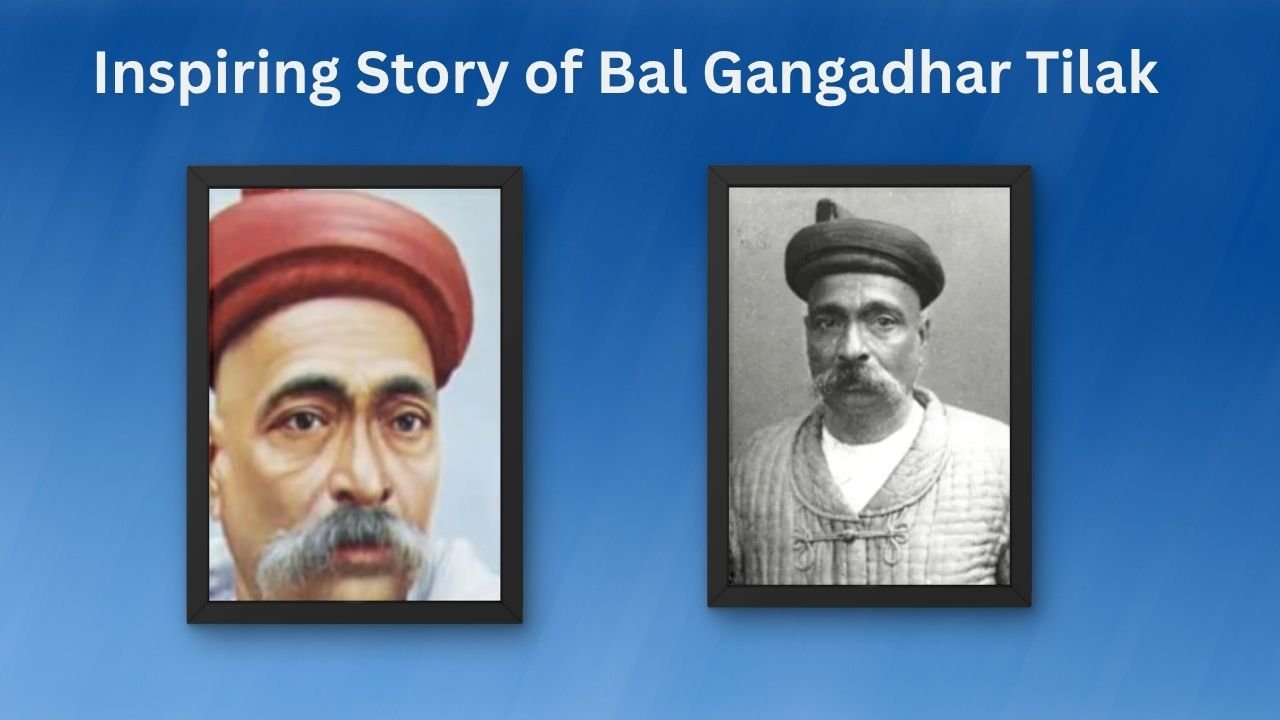
Inspiring Story of Bal Gangadhar Tilak emerged as a great Indian freedom fighter and leader. He earned the title “Father of Indian Unrest” because he fiercely challenged British rule. His famous slogan, “Swaraj is my birthright, and I shall have it,” ignited the spirits of many Indians.
Early Life of Bal Gangadhar Tilak
Bal Gangadhar Tilak was born on July 23, 1856, in Ratnagiri. His full name was Keshav Gangadhar Tilak.
From childhood, Tilak was very intelligent, honest, and disciplined. He loved learning and was especially interested in mathematics and Sanskrit. His teachers and family noticed his sharp memory and strong thinking skills at a young age.
In 1866, when Tilak was about 10 years old, his family moved to Pune. This city later became a significant center for his education and future endeavors.
Family Background
Tilak was born into a traditional and educated Brahmin family.
- His father, Gangadhar Ramachandra Tilak, was a respected teacher and a scholar of Sanskrit. He wrote books on grammar and education.
- His mother, Parvatibai Tilak, was a religious and kind woman who taught him good values and discipline.
In 1871, at a young age of about 15, Tilak was married to Tapibai (later known as Satyabhamabai), which was common in those times.
His family environment was simple but focused on education, culture, and strong moral values. These values influenced Tilak’s future leadership. Inspiring Story of Bal Gangadhar Tilak
Siblings
There is very limited historical information available about Tilak’s siblings. However, it is known that he grew up in a traditional family where education and discipline were very important.
Even without detailed records of his brothers and sisters, it is clear that his family supported his education and helped shape his character.
Marriage of Bal Gangadhar Tilak (1871)
Tilak married Tapibai (later Satyabhamabai) in 1871 at about 15 years old.
Child marriage was common in India during that time. Even at a young age, Tilak continued his education after marriage and remained focused on his goals. Inspiring Story of Bal Gangadhar Tilak
Married Life and Support (1871–1912)
From 1871 to 1912, Tilak and his wife lived a simple and traditional life.
Satyabhamabai Tilak was a supportive and responsible partner. She managed the household while Tilak focused on education, journalism, and the freedom struggle.
During difficult times, especially when Tilak was arrested by the British, she stayed strong and took care of the family.
Children of Bal Gangadhar Tilak
Bal Gangadhar Tilak had three sons:
- Vishwanath Tilak (born around the late 1870s)
- Shridhar Tilak (born around the early 1880s)
- Ramrao Tilak (born around mid-1880s)
Although exact birth years are not clearly recorded, all his children were raised during a time of political change in India.
Family Struggles During Imprisonment (1908–1914)
In 1908, Tilak was arrested by the British government and sent to Mandalay (Burma) for 6 years until 1914.
During this period, his family faced many hardships. His wife and children had to live without him, but they remained strong and continued to support his mission.
Death of His Wife (1912)
Satyabhamabai Tilak passed away in 1912, while Tilak was still involved in the freedom movement.
Her death was a great loss to him, but he did not stop his work for India’s independence. Inspiring Story of Bal Gangadhar Tilak
Contribution to Education
He worked hard to improve the education system and inspire young Indians.
Beginning of Educational Work (1870s)
After completing his education in 1877 (B.A. in Mathematics) and 1879 (LLB), Tilak decided not to take a government job under British rule. Instead, he chose to serve society through education.
In the late 1870s, he began teaching and encouraging students to think independently and develop national pride.
Founding of New English School (1880)
In 1880, Tilak, along with his friends like Gopal Ganesh Agarkar, founded the New English School in Pune.
The aim of this school was to provide quality education to Indian students and promote Indian values instead of British-controlled education.
Deccan Education Society (1884)
In 1884, Tilak became one of the founders of the Deccan Education Society.
This organization aimed to spread education among Indians and create a system that focused on national awareness, culture, and self-respect.
The society played an important role in shaping modern education in India.
Fergusson College (1885)
In 1885, the Deccan Education Society established Fergusson College in Pune.
Tilak contributed to its growth and development. The college became one of the leading educational institutions in India and helped produce many future leaders.
Role in India Freedom Struggle
He played a key role in awakening national pride and demanding independence from British rule.
Early Political Entry (1890)
Tilak entered active politics in 1890 when he joined the Indian National Congress.
He soon became a prominent leader and started speaking strongly against British policies. Unlike moderate leaders, Tilak believed in direct action and self-rule.
Spread of Nationalism through Newspapers (1881 onwards)
In 1881, Tilak started two newspapers:
- Kesari (Marathi)
- Maratha (English)
Through these newspapers, he educated people about their rights and encouraged them to fight for freedom. His writings created awareness and unity among Indians.
Promotion of Public Festivals (1893–1895)
Between 1893 and 1895, Tilak started public celebrations of:
- Ganesh Utsav (1893)
- Shivaji Jayanti (1895)
These festivals brought people together and increased national unity. They also became a platform to spread patriotic ideas.
Partition of Bengal and Swadeshi Movement (1905)
In 1905, during the Partition of Bengal, Tilak strongly supported the Swadeshi Movement.
He encouraged people to:
- Boycott foreign goods
- Use Indian-made products
- Support local industries
This movement became a major step toward independence.
Famous Slogan and Demand for Swaraj (1906)
In 1906, Tilak openly demanded Swaraj (self-rule).
His famous slogan: “Swaraj is my birthright, and I shall have it.”
This slogan inspired millions of Indians and became a powerful message in the freedom struggle.
Arrest and Imprisonment (1908–1914)
The British government arrested Tilak in 1908 for his writings and speeches. Inspiring Story of Bal Gangadhar Tilak
He was sent to Mandalay (Burma) for 6 years and remained in prison until 1914. Even during imprisonment, he continued to write and think about India’s freedom.
Home Rule Movement (1916)
After his release, Tilak became even more active. In 1916, he started the Home Rule Movement along with Annie Besant.
The aim of this movement was to demand self-government for India within the British Empire. It gained wide support across the country.
Lucknow Pact (1916)
In 1916, Tilak also played an important role in the Lucknow Pact between the Congress and the Muslim League.
This agreement helped bring unity among different communities in the fight for freedom.
Imprisonment
Bal Gangadhar Tilak was imprisoned several times for opposing British rule. His first arrest was in 1897, when he was sentenced to 18 months for writing against the government in Kesari. His most important imprisonment came in 1908, when he was arrested again for sedition and sent to Mandalay, Burma. He remained in jail for 6 years (1908–1914). During this time, he wrote the famous book Gita Rahasya around 1910–1911. Tilak was released in 1914. His imprisonments made him a national hero and inspired many Indians to join the freedom struggle.
Famous Slogan
His famous slogan:“Swaraj is my birthright, and I shall have it.”
This message gave courage and motivation to many Indians during the freedom struggle.
Bal Gangadhar Tilak’s Death and Place
Bal Gangadhar Tilak passed away on 1 August 1920 in Mumbai. His death was a great loss to India’s freedom movement. At that time, he was one of the most respected and powerful leaders fighting for Swaraj.
Thousands of people gathered to pay their last respects, showing his popularity among the masses. His funeral became a large public event, reflecting the love and respect people had for him. Even after his death in 1920, Tilak’s ideas and slogans inspired future leaders and freedom fighters across India.
Bal Gangadhar Tilak Awards
Bal Gangadhar Tilak did not receive official awards during British rule. In 1897, he was honored with the title “Lokmanya,” meaning “accepted by the people.” After his death in 1920, many institutions were named after him. The Tilak National Award was started in 1983 to honor his legacy and contributions.
FAQS
1) What were Tilak’s key achievements?
Bal Gangadhar Tilak led India’s freedom movement, promoted Swaraj, started Kesari (1881), founded New English School (1880), launched Ganesh Utsav (1893), supported Swadeshi (1905), and led the Home Rule Movement (1916), inspiring national unity and resistance.
2) What is the nickname of Gangadhar Tilak?
Bal Gangadhar Tilak was popularly known as “Lokmanya,” meaning “accepted by the people.” This nickname, given around 1897, showed the deep respect and trust Indians had for him as a strong leader in the freedom struggle.
3) What are the amazing facts about Bal Gangadhar Tilak?
Bal Gangadhar Tilak was called “Lokmanya,” wrote Gita Rahasya in jail (1910–1911), started Kesari (1881), began Ganesh Utsav (1893), demanded Swaraj (1906), and spent six years in Mandalay prison (1908–1914) for India’s freedom.
4) Which festival was started by Tilak?
Bal Gangadhar Tilak started the public celebration of Ganesh Utsav in 1893 to unite people and spread nationalism. He also promoted Shivaji Jayanti in 1895, turning festivals into platforms for awareness and strengthening India’s freedom movement.
Read More: