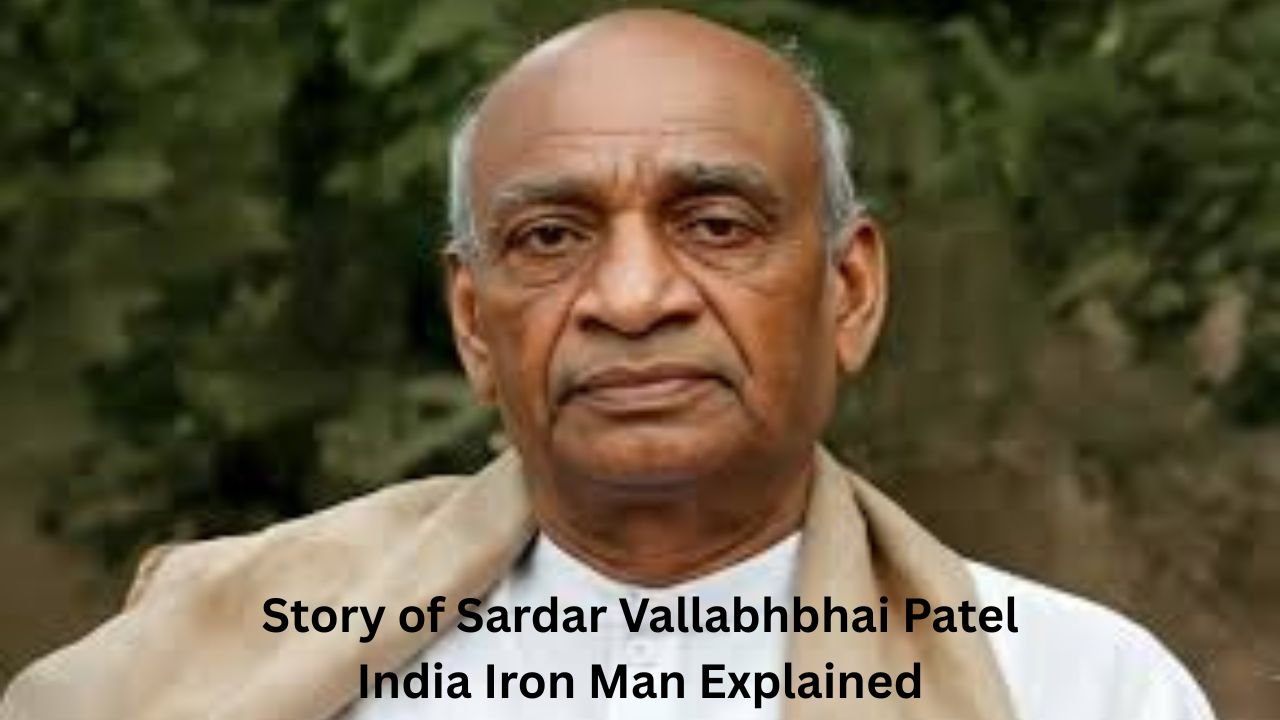
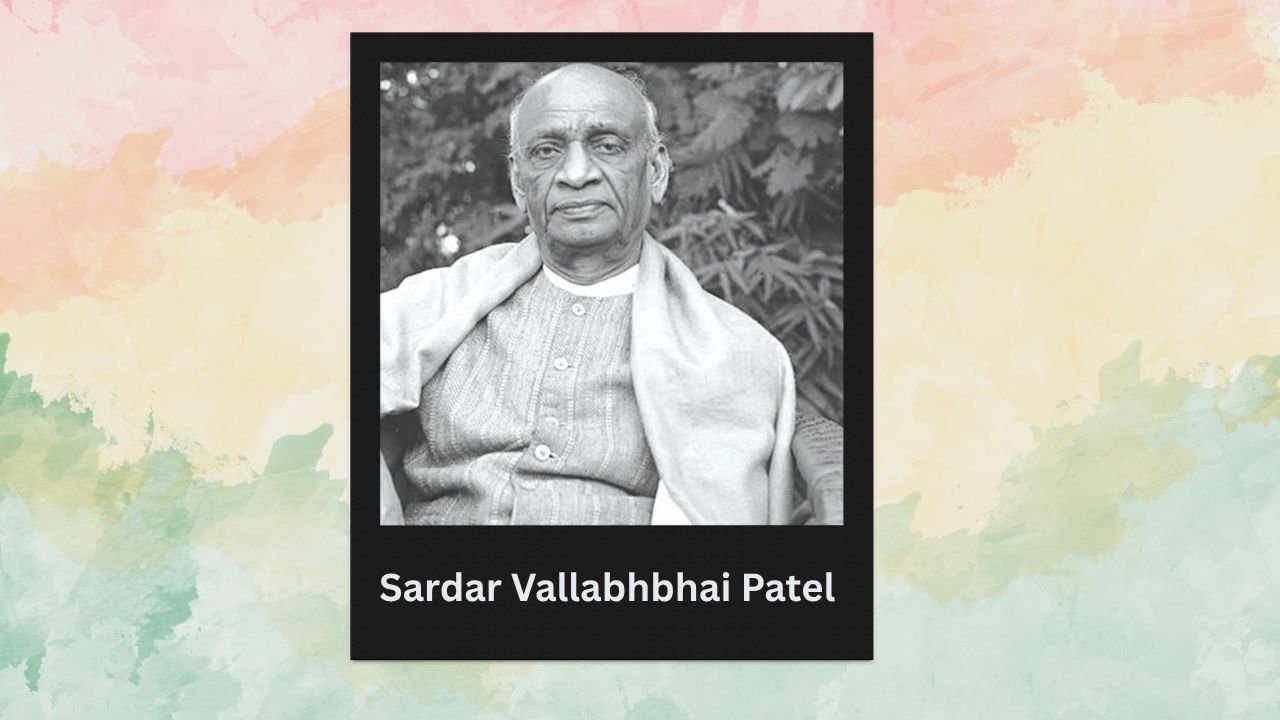
Story of Sardar Vallabhbhai Patel India Iron Man Explained was a great leader of India. He is known as the Iron Man of India because of his strong personality and leadership. He played an important role in India’s freedom struggle and in uniting the country after independence.
Sardar Vallabhbhai Patel Early Life (1875–1900)
Sardar Vallabhbhai Patel was born on 31 October 1875 in Karamsad, Gujarat, India. He was born into a simple farming family.
His father, Jhaverbhai Patel, was a farmer and had served in the army of Rani Lakshmibai. His mother, Ladbai, was a religious and caring woman.
Patel completed his early education in Gujarat. He was a hardworking student and showed strong determination from a young age. He passed his matriculation in 1897, which was considered a big achievement at that time.
Siblings (1870s–1900s)
Sardar Vallabhbhai Patel had five brothers and one sister. His family was large and closely connected.
His elder brother, Vithalbhai Patel (born 1873), was also an important political leader. He later became the first Indian President of the Central Legislative Assembly in 1925.
The strong bond between the brothers helped Patel grow in confidence and leadership.
Sardar Vallabhbhai Patel Marriage (1891–1909)
Sardar Vallabhbhai Patel was married at a young age in 1891 to Jhaverba Patel, following the customs of that time.
His wife supported him during his early struggles. However, she passed away in 1909 due to illness while Patel was in England for legal studies.
After her death, Patel chose not to remarry and focused on his children and career.
Children (1900s–1950)
Sardar Vallabhbhai Patel had two children:
- Dahyabhai Patel (born 1900) – his son
- Maniben Patel (born 1903) – his daughter
Maniben Patel played an important role in his life. She stayed with him and supported him in both personal and political life.
His children followed his values of discipline, service, and dedication.
Early School Education (1880s–1897)
Sardar Vallabhbhai Patel started his education in his village, Karamsad, Gujarat. Later, he studied in nearby towns like Petlad and Nadiad.
He was a serious and disciplined student. Patel completed his matriculation (10th class) around 1897 at the age of about 22. At that time, completing school itself was a big achievement.
Self-Study and Law Preparation (1897–1910)
After finishing school, Patel could not immediately go abroad due to financial problems. Instead, he chose to study law by himself. He prepared for the pleader’s examination (a law qualification in India at that time) through self-study. He passed the exam and started working as a lawyer around 1900.He practiced law in places like Godhra and Borsad and became a successful and respected lawyer.
Higher Education in England (1910–1913)
In 1910, Sardar Vallabhbhai Patel went to England to study law. He joined the Middle Temple in London, which is one of the famous law institutions.
Patel worked very hard and completed his course in just 3 years (1910–1913). He passed with high marks and ranked among the top students in his class.
Return to India and Legal Career (1913 onwards)
After completing his studies in 1913, Patel returned to India and started practicing law in Ahmedabad.
He quickly became one of the most successful lawyers in the region. His sharp thinking, confidence, and knowledge of the law made him popular.
Later, he left his legal career to join the Indian freedom movement under Mahatma Gandhi.
Life Before Freedom Movement (1913–1916)
After returning from England in 1913, Patel started working as a successful lawyer in Ahmedabad. He lived a comfortable life and focused on his legal career.
At this time, he was not deeply involved in politics. However, his life changed after meeting Mahatma Gandhi.
Inspiration from Mahatma Gandhi (1917)
In 1917, Sardar Vallabhbhai Patel met Mahatma Gandhi during a political meeting. Gandhi’s ideas of truth (satya) and non-violence (ahimsa) deeply influenced him.
This meeting marked the beginning of Patel’s entry into the Indian freedom movement. He decided to follow Gandhi and serve the nation.
First Major Role – Kheda Satyagraha (1918)
In 1918, Patel took part in the Kheda Satyagraha, led by Mahatma Gandhi.
Farmers in Kheda district were suffering due to crop failure, but were still forced to pay taxes by the British government. Patel organized the farmers and asked them not to pay taxes.
Due to strong unity and leadership, the British government agreed to reduce taxes. This success made Patel popular among the people.
Active Participation in National Movements (1920–1922)
Sardar Patel actively joined the Non-Cooperation Movement (1920–1922) started by Mahatma Gandhi.
He gave up his legal career and encouraged people to boycott British goods, schools, and services. He traveled across Gujarat to spread awareness and motivate people to join the movement.
Bardoli Satyagraha A Turning Point (1928)
In 1928, Patel led the famous Bardoli Satyagraha in Gujarat.
The British government increased land taxes, which created problems for farmers. Patel organized a peaceful protest and guided the farmers with discipline.
The movement was successful, and the government reduced taxes. After this victory, people gave him the title “Sardar”, meaning leader.
Growth as a National Leader (1930s–1940s)
After Bardoli, Sardar Patel became one of the top leaders of the Indian National Congress.
He played an important role in major movements like:
- Civil Disobedience Movement (1930)
- Quit India Movement (1942)
He was also jailed several times by the British government for his active role in the freedom struggle.
Role in India’s Independence Freedom Struggle (1917–1920)
Sardar Vallabhbhai Patel joined the freedom movement in 1917 after being inspired by Mahatma Gandhi.
In 1918, he led the Kheda Satyagraha, where farmers refused to pay taxes due to crop failure. His leadership helped farmers get relief from the British government. This was his first major success in the independence movement.
Non-Cooperation Movement (1920–1922)
Patel played an active role in the Non-Cooperation Movement (1920–1922).
He gave up his successful law career and encouraged people to boycott British goods, schools, and services. He traveled across Gujarat and inspired many people to join the struggle for freedom.
Bardoli Satyagraha Success (1928)
In 1928, Patel led the Bardoli Satyagraha, which became one of the most successful movements.
Farmers protested against high land taxes imposed by the British. Patel guided them peacefully and strongly. The British government finally reduced taxes, and people gave him the title “Sardar”, meaning leader.
Civil Disobedience Movement (1930–1934)
During the Civil Disobedience Movement (1930–1934), Patel supported Gandhi’s actions, such as breaking unjust laws.
He was arrested by the British government for his activities and spent time in jail. Despite this, he continued to motivate people to fight for independence.
Quit India Movement (1942)
Sardar Patel played a major role in the Quit India Movement (1942).
He strongly supported the demand for immediate independence. He was arrested along with other leaders and remained in prison until 1945. His dedication during this period showed his strong commitment to India’s freedom. Story of Sardar Vallabhbhai Patel India Iron Man Explained
Role in India’s Independence (1947)
When India finally became independent on 15 August 1947, Patel was one of the key leaders who made it possible.
He worked closely with other leaders in planning the future of the country. His efforts helped India transition from British rule to independence smoothly. towards independence.
Unification of India
Sardar Vallabhbhai Patel is known as the Unifier of India. After independence in 1947, he played the most important role in bringing together hundreds of princely states into one strong nation.
India’s Situation After Independence (1947)
When India became independent on 15 August 1947, the country was divided into two parts: India and Pakistan.
At that time, there were more than 560 princely states. These states were ruled by kings and were not directly under British India. They had the choice to join India, join Pakistan, or remain independent.
This created a big challenge for the unity and safety of India. Story of Sardar Vallabhbhai Patel India Iron Man Explained
Patel Becomes Home Minister (1947)
In 1947, Sardar Vallabhbhai Patel became the first Deputy Prime Minister and Home Minister of India.
He was given the responsibility to unite all the princely states into one nation. He worked closely with V. P. Menon, a skilled civil servant.
Awards and Honors
Sardar Vallabhbhai Patel was awarded the Bharat Ratna in 1991, which is India’s highest civilian award. His contribution is remembered through the Statue of Unity in Gujarat, the tallest statue in the world.
Death of Sardar Vallabhbhai Patel (1950)
Sardar Vallabhbhai Patel passed away on 15 December 1950.
His death was caused by a heart attack. At the time of his death, he was 75 years old.
The whole nation mourned his loss, and people paid deep respect to one of India’s greatest leaders.
Place of Death
Sardar Vallabhbhai Patel died in Mumbai (then Bombay), India.
He spent his last days there for medical treatment and rest. Mumbai became the place where the great leader took his final breath.
Funeral and Last Rites (1950)
His last rites were performed in Mumbai on 15 December 1950.
Many national leaders and thousands of people attended his funeral to pay their final respects. The country observed a period of mourning.
FAQS
1) Which caste is Sardar Patel?
Sardar Vallabhbhai Patel belonged to the Leuva Patidar (Patel) caste, a farming community in Gujarat. This community is part of the Kurmi/Patidar group, known for agriculture, land ownership, and strong social influence in Gujarat and other parts of India.
2) Who gave Sardar the title of Patel?
The title “Sardar” was given to Sardar Vallabhbhai Patel by the people of Bardoli in 1928 after the successful Bardoli Satyagraha. It means “leader,” showing respect for his strong leadership and courage.
3) Was Sardar Patel a smoker?
Sardar Vallabhbhai Patel was known to smoke in his early life, especially during his years as a lawyer. However, after joining the freedom movement and following Mahatma Gandhi, he gave up smoking and adopted a simple lifestyle.
4) Did Sardar Vallabhbhai Patel’s wife die?
Yes, Jhaverba Patel, the wife of Sardar Vallabhbhai Patel, died in 1909 due to illness. At that time, Patel was in England for studies. He never remarried and dedicated his life to his children and the nation.
Read More: