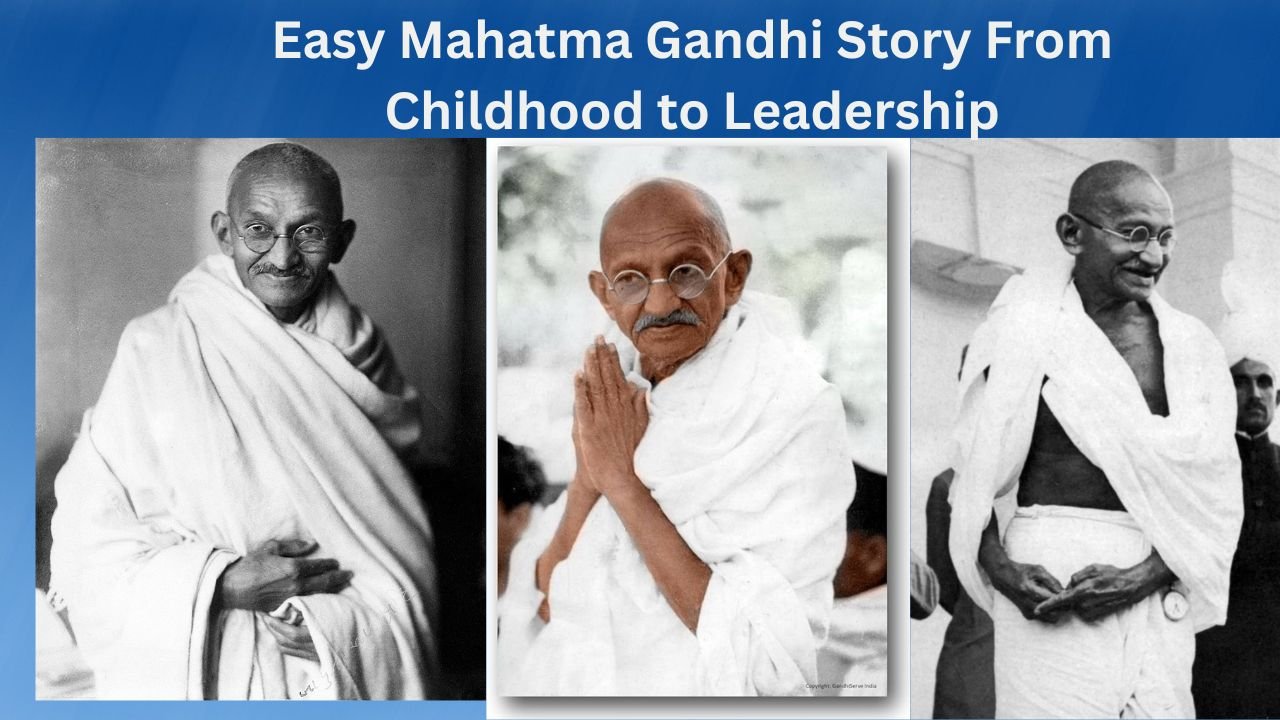
Easy Mahatma Gandhi Story From Childhood to Leadership was one of the greatest leaders of India.He is known as the “Father of the Nation.” He helped India get freedom from British rule using truth and non-violence.
He followed the path of truth and non-violence (Ahimsa). His life story inspires millions of people around the world.
Birth and Family Background (1869)
Mahatma Gandhi was born on October 2, 1869, in Porbandar. His full name was Mohandas Karamchand Gandhi.
- Father: Karamchand Gandhi He was a Diwan (chief minister) of Porbandar.
- Mother: Putlibai She was a religious and kind woman.
Gandhi’s family followed strong moral values and traditions. His mother had a big influence on his life.
Mahatma Gandhi Brothers and Sisters
Mahatma Gandhi had 3 siblings in total.
Family Details
- 1 elder brother: Laxmidas Gandhi
- 1 elder brother: Karsandas Gandhi
- 1 elder sister: Raliatbehn (Raliat Gandhi)
So, including Gandhi, there were 4 children in the family.
Childhood and Education (1870s–1887)
Gandhi spent his childhood in Porbandar and later in Rajkot. He was a shy and simple boy.
- He went to school in Rajkot.
- He was average in studies but very honest.
- He always followed truth and discipline.
In 1887, he passed his matriculation (school exam).
Marriage at a Young Age (1883)
In 1883, at the age of 13, Gandhi married Kasturba Gandhi.
This was a common practice in India at that time. Kasturba later supported Gandhi in his life and struggles.
College Education in India (1887–1888)
After school, Gandhi joined Samaldas College in Bhavnagar in 1887.
- He found studies difficult.
- He was not comfortable with English lectures.
- So, he left college after a few months.
Higher Studies in London (1888–1891)
In 1888, Gandhi went to London to study law. Before going, he promised his mother to follow moral values.
- He studied at Inner Temple (law college).
- He learned discipline and simple living.
In 1891, he returned to India as a barrister (lawyer).
Influence of Family Values
Gandhi’s early life was deeply influenced by his parents:
- From his mother, he learned truth, fasting, and devotion.
- From his father, he learned honesty and responsibility.
These values later became the foundation of his philosophy of truth (Satya) and non-violence (Ahimsa). Easy Mahatma Gandhi Story From Childhood to Leadership
Arrival in South Africa (1893)
In 1893, Gandhi went to South Africa to work as a lawyer for an Indian company.
During this time, Indians faced racial discrimination. One famous incident changed his life—he was thrown out of a train at Pietermaritzburg station despite having a valid ticket. This made him decide to fight injustice.
Fighting Against Discrimination (1893–1906)
Gandhi stayed in South Africa for about 21 years. He started working for the rights of Indians.
- He organized protests against unfair laws.
- He encouraged unity among Indians.
- He used peaceful methods instead of violence.
In 1894, he helped form the Natal Indian Congress to fight for Indian rights. Easy Mahatma Gandhi Story From Childhood to Leadership
Birth of Satyagraha (1906)
In 1906, Gandhi introduced the idea of Satyagraha, which means “truth force” or “soul force.”
- It was a method of non-violent resistance.
- People protested without fighting.
- 1908 (South Africa) First arrest during Satyagraha
- It focused on truth and justice.
This became his main philosophy later in India’s freedom struggle.
Return to India (1915)
In 1915, Gandhi returned to India as a respected leader. His experiences in South Africa prepared him to lead India’s freedom movement.
He joined the Indian National Congress, which was leading the freedom struggle.
Learning About India (1915–1916)
Before starting political movements, Gandhi traveled across India.
- He met farmers, workers, and common people.
- He understood their problems.
- He focused on poverty, injustice, and British exploitation.
This helped him connect with the masses.
First Political Movement Champaran (1917)
In 1917, Gandhi started his first major political action in Champaran, Bihar.
- Farmers were forced to grow indigo.
- Gandhi supported them using non-violence.
- The British accepted some demands.
This was his first success in Indian politics.
Rise as a National Leader (1918)
In 1918, Gandhi led more movements:
- Kheda Satyagraha: Helped farmers who could not pay taxes
- Ahmedabad Mill Strike Supported workers for better wages
These movements made him popular across India. Easy Mahatma Gandhi Story From Childhood to Leadership
Entry into National Politics (1920)
By 1920, Gandhi became a top leader of the Indian freedom movement.
He launched the Non-Cooperation Movement (1920):
- Boycott British goods and services
- Promote Swadeshi (Indian products)
- Encourage unity among Indians.
This marked his full entry into national politics.
Role in India’s Freedom Struggle
Gandhi returned to India in 1915 and joined the freedom movement. He became a strong leader and guided people with nonviolence.
Champaran Movement (1917)
In 1917, Gandhi led his first major movement in Champaran, Bihar.
- Farmers were forced to grow indigo.
- Gandhi fought for their rights.
- The British government accepted his demands.
- 1917 – Champaran movement
This was his first big success in India.
Kheda and Ahmedabad Movements (1918)
In 1918, Gandhi helped farmers and workers:
- Kheda Satyagraha Farmers could not pay taxes due to crop failure
- Ahmedabad Mill Strike Workers demanded fair wages
Both movements showed the power of non-violence.
Non-Cooperation Movement (1920–1922)
In 1920, Gandhi launched the Non-Cooperation Movement.
- People boycotted British goods, schools, and offices.
- Promoted the use of Swadeshi (Indian goods)
- Encouraged spinning cloth (charkha)
- 1922 – After Non-Cooperation Movement (6 years jail, released early)
This movement united Indians but was stopped in 1922 after the Chauri Chaura incident.
Civil Disobedience Movement and Dandi March (1930)
In 1930, Gandhi started the Civil Disobedience Movement.
- He led the famous Dandi March.
- Protested against the British salt tax
- 1930 – During the Civil Disobedience Movement (Dandi March)
- Thousands of people joined.
This movement gained worldwide attention.
Quit India Movement (1942)
In 1942, Gandhi launched the Quit India Movement.
- Gave the slogan “Do or Die.”
- Demanded immediate independence
- Many leaders were arrested.
This movement made the British realize they could not rule India for long.
He also led the famous Dandi March against the salt tax.
Gandhi’s Principles
Gandhi believed in:
- Truth (Satya)
- Non-violence (Ahimsa)
- Peace and unity
- Simple living
He taught people to solve problems without fighting.
India’s Independence
India’s independence is one of the most important events in history. After many years of struggle, India became free from British rule on August 15, 1947. Many leaders, including Mahatma Gandhi, played a key role in achieving freedom.
Background of Independence
Before 1947, India was ruled by the British for nearly 200 years. Indians faced many problems like high taxes, lack of rights, and poverty.
Many freedom fighters worked hard to end British rule:
- Mahatma Gandhi
- Jawaharlal Nehru
- Subhas Chandra Bose
- Bhagat Singh
Their sacrifices helped India move towards independence.
Final Phase of Freedom Struggle (1940–1947)
During the 1940s, the demand for freedom became stronger.
- In 1942, the Quit India Movement was launched.
- People protested across the country.
- The British government faced strong pressure.
- 1942 – Quit India Movement (last major arrest)
After World War II, Britain was weakened and decided to leave India.
Independence and Partition (1947)
India became independent on August 15, 1947.
However, the country was divided into two nations:
- India
- Pakistan
This division is called Partition. It led to large-scale migration and violence between communities.
First Prime Minister of India
After independence, Jawaharlal Nehru became the first Prime Minister of India.
He gave a famous speech called “Tryst with Destiny” on the night of independence.
Role of Mahatma Gandhi
Mahatma Gandhi did not celebrate independence. He worked to stop violence during Partition and promote peace between people.
Importance of Independence
India’s independence means:
- Freedom from British rule
- Right to self-govern
- Beginning of a democratic nation
It is celebrated every year as Independence Day.
Death of Mahatma Gandhi
Mahatma Gandhi was killed on January 30, 1948, in New Delhi. His death was a great loss for the nation.
Legacy
Gandhi’s teachings are still followed around the world. His birthday, October 2, is celebrated as Gandhi Jayanti. He remains a symbol of peace and truth.
Mahatma Gandhi Awards and International Recognition
Mahatma Gandhi is one of the most respected leaders in the world. Even though he did not receive many official awards, he got great international recognition for his work in peace and nonviolence.
Nobel Peace Prize Nominations (1937–1948)
Gandhi was nominated for the Nobel Peace Prize multiple times:
- 1937 – First nomination
- 1938 – Nominated again
- 1939 – Continued recognition
- 1947 – Strong nomination after India’s independence
- 1948 – Nominated, but no award given after his death
He never won the Nobel Prize, but many believe he deserved it.
Title “Mahatma” (1914–1915)
- Around 1914–1915, he was given the title “Mahatma”, meaning “Great Soul.”
- This title was popularized by Rabindranath Tagore.
International Influence (1920s–1940s)
During his lifetime, Gandhi became globally famous:
- 1920s–1940s – His non-violent ideas spread worldwide
- Inspired leaders like:
-
- Martin Luther King Jr. (1950s–1960s)
- Nelson Mandela (1940s–1990s)
Honors After His Death
Gandhi Jayanti (From 1948)
- Since 1948, October 2 has been celebrated as Gandhi Jayanti in India.
International Day of Non-Violence (2007)
- In 2007, the United Nations declared October 2 as the
International Day of Non-Violence
FAQS
1) Who are the 4 children of Gandhi?
Mahatma Gandhi had four sons: Harilal Gandhi, Manilal Gandhi, Ramdas Gandhi, and Devdas Gandhi. They were born between 1888 and 1900 and followed different paths in life, with some supporting their father’s ideals and work.
2) Who called Gandhiji first?
Mahatma Gandhi was first called “Mahatma” by Rabindranath Tagore around 1915. The title means “Great Soul.” It became popular as people respected Gandhi’s truth, non-violence, and leadership in India’s freedom struggle.
3) How did Gandhi dress?
Mahatma Gandhi dressed very simply. He wore a khadi loincloth (dhoti) and a shawl, often made by hand using a spinning wheel. His simple clothing showed equality, self-reliance, and support for Indian-made goods (Swadeshi).
4) What are the 11 rules of Gandhi?
Mahatma Gandhi gave 11 rules called vows: truth, non-violence, non-stealing, celibacy, non-possession, control of palate, bread labour, fearlessness, equality of religions, Swadeshi, and removal of untouchability. These guided a simple, disciplined, and moral life.
Read More: