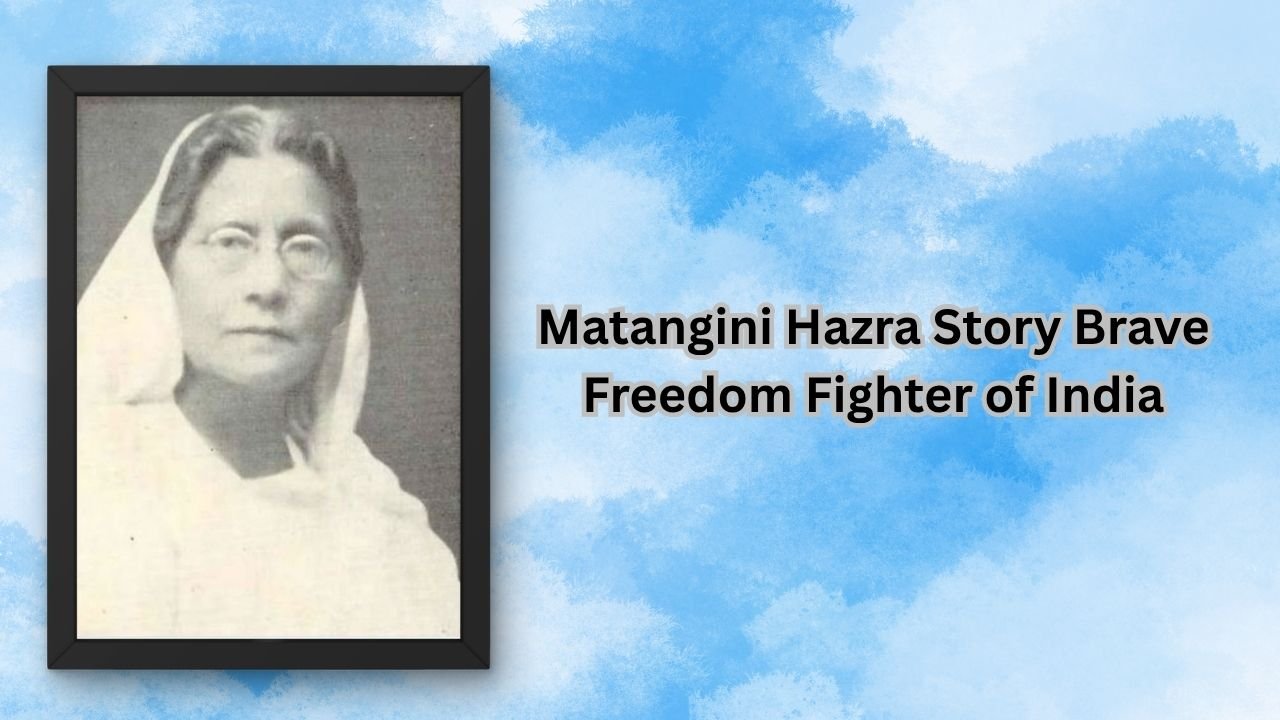
Matangini Hazra Story Brave Freedom Fighter of India stood out as a fearless leader during India’s freedom struggle. Through courage and unwavering dedication, she became a living symbol of sacrifice against British rule, joining in Mahatma Gandhi’s movements even in her later years.
Early Life (1870–1880s)
Matangini Hazra was born on 19 October 1870 in Hogla, West Bengal, India. She was born into a poor farming family. Life was difficult, and she had to work from a young age.
Her childhood was simple and full of struggles. Like many girls at the time, she had few opportunities for growth or education.
Parents
Although not widely recorded in history, the names of Matangini Hazra’s parents are known less than the humble life they led as poor farmers. Instilled with honesty, hard work, and a spirit of helping others, these values shaped her character as she grew.
Education
Matangini Hazra did not receive a formal education. Due to poverty and social conditions in the late 19th century, girls were rarely sent to school. However, she was wise, strong, and learned through life experiences.
Marriage (1880s–1890s)
She was married at a very young age, around her early teens, to an older widower. This was common in India during that period.
Children
Matangini Hazra had no children. After her husband’s death, she lived a lonely life but chose to dedicate herself to society and later to the nation.
Widow Life (1890s–1920s)
She became a widow at a young age. Instead of surrendering to grief, she forged a life of dignity and purpose, standing by her village with an open heart. Her quiet resilience and acts of kindness earned her great respect and affection.
Career and Social Work (1920s–1930s)
Without a formal career, Matangini Hazra became a well-known social worker and activist. She dedicated herself to helping the poor and was deeply involved in the growing independence movements of her time.
Entry into Freedom Movement (1930)
In 1930, inspired by Mahatma Gandhi, Matangini Hazra committed herself to India’s freedom struggle. This was a turning point in her life, marking her active involvement in the movement. Matangini Hazra Story Brave Freedom Fighter of India
Key Events:
- 1930 – Salt March Movement: She took part in protests against British salt laws.
- 1932 – Civil Disobedience Movement: She was arrested and sent to jail for protesting.
- Age did not deter her. She remained active in protests regardless of the challenges.
She held a deep, almost sacred faith in non-violence, embracing Gandhian ideals with unwavering devotion.
Role in Quit India Movement (1942)
In 1942, Matangini Hazra emerged as a key leader in the Quit India Movement, guiding the people of Tamluk, West Bengal, in their fight for independence.
On 29 September 1942, with the Indian national flag in hand, she led a large group of freedom fighters to capture the Tamluk police station, raising patriotic slogans such as “Vande Mataram.”
Her leadership ignited a flame of hope, inspiring countless people, especially women, to rise and join the fight for India’s freedom.
Martyrdom and Death (1942)
During the protest on 29 September 1942, British police opened fire on the crowd.
- She was shot multiple times.
- Even after bullets struck her, she pressed on, clutching the flag close to her chest, her determination shining brighter than her wounds.
- She continued to chant “Vande Mataram,” her voice unwavering with love for her country until her final breath.
Death Place
Matangini Hazra died in Tamluk, Midnapore district, West Bengal, India.
Age at Death
She was 72 years old at the time of her death in 1942.
Awards and Honors (Post-1947)
Matangini Hazra did not receive awards during her lifetime because India was still under British rule. However, after independence in 1947, she was honored in many ways:
- Statues were built in her memory across West Bengal.
- Schools and roads were named after her.
- She is remembered as “Gandhi Buri,” meaning “old-lady Gandhi.”
- Her contribution is taught in history books.
- The Government of India recognized her as a brave freedom fighter.
Though she did not receive official awards like modern honors, her legacy itself is her greatest award.
Legacy
Matangini Hazra’s life embodies courage, sacrifice, and resolve. Even in old age, she rallied against injustice and inspired many to join India’s freedom movement.
Her bravery continues to inspire generations of Indians.
Conclusion
Matangini Hazra’s journey from a poor village woman to a resolute freedom fighter highlights the sacrifices made in India’s struggle for independence. Her life remains a source of inspiration.
She gave her life for her beloved country, holding the national flag high despite her mortal wounds. Matangini Hazra’s story lives on, forever beating in the heart of India.
To further understand her impact, let’s address some common questions about Matangini Hazra. Matangini Hazra was famous for her bravery in India’s freedom struggle.
FAQS
1) What is the nickname of Matangi Hazra?
Matangini Hazra was popularly called “Gandhi Buri,” meaning “Old Lady Gandhi.” She earned this nickname for her dedication to Mahatma Gandhi’s principles of non-violence, simplicity, and active participation in the freedom movement despite her old age.
2) How many languages does Matangini Hazra speak?
Matangini Hazra spoke only Bengali, her mother tongue in West Bengal. There is no clear historical record of her speaking multiple languages, as she lived a simple rural life without formal education.
3) Matangini Hazra’s last words
Matangini Hazra’s last words are remembered as “Vande Mataram.” Even after being shot during the Quit India Movement in 1942, she continued chanting patriotic slogans while holding the Indian flag until her final breath.
4) Matangini Hazra’s mother tongue
Matangini Hazra’s mother tongue was Bengali, as she was born and raised in West Bengal. She used Bengali in daily life and during the freedom movements to inspire local people with patriotic slogans and messages.
Read More: