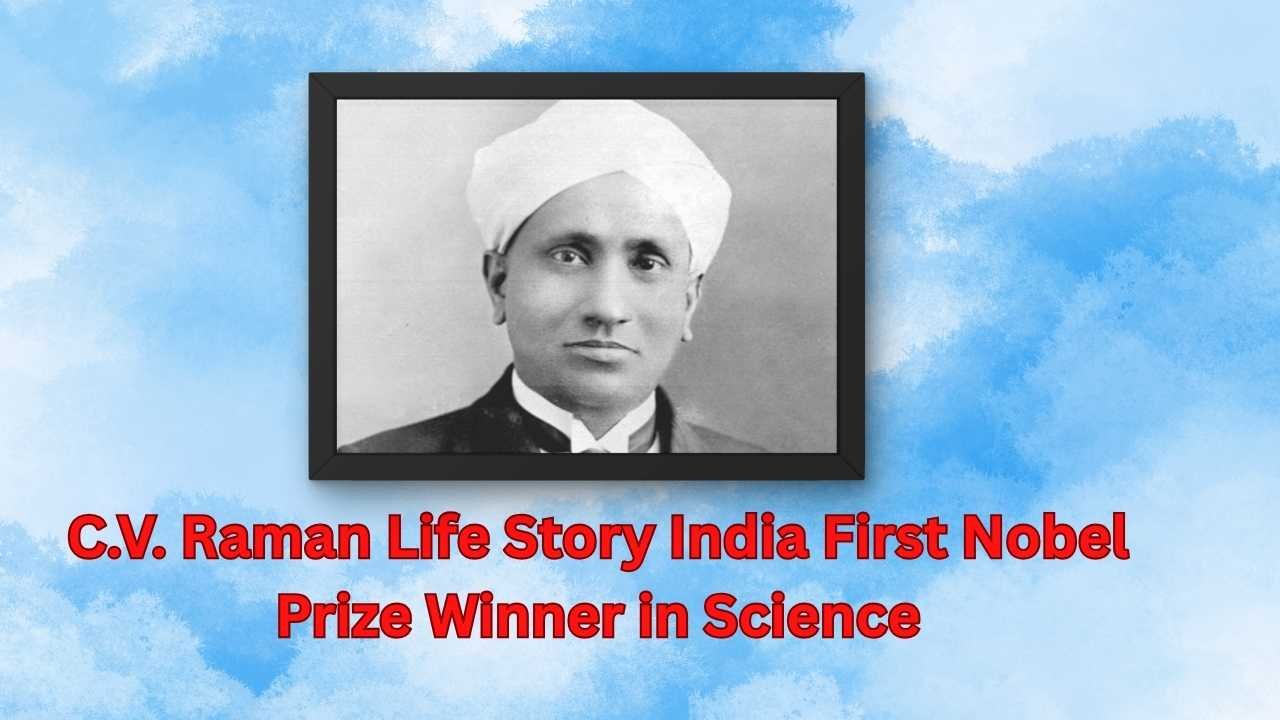
C.V. Raman Life Story India First Nobel Prize Winner in Science The life story of C.V. Raman is one of hard work, curiosity, and success. Chandrasekhara Venkata Raman, popularly known as C.V. Raman, was a famous Indian physicist who made remarkable contributions to science. His discovery of the Raman Effect won him the Nobel Prize in Physics in 1930, making him the first Indian scientist to receive this honor.
Birth and Early Life (1888)
C.V. Raman was born on 7 November 1888 in Tiruchirappalli, Tamil Nadu, India. His father, Chandrasekhara Iyer, was a teacher of mathematics and physics. From a young age, Raman showed great interest in studies, especially science.
Because of his intelligence and dedication, he excelled in school and became one of the brightest students in his class.
Education and Academic Success (1904–1907)
In 1904, C.V. Raman completed his Bachelor’s degree from Presidency College, Madras, securing the first rank. He was only 15 years old when he entered college.
In 1907, he earned his Master’s degree in Physics with outstanding marks. His professors recognized his talent and predicted a bright future for him.
Government Job and Interest in Science (1907–1917)
After completing his education in 1907, Raman joined the Indian Finance Department as an Assistant Accountant General. Although he worked as a government officer, his passion for scientific research remained strong.
He spent his free time conducting experiments and studying physics. During this period, he published several research papers and earned recognition in the scientific community.
Becoming a Professor (1917)
In 1917, C.V. Raman left his government job and accepted the position of Professor of Physics at the University of Calcutta. This decision allowed him to focus entirely on scientific research.
His work in optics and acoustics attracted the attention of scientists worldwide.
Discovery of the Raman Effect (1928)
The most important event in the life of C.V. Raman occurred on 28 February 1928. He discovered that when light passes through a transparent substance, its wavelength changes slightly.
This scientific phenomenon became known as the Raman Effect.
The discovery helped scientists understand the interaction between light and matter. Today, the Raman Effect is used in chemistry, physics, medicine, and material science.
To honor this achievement, India celebrates National Science Day every year on 28 February.
Nobel Prize in Physics (1930)
In 1930, C.V. Raman received the Nobel Prize in Physics for his discovery of the Raman Effect.
This achievement was historic because he became:
- The first Indian scientist to win a Nobel Prize in science.
- The first Asian scientist to receive the Nobel Prize in Physics.
His success brought global recognition to Indian science and inspired future generations of researchers.
Leadership and Research Work (1933–1948)
In 1933, Raman became the Director of the Indian Institute of Science (IISc), Bangalore. He continued his research and guided many young scientists.
In 1948, he established the Raman Research Institute in Bangalore. The institute became an important center for scientific research in India.
Bharat Ratna Award (1954)
In 1954, the Government of India honored C.V. Raman with the Bharat Ratna, the country’s highest civilian award.
This award recognized his outstanding contribution to science and education. C.V. Raman Life Story India First Nobel Prize Winner in Science
Final Years and Death (1970)
Even in his later years, Raman remained active in scientific research and education. He encouraged students to develop curiosity and pursue scientific knowledge.
On 21 November 1970, C.V. Raman passed away in Bangalore, Karnataka, at the age of 82.
Timeline of C.V. Raman’s Life
| Year | Event |
| 1888 | Born in Tiruchirappalli, Tamil Nadu |
| 1904 | Completed Bachelor’s degree |
| 1907 | Earned Master’s degree and joined government service |
| 1917 | Became Professor at the University of Calcutta |
| 1928 | Discovered the Raman Effect |
| 1930 | Won the Nobel Prize in Physics |
| 1933 | Became Director of IISc Bangalore |
| 1948 | Founded Raman Research Institute |
| 1954 | Received Bharat Ratna |
| 1970 | Passed away in Bangalore |
Conclusion
The life story of C.V. Raman is a powerful example of determination, dedication, and scientific curiosity. From a small town in India to becoming a Nobel Prize-winning physicist, Raman showed that hard work and passion can lead to extraordinary achievements.
His discovery of the Raman Effect changed science and continues to benefit researchers today. C.V. Raman remains a source of inspiration for students, scientists, and dreamers across the world.
Frequently Asked Questions (FAQs)
Who was C.V. Raman?
C.V. Raman was a famous Indian physicist who discovered the Raman Effect and won the Nobel Prize in Physics in 1930.
When was C.V. Raman born?
He was born on 7 November 1888 in Tiruchirappalli, Tamil Nadu.
What is the Raman Effect?
The Raman Effect is the change in the wavelength of light when it passes through a transparent substance.
Why is C.V. Raman famous?
He is famous for discovering the Raman Effect and becoming the first Indian scientist to win the Nobel Prize in Physics.
When did C.V. Raman die?
He passed away on 21 November 1970 in Bangalore, India.
Read more: