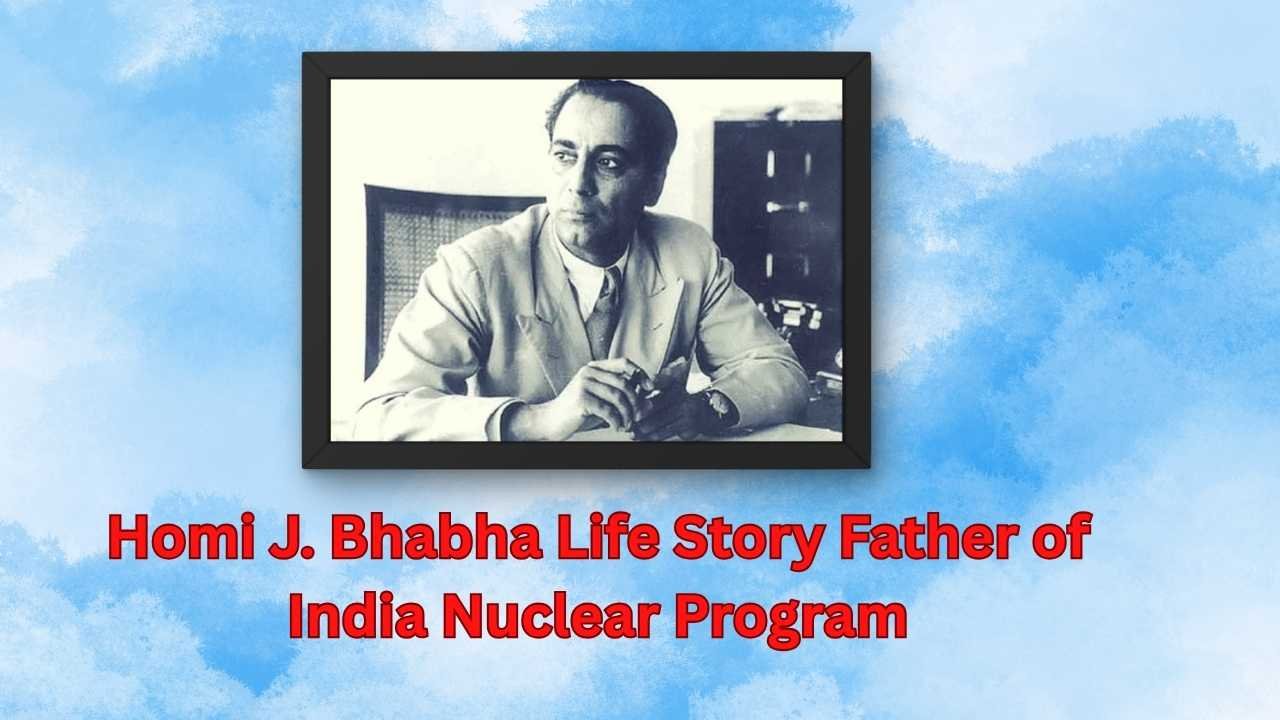
Homi J. Bhabha Life Story Father of India Nuclear Program Homi J. Bhabha was one of India’s greatest scientists. He is known as the “Father of India’s Nuclear Program.” His vision helped India become a strong nation in science and nuclear research. His life story inspires students, scientists, and young people around the world.
Early Life of Homi J. Bhabha
Homi Jehangir Bhabha was born on October 30, 1909, in Mumbai, India. He came from a well-educated and respected Parsi family, and from a young age, he showed a strong interest in science and mathematics.
He completed his early education in Mumbai and later went to England for higher studies. There, he studied at the University of Cambridge, one of the world’s leading universities.
Education and Scientific Career
Initially, Homi Bhabha studied engineering because his family wanted him to become an engineer. However, his passion was physics. He soon switched to physics and began research in nuclear science.
His research on cosmic rays and particle physics gained international recognition. Scientists around the world appreciated his intelligence and his contributions to modern physics.
Return to India
When World War II began in 1939, Homi Bhabha returned to India. There, he joined the Indian Institute of Science (IISc) in Bengaluru and worked with the famous scientist C. V. Raman.
During this period, he continued his research and encouraged scientific development in India.
Building India’s Nuclear Program
Homi Bhabha believed that nuclear energy could help India’s growth and development. With this vision, in 1945, he established the Tata Institute of Fundamental Research (TIFR) in Mumbai. This institute became one of India’s top research centers.
Later, he played a key role in establishing the Atomic Energy Commission of India in 1948. As a result, India made significant progress in nuclear science and technology under his leadership.
Because of these efforts, he earned the title “Father of India’s Nuclear Program.”
Major Achievements
Some important achievements of Homi J. Bhabha include:
- Founder of Tata Institute of Fundamental Research (TIFR)
- Founder of India’s nuclear energy program
- Chairman of the Atomic Energy Commission
- Promoted scientific research and education in India
- Helped establish nuclear reactors for peaceful purposes
His work laid the foundation for India’s future scientific success. Homi J. Bhabha Life Story Father of India Nuclear Program
Awards and Recognition
Homi Bhabha received many honors for his contributions to science. In 1954, he was awarded the prestigious Padma Bhushan by the Government of India.
He was respected not only in India but also by scientists worldwide.
Tragic Death
On January 24, 1966, Homi J. Bhabha died in an airplane crash near Mont Blanc in the Alps. As a result, his sudden death was a great loss to India and the scientific community.
Even after his death, his work continues to inspire generations of scientists.
Legacy of Homi J. Bhabha
Homi Bhabha’s vision transformed India’s scientific landscape. Because of the institutions he established, they continue to contribute to science and technology today.
The Bhabha Atomic Research Center (BARC) was named in his honor and remains one of India’s leading research organizations. Homi J. Bhabha Life Story Father of India Nuclear Program
Conclusion
The life story of Homi J. Bhabha is a tale of intelligence, dedication, and national service. He devoted his life to science and helped India become a global leader in nuclear research. His achievements continue to inspire students, researchers, and future scientists. Homi J. Bhabha will always be remembered as one of India’s greatest scientific pioneers.
Read more:
C.V. Raman Life Story India First Nobel Prize Winner in Science