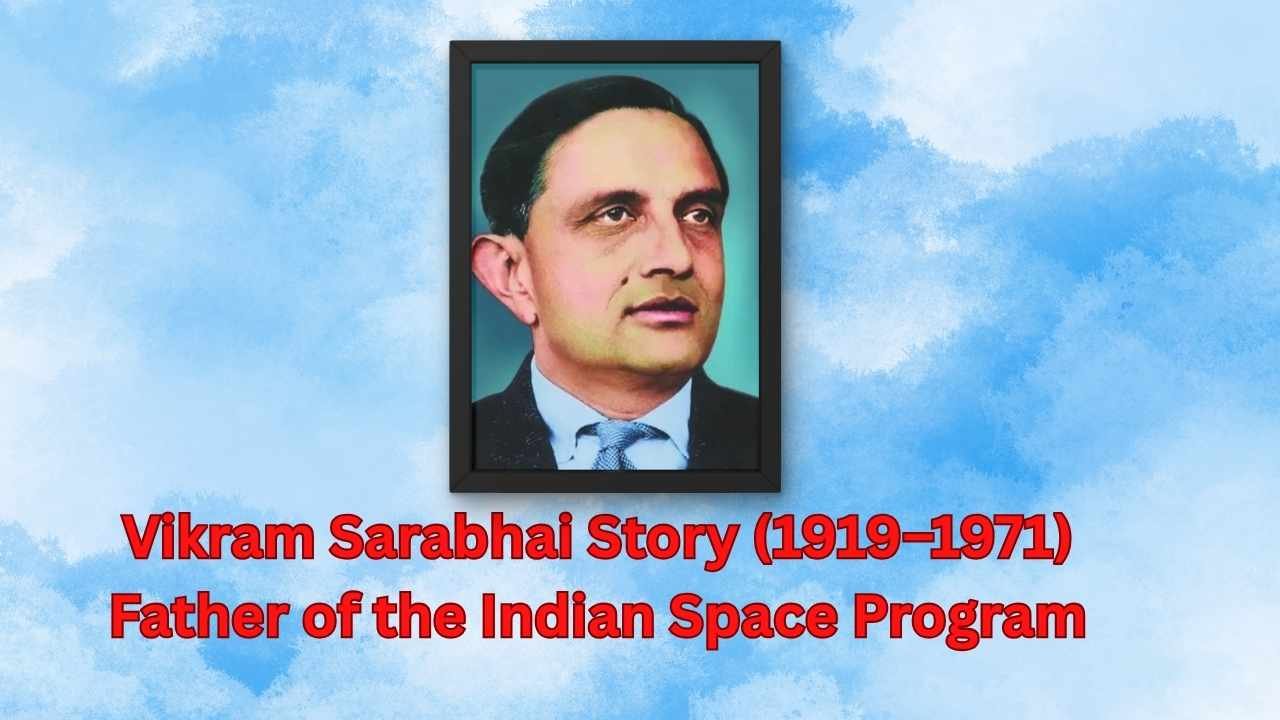
Vikram Sarabhai Story (1919–1971) Father of the Indian Space Program The life story of Vikram Sarabhai is an inspiring journey of science, innovation, and national service. He is known as the “Father of the Indian Space Program” for his significant contributions to India’s space research. Through his vision and hard work, India became a respected nation in space science.
Early Life of Vikram Sarabhai
Vikram Ambalal Sarabhai was born on 12 August 1919 in Ahmedabad, Gujarat, India. He was born into a wealthy and educated family. His father, Ambalal Sarabhai, was a successful industrialist, and his mother, Sarla Devi, was a social worker.
From a young age, Vikram showed great interest in science and mathematics. His family encouraged him to learn and explore new ideas.
Education
Vikram Sarabhai completed his early education in Ahmedabad. Later, he went to Cambridge University in England for further studies.
- 1937 – Joined St. John’s College, Cambridge.
- 1940 – Completed the Natural Sciences Tripos.
- 1947 – Earned a Ph.D. in Cosmic Ray Physics from Cambridge University.
His research focused on cosmic rays and space science.
Beginning of Scientific Career
After returning to India, Vikram Sarabhai worked with the famous Indian scientist C. V. Raman.
In 1947, he established the Physical Research Laboratory (PRL) in Ahmedabad. This institution later became one of India’s leading centers for space and scientific research.
Contribution to India’s Space Program
The greatest achievement of Vikram Sarabhai’s life was his contribution to India’s space program.
- 1962 – Founded the Indian National Committee for Space Research (INCOSPAR).
- 1963 – India’s first sounding rocket was launched from Thumba, Kerala.
- 1969 – Helped establish the Indian Space Research Organization (ISRO).
He believed that space technology could help improve communication, education, weather forecasting, and agriculture in India.
Today, ISRO is one of the world’s leading space agencies, thanks to the foundation laid by Vikram Sarabhai. Vikram Sarabhai Story (1919–1971) Father of the Indian Space Program
Other Major Contributions
Apart from space research, Vikram Sarabhai contributed to many fields.
Indian Institute of Management Ahmedabad (IIMA)
- 1961 – Played a key role in establishing the Indian Institute of Management Ahmedabad.
Atomic Energy Program
- 1966 – Became Chairman of the Atomic Energy Commission of India after the death of Homi J. Bhabha.
He worked to strengthen India’s nuclear and scientific research programs. Vikram Sarabhai Story (1919–1971) Father of the Indian Space Program
Awards and Honors
Vikram Sarabhai received many awards for his contributions to science.
- 1966 – Padma Bhushan
- 1972 – Padma Vibhushan (awarded posthumously)
These awards recognized his service to the nation and scientific community.
Personal Life
Vikram Sarabhai married Mrinalini Sarabhai, a famous classical dancer. They had two children and supported education, science, and the arts.
Death
Vikram Sarabhai passed away on 30 December 1971 in Kerala, India, at the age of 52. His sudden death was a great loss to the country.
However, his vision and contributions continue to inspire scientists and students worldwide.
Timeline of Vikram Sarabhai’s Life
| Year | Event |
| 1919 | Born in Ahmedabad, Gujarat |
| 1937 | Joined Cambridge University |
| 1940 | Completed Natural Sciences studies |
| 1947 | Founded Physical Research Laboratory (PRL) |
| 1961 | Helped establish IIM Ahmedabad |
| 1962 | Founded INCOSPAR |
| 1963 | First rocket launch from Thumba |
| 1966 | Became Chairman of the Atomic Energy Commission |
| 1969 | Established ISRO |
| 1971 | Passed away in Kerala |
| 1972 | Awarded Padma Vibhushan (Posthumously) |
Conclusion
The life story of Vikram Sarabhai is a story of dedication, vision, and scientific excellence. From establishing research institutions to creating India’s space program, he transformed the nation’s future. His work laid the foundation for ISRO’s success and made India a global leader in space technology. Even today, Vikram Sarabhai remains an inspiration for young scientists and dreamers around the world.
Read More:
Homi J. Bhabha Life Story Father of India Nuclear Program
C.V. Raman Life Story India First Nobel Prize Winner in Science