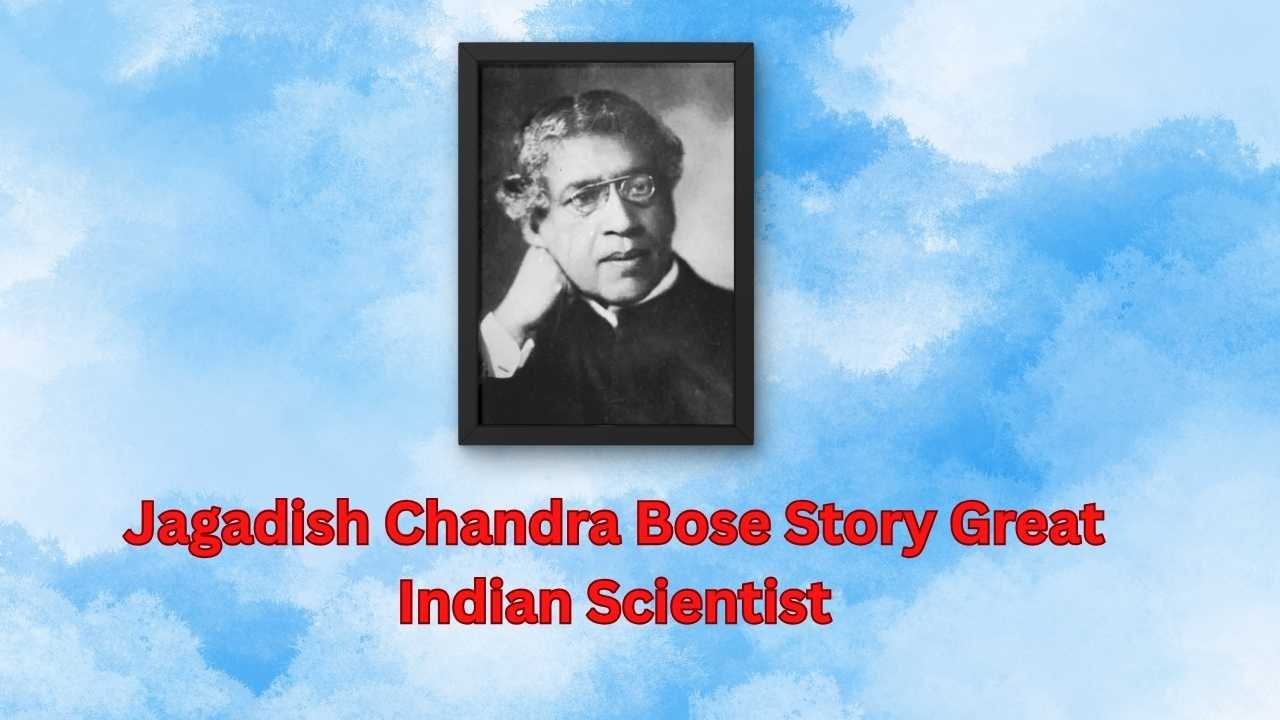
Jagadish Chandra Bose Story Great Indian Scientist Jagadish Chandra Bose was one of India’s greatest scientists. He made important scientific discoveries and showed that plants can feel and respond to their environment. His work in physics, biology, and wireless communication made him famous worldwide. The story of Jagadish Chandra Bose is an inspiration for students, scientists, and anyone who loves learning.
Early Life
Jagadish Chandra Bose was born on 30 November 1858 in Mymensingh, Bengal Presidency, British India (now in Bangladesh).
His father, Bhagawan Chandra Bose, was a government officer. His mother was Bama Sundari Bose.
His father believed that children should learn in their mother tongue before studying English. As a result, Jagadish stayed connected to Indian culture and values.
Education
Jagadish Chandra Bose completed his early education in Bengal. Later, he studied at St. Xavier’s College, Kolkata. He then traveled to England for higher studies.
He studied natural science at the University of Cambridge and also attended the University of London. After completing his education, he returned to India to begin his work there.
Career as a Scientist
In 1885, Jagadish Chandra Bose joined Presidency College, Kolkata, as a professor of physics. At that time, Indian teachers received lower salaries than British teachers. Bose protested this unfair treatment and eventually won equal pay.
He became known for his dedication to teaching and research.
Work in Wireless Communication
Jagadish Chandra Bose conducted important experiments in wireless communication. In the 1890s, he demonstrated the transmission of radio waves over a distance.
His research helped develop wireless technology. Many scientists recognize it as an important step in the history of radio communication.
Discoveries About Plants
One of Bose’s most famous achievements was his study of plants. He believed that plants respond to light, heat, cold, and other external conditions.
To prove this, he invented a scientific instrument called the Crescograph. This device could measure plant growth with great accuracy.
His experiments showed that plants react to stimuli, making him a pioneer in plant physiology.
Bose Institute
In 1917, Jagadish Chandra Bose founded the Bose Institute in Kolkata. The institute was created to promote scientific research and education.
Today, the institute remains an important center of scientific research in India.
Awards and Recognition
Jagadish Chandra Bose received many honors for his contributions to science.
Some of his achievements include:
- Knighted by the British Government in 1917.
- Elected Fellow of the Royal Society in 1920.
- Recognized worldwide for his research in physics and plant science. Jagadish Chandra Bose Story Great Indian Scientist
Personal Life
Jagadish Chandra Bose was married to Abala Bose, a social worker and educationist. She supported his scientific work and encouraged women’s education.
Death
Jagadish Chandra Bose passed away on 23 November 1937 in Giridih, India. He was 78 years old.
Although he is no longer with us, his discoveries continue to inspire scientists worldwide.
Legacy
The legacy of Jagadish Chandra Bose remains strong today. He proved that hard work, curiosity, and dedication can lead to great achievements. His contributions to wireless communication and plant science made India proud.
Students continue to learn about his life and discoveries, and he is remembered as a pioneer of modern science. Jagadish Chandra Bose Story Great Indian Scientist
Conclusion
The story of Jagadish Chandra Bose is a story of knowledge, determination, and innovation. From his early education in Bengal to his groundbreaking scientific discoveries, he demonstrated the power of research and creativity. His life remains an inspiration for future generations and a shining chapter in India’s scientific history.
Read More:
Vikram Sarabhai Story (1919–1971) Father of the Indian Space Program