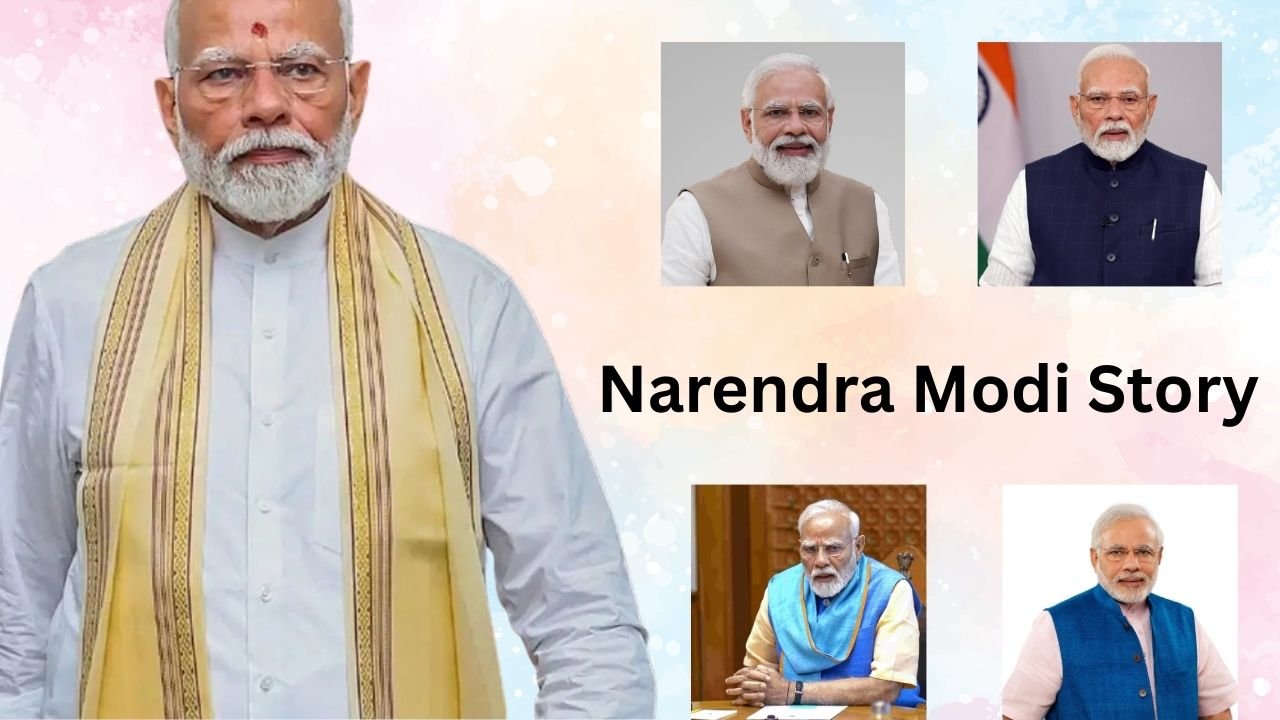
Narendra Modi Story is one of the most important leaders in India. He is the 14th Prime Minister of India and is known for his strong leadership and development ideas. His life story is inspiring for many people.
Early Life
Narendra Modi was born on September 17, 1950, in Vadnagar. He was born into a low-income family. His father, Damodardas Modi, was a tea seller, and his mother, Hiraben Modi, was a homemaker.
- Narendra Modi grew up in a small house with his family.
- He has five siblings (brothers and a sister).
- During the 1960s, he helped his father sell tea at a railway station.
From a young age, Narendra Modi helped his father sell tea at a railway station. This taught him the value of hard work and responsibility. He was a disciplined and active child who liked reading and participating in school activities.
Personal Life (Marriage – 1968)
Narendra Modi married Jashodaben Modi in 1968 (a traditional arranged marriage at a young age).
Narendra Modi’s early life was full of struggles, but these experiences made him strong and determined. His simple background and hard work played an important role in shaping his future as a leader.
Narendra Modi Education
Narendra Modi has a simple educational background, but his learning, discipline, and activities helped shape his leadership.
School Education (1950s–1967)
Narendra Modi was born in 1950 and completed his early education in Vadnagar.
He studied at:
- Vadnagar Primary School (Primary Education – 1955 to early 1960s)
- Bhagavatacharya Narayana Acharya High School (High School – completed around 1967)
He was an active student who liked debates, reading, and drama.
College Education (1970s–1980s)
After school, Narendra Modi continued his studies while also engaging in social work.
- Bachelor of Arts (BA) in Political Science – from the University of Delhi (Completed in 1978)
- Master of Arts (MA) in Political Science – from Gujarat University (Completed in 1983)
These degrees helped him understand politics, governance, and society.
Degree Names
- BA in Political Science – 1978
- MA in Political Science – 1983
Extra Activities (1960s–1980s)
Narendra Modi was very active outside of studies:
- Participated in school debates and speeches (1960s)
- Took part in drama and stage performances (1960s)
- Interested in reading and social service (teenage years)
- Joined Rashtriya Swayamsevak Sangh (RSS) as a young boy and became a full-time worker in the early 1970s
These activities helped him develop leadership, confidence, and discipline.
Languages Spoken by Narendra Modi
- Gujarati – His mother tongue. He speaks it fluently.
- Hindi – His main speaking language for public speeches across India.
- English – He has a basic understanding and uses it in international communication when needed.
How He Uses These Languages
- Narendra Modi Story mostly gives speeches in Hindi so that many people in India can understand.
- He uses Gujarati when speaking with people from his home state.
- He uses English during global meetings and international events.
Entry into Politics
Narendra Modi entered politics gradually through social service and strong dedication. His political journey developed over many years.
Early Association with RSS (1960s–1970s)
Narendra Modi joined the Rashtriya Swayamsevak Sangh (RSS) in his teenage years during the 1960s.
- In the early 1970s, he became a full-time worker (pracharak).
- He organized events, worked with people, and learned discipline and leadership.
This was the foundation of his political life.
Joining the BJP (1987)
Narendra Modi officially entered active politics when he joined the Bharatiya Janata Party (BJP) in 1987.
- He started as a party worker in Gujarat.
- He managed campaigns and helped organize party activities.
Growth in the BJP (1990–1995)
Between 1990 and 1995, Narendra Modi Story played an important role in the BJP’s growth.
- He helped plan major political campaigns.
- He worked on election strategies in Gujarat and other states.
His hard work made him a key leader in the party.
National Level Role (1995–2001)
- In 1995, he became a BJP National Secretary.
- In 1998, he was promoted to General Secretary (Organization).
During this time, he handled party work across India and gained national recognition.
Turning Point – Chief Minister (2001)
In 2001, Narendra Modi became the Chief Minister of Gujarat.
This was a major turning point in his political career, making him a well-known leader across India.
Chief Minister of Gujarat
Narendra Modi became the Chief Minister of Gujarat in 2001. His time as Chief Minister was a significant part of his political career.
First Term (2001–2002)
- Narendra Modi took oath as Chief Minister on October 7, 2001.
- He focused on improving administration and development.
- In 2002, he led the state during a difficult period and later won the elections.
Second Term (2002–2007)
- After winning the 2002 Gujarat Assembly Elections, he continued as Chief Minister.
- Focused on:
- Infrastructure development
- Electricity and water supply
- Industrial growth
Third Term (2007–2012)
- Narendra Modi won the 2007 elections and started his third term.
- Gujarat saw strong development in:
- Roads and transport
- Business and industries
- Investment through Vibrant Gujarat Summit
Fourth Term (2012–2014)
- He won the 2012 elections and became Chief Minister again.
- Continued focus on growth, technology, and governance.
- Gujarat became one of the fastest-growing states in India.
End of Tenure (2014)
- Narendra Modi served as Chief Minister until May 2014.
- In 2014, he became the Prime Minister of India.
Total Years as Chief Minister
- 2001 to 2014 (around 13 years)
Key Achievements over the Years
- 2003 onwards – Vibrant Gujarat Summit started
- 2005–2013 – Major industrial and infrastructure growth
- 2012 – Continued leadership with a strong election victory
Prime Minister of India
Narendra Modi became the Prime Minister of India in 2014. He is the 14th Prime Minister and has served multiple terms.
First Term as Prime Minister (2014–2019)
- Narendra Modi took the oath as Prime Minister on May 26, 2014.
- His party, the Bharatiya Janata Party (BJP), won a strong majority.
Major Programs (2014–2019)
- 2014 – Swachh Bharat Abhiyan (Clean India Mission)
- 2014 – Pradhan Mantri Jan Dhan Yojana (bank accounts for all)
- 2015 – Digital India program
- 2015 – Make in India initiative
- Focus on infrastructure, financial inclusion, and technology
Second Term as Prime Minister (2019–Present)
- Narendra Modi was re-elected in 2019 with a bigger victory.
- He took the oath again on May 30, 2019.
Major Work (2019–Present)
- Continued focus on economic growth and development
- Expansion of digital services and infrastructure
- Focus on self-reliance (Atmanirbhar Bharat)
- Strengthening India’s global position
Key Achievements over the Years
- 2014 – Became Prime Minister for the first time
- 2016 – Major economic reform (demonetization)
- 2019 – Re-elected as Prime Minister
- 2020 onwards – Focus on the digital economy and self-reliance
Leadership Style
Narendra Modi is known for strong decision-making, clear vision, and powerful communication. He focuses on development, innovation, and global relations.
Awards and Recognition
Narendra Modi has received many national and international awards for his leadership, governance, and global influence. These recognitions came at different stages of his career.
Awards During the Chief Minister Period (2001–2014)
While serving as Chief Minister of Gujarat, Narendra Modi received several awards:
- 2007 – Best Chief Minister Award (India Today survey)
- 2009 – FDI Personality of the Year (Asia) for attracting foreign investment
- 2012 – Recognized for strong governance and economic growth
Narendra Modi Story These awards were given for development, industry growth, and better administration in Gujarat.
National and International Recognition (2014–Present)
After becoming Prime Minister in 2014, Narendra Modi received global recognition:
- 2016 – Awarded the highest civilian honor of Saudi Arabia (King Abdulaziz Sash)
- 2018 – Received the Champions of the Earth Award from the United Nations
- 2019 – Honored with the highest civilian award of the United Arab Emirates (Order of Zayed)
- 2019 – Received the Global Goalkeeper Award by the Bill & Melinda Gates Foundation
- 2020 – Received the Legion of Merit award from the United States
- 2021 – Received the Legion of Honour (France’s highest award) from France (announced recognition in a global leadership context)
- 2023 – Honored with Order of the Nile (Egypt’s highest award) from Egypt
Other Recognitions
- Featured many times in Time Magazine’s Most Influential People list
- Recognized globally for leadership, climate action, and development initiatives
Total Countries Visited
Since becoming Prime Minister in 2015, Narendra Modi has visited 60+ countries (approximately).
(Note: The number may change over time as he continues to travel.)
Total International Wars
- 0 international wars under Narendra Modi (2014–2025)
Important Military Situations (Not Wars)
Even though there were no international wars, some serious situations happened:
- 2016 – Surgical Strikes (India–Pakistan)
- India carried out targeted strikes on terrorist camps across the border.
- 2019 – Balakot Air Strike (India–Pakistan)
- India conducted an air strike after the Pulwama attack.
- 2017 – Doklam Standoff (India–China)
- A border standoff between Indian and Chinese forces, but no war.
- 2020 – Galwan Valley Clash (India–China)
- A serious clash between soldiers, but it did not turn into a war.
India’s Approach
Under Narendra Modi Story, India has focused on:
- Avoiding full-scale wars
- Taking strong action against threats
- Maintaining international peace and stability
FAQS
1) How many times did Modi become PM?
Narendra Modi has served as Prime Minister of India twice. He first took office in 2014 after winning the general elections. He was re-elected in 2019, continuing his leadership with a stronger majority in the Indian government.
2) What is Modi’s monthly salary?
Narendra Modi receives a monthly salary of about ₹2 lakh (200,000 rupees). This includes basic pay, allowances, and benefits. In addition, he also gets official residence, security, travel, and other facilities provided by the Government of India.
3) What does Modi eat daily?
Narendra Modi eats simple and healthy vegetarian food daily. His diet includes fruits, vegetables, khichdi, dal, roti, and curd. He prefers light meals, drinks plenty of water, and follows disciplined eating habits to stay fit and energetic.
4) If any company, Narendra Modi
Narendra Modi does not own any private company. He is a full-time politician and public servant. As Prime Minister, he focuses on government duties and national development, not on business activities or personal ownership of companies.
Read More: