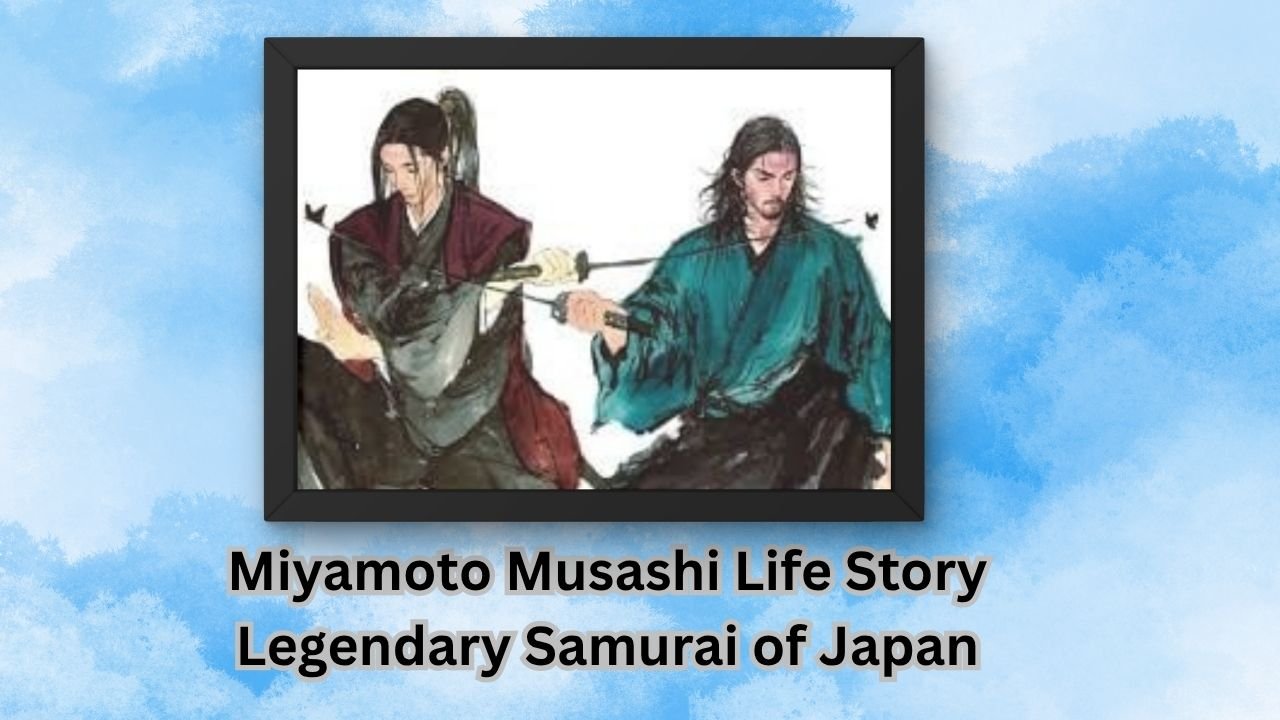
Miyamoto Musashi Life Story Legendary Samurai of Japan is renowned as one of history’s most famous samurai; undefeated as a swordsman, he was also a philosopher, writer, and artist. His disciplined, courageous, and wise journey enriches many tales. Not only did Musashi fight in over 60 duels without defeat, but he also authored the influential Book of Five Rings, which is still widely read. To best understand Musashi’s journey, one must explore his early life, family background, and personal development.
Miyamoto Musashi’s Early Life (1584–1596)
Born in 1584 in Harima Province, Japan, Miyamoto Musashi was known as Shinmen Takezo in his early years. His father, Shinmen Munisai, possessed expertise in swordsmanship and martial arts, while his mother is believed to have died young. Raised mostly by his uncle, a Buddhist monk, Musashi’s formative years were shaped by this unique environment.
Musashi developed both practical martial skills and a spiritual foundation through his uncle’s guidance. This balance between discipline and values shaped his future achievements.
Parents and Family Background
An expert in sword fighting and martial arts, Musashi’s father, Shinmen Munisai, served local lords and was celebrated for his skill. Many early techniques likely came to Musashi from his father.
While little detailed information survives about his mother, she is credited with playing a significant role in his early life before her passing. Without a traditional family setting, Musashi spent most of his childhood under his uncle’s care.
Education
Musashi’s education was learned through martial arts training and spiritual lessons from his uncle, leading to a distinct worldview built on experience rather than formal learning.
He learned:
- Sword-fighting techniques
- Discipline and self-control
- Strategy and observation
- Basic reading and writing
Later, Musashi became skilled in calligraphy, painting, and philosophy through continuous self-education, a skill reflected in his later philosophies.n.
Though Musashi did not marry or have biological children, he adopted a son named Miyamoto Iori, who later became a samurai in the service of a feudal lord. Devotion to self-discipline, training, and personal growth defined most of Musashi’s life, rather than building a conventional family. Miyamoto Musashi Life Story Legendary Samurai of Japan
First Duel and Early Battles (1596–1600)
At age 13 in 1596, Musashi fought his first duel—his opponent, Arima Kihei, was a trained samurai. Musashi won, wielding only a wooden stick.
This victory made him confident and marked the start of his journey as a warrior.
Musashi likely participated in the famous Battle of Sekigahara around 1600, a decisive event in Japanese history that ushered in a new era. Miyamoto Musashi Life Story Legendary Samurai of Japan
Journey as a Ronin (1600–1612)
After the war, Musashi became a masterless samurai—known as a ronin—and journeyed across Japan. Seeking to refine his abilities and to challenge other fighters, he wandered widely, a crucial period for building his legendary reputation.
It was during this journey that Musashi developed a unique sword technique: Niten Ichi-ryu. This approach employs two swords simultaneously, a long and a short sword.
Musashi fought many duels, becoming famous for his strategies and strength, valuing mental understanding as much as physical skill.
Famous Duels and Victory over Sasaki Kojiro (1612)
Musashi’s most celebrated duel took place in 1612, facing off against the highly respected swordsman Sasaki Kojiro.
Held on Ganryu Island, the duel saw Musashi intentionally arrive late, unsettling Kojiro with his unconventional tactics. Using a wooden sword fashioned from a boat oar, Musashi ended the match in a single, powerful strike.
Through this celebrated duel, Musashi’s name became legendary, solidifying his place as a renowned swordsman of his era.
Life During the Edo Period (1615–1635)
Musashi’s participation in combat diminished as the peaceful Edo period began, allowing him to pursue other interests. Calligraphy brought Musashi acclaim for works featuring nature, birds, and spiritual themes. This period not only nurtured him as a thinker but also broadened his influence in philosophy and literature beyond his reputation as a warrior.
Languages
Miyamoto Musashi spoke Japanese, which was his native language.
Musashi also demonstrated considerable knowledge of classical Japanese writing found in literature and philosophy. His own works, especially The Book of Five Rings, reveal his mastery of expression and language.
His communication style was simple yet powerful, making his teachings accessible.
Philosophy and Way of Life
According to Musashi, life is a continuous journey of learning, and his philosophy emphasizes discipline, simplicity, and constant awareness.
- Understand both body and mind.
- Learn from every experience.
Musashi believed that mastering the sword mirrored the challenge of mastering life itself. His principles remain relevant today, resonating across business, sports, and personal growth. Miyamoto Musashi Life Story Legendary Samurai of Japan
Writing of The Book of Five Rings (1643–1645)
In 1643, Musashi retreated to Reigando Cave in Japan, where he began work on The Book of Five Rings.
After completing the book in 1645, Musashi died shortly thereafter.
The book has five parts:
- Earth – Basic strategy
- Water – Flexibility
- Fire – Battle methods
- Wind – Understanding other schools
- Void – Spiritual thinking
The Book of Five Rings is studied for its insights on strategy, not just by martial artists but also by leaders and students seeking practical guidance.
Death (1645)
Miyamoto Musashi died in 1645 at the age of 61.
Death Place
He passed away in Reigando Cave, located in Kumamoto, Japan.
Just before death, Musashi composed Dokkodo—a set of 21 life principles reflecting both his wisdom and disciplined lifestyle.
Legacy and Inspiration
Miyamoto Musashi’s legacy is powerful and timeless. He is remembered as:
- An undefeated swordsman
- A master strategist
- A philosopher and writer
His influence can be seen in:
- Martial arts training
- Business strategies
- Leadership development
- Personal growth
His book, The Book of Five Rings, is still used worldwide.
Musashi’s life demonstrates that discipline, focus, and continuous learning sit at the heart of success. From determined young fighter to wise philosopher, his journey continues to inspire millions.
Conclusion
Miyamoto Musashi’s life embodies strength, wisdom, and self-mastery. From his first duel at 13 to authoring a timeless book before passing in 1645, Musashi lived with purpose.
His teachings continue to guide people in many fields even today. He was not just a warrior but a true master of life. Miyamoto Musashi Life Story Legendary Samurai of Japan
Read more: