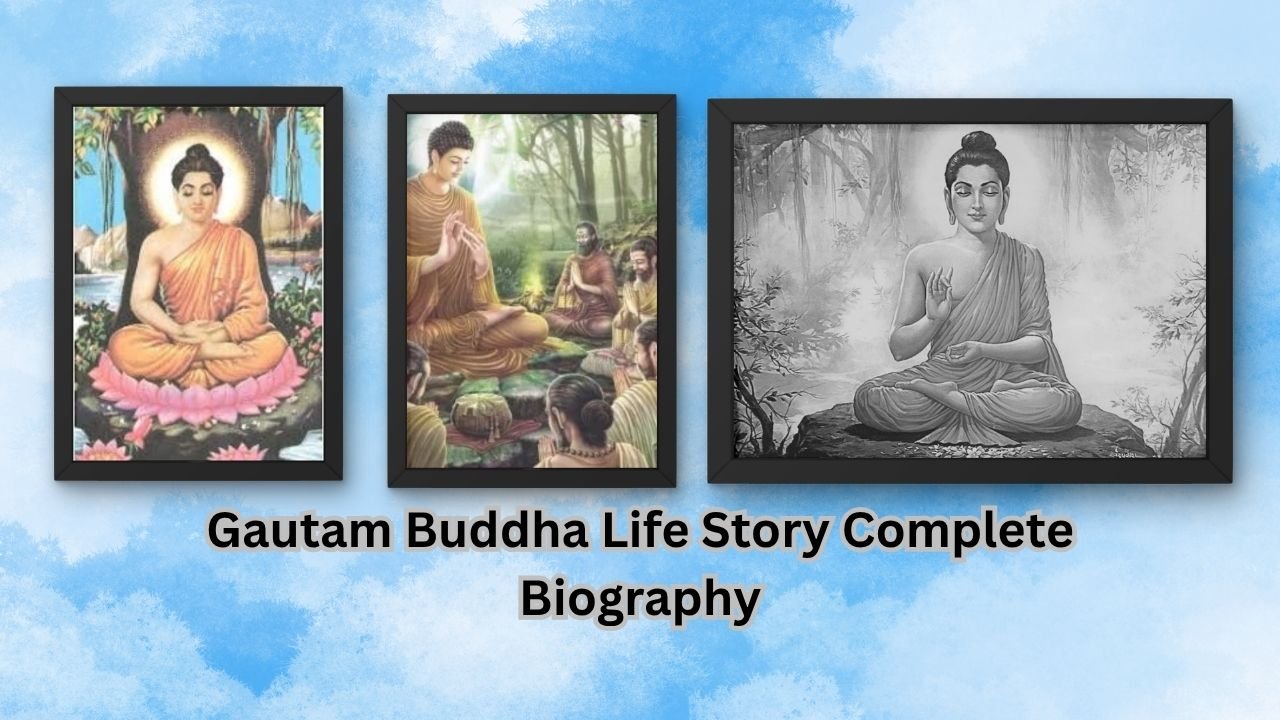
Gautam Buddha Life Story Complete Biography. The life story of Gautam Buddha is one of the most powerful and inspiring journeys in human history. Born a prince, he renounced luxury to seek the truth and became a great spiritual teacher. His teachings later formed the foundation of Buddhism, which continues to guide millions of people worldwide.
Early Life of Gautam Buddha (563 BCE)
Gautam Buddha was born in 563 BCE in Lumbini, which is in present-day Nepal. His birth name was Siddhartha Gautama. He was born into a royal family and lived a life of comfort and wealth. As he grew, this environment shaped his worldview.
He grew up in Kapilavastu, the capital of the Shakya kingdom. Wishing for his son to become a great king, his father shielded him from sadness and suffering at every turn.
Parents and Family
- Father: King Suddhodana, ruler of the Shakya clan
- Mother: Queen Maya Devi
Sadly, his mother died just a few days after his birth. After this loss, he was raised by his aunt and stepmother, Mahaprajapati Gautami.
Siblings
Historical texts do not clearly mention Siddhartha’s real siblings. However, he grew up with cousins and royal relatives in the palace.
Education of Gautam Buddha
As a prince, Siddhartha received the best education. He was trained in:
- Archery and sword fighting
- Horse riding
- Administration and leadership
- Religious and philosophical thinking
Even as a young boy, he was calm, kind, and thoughtful. During this period, he often spent time thinking deeply about life, which foreshadowed his later quest. Gautam Buddha Life Story Complete Biography
Marriage and Children (Around 16 Years Old)
When Siddhartha turned 16, he wed Yashodhara, a graceful princess. Their days together in the palace were filled with joy and warmth.
Later, they had a son named Rahula. Despite having a loving family, Siddhartha was not fully satisfied. This feeling set the stage for his pursuit of life’s deeper meaning. Gautam Buddha Life Story Complete Biography
The Four Sights (Around 29 Years Old)
One fateful day at 29, Siddhartha stepped outside the palace, encountering four sights that would change his destiny forever:
- An old man
- A sick person
- A dead body
- A peaceful, holy man
These are known as the Four Sights. They made him realize that:
- Life includes suffering
- Everyone faces old age, sickness, and death.
This changed his thinking completely and pushed him to search for answers about life’s suffering.
The Great Renunciation (534 BCE)
In 534 BCE, Siddhartha made a bold decision: he left his palace, family, and royal life forever. This event would later be called the Great Renunciation.
He cut his hair, wore simple clothes, and became a wandering monk. From this point, his goal was to understand the truth of life and how to end suffering.
Search for Enlightenment
Siddhartha wandered through India for many years, learning from wise teachers and immersing himself in meditation. Each step took him closer to his goal.
He also followed strict fasting and extreme self-control. However, after experiencing the limits of such practices, he realized that extreme suffering was not the right path.
He saw that the Middle Path, a balanced life, leads to understanding truth and ending suffering.
Enlightenment (528 BCE)
At the age of 35, Siddhartha sat under a Bodhi tree in Bodh Gaya, ready to meditate deeply.
After deep meditation, he finally achieved Enlightenment in 528 BCE. From that moment on, he became known as the Buddha, meaning “The Enlightened One.”
He understood fundamental truths about life, identified the causes of suffering, and discovered the path to peace. Gautam Buddha Life Story Complete Biography
First Sermon at Sarnath
After enlightenment, Buddha began a new phase by traveling to Sarnath.
There, he gave his first sermon to his five followers. This event is called Dharmachakra Pravartana (Turning the Wheel of Dharma).
He explained the Four Noble Truths:
- Life is full of suffering.
- Desire causes suffering
- Suffering can end
- There is a path to end suffering.
The Eightfold Path
Buddha taught the Eightfold Path, which helps people live a peaceful and meaningful life:
- Right understanding
- Right thought
- Right speech
- Right action
- Right livelihood
- Right effort
- Right mindfulness
- Right concentration
This path is a practical guide to removing suffering and achieving inner peace for anyone who follows it.
Spread of Buddhism
After gaining enlightenment, Buddha devoted around 45 years to traveling and teaching throughout India. Through these journeys, his teachings became more widely known.
His teachings spread to many regions and later to countries like:
- Sri Lanka
- China
- Japan
- Thailand
He accepted people from all castes and backgrounds, thereby promoting equality and compassion among his followers.
Teachings of Gautam Buddha
The teachings of Buddha are simple and practical. They focus on:
- Non-violence (Ahimsa)
- Truthfulness
- Controlling desires
- Meditation and mindfulness
- Living a balanced life
He taught people to find peace within themselves rather than depend on external things.
Death (Mahaparinirvana) 483 BCE
Gautam Buddha passed away in 483 BCE at the age of 80.
- Death Place: Kushinagar
- Age at Death: 80 years
His death is known as Mahaparinirvana, which means complete freedom from the cycle of birth and death, marking the final stage of his journey.
Languages Spoken by Gautam Buddha
Gautam Buddha mainly spoke:
- Magadhi (Prakrit language) the common language of the people
- He also understood Sanskrit, the language of scholars.
He chose simple language so that ordinary people could easily understand his teachings.
Awards and Recognition
Gautam Buddha did not receive any formal awards because awards did not exist in his time.
However, his recognition includes:
- Being one of the greatest spiritual leaders in history
- Founder of Buddhism
- Revered as a symbol of peace and wisdom worldwide
Legacy of Gautam Buddha
Gautam Buddha’s legacy echoes through the ages, offering timeless wisdom and hope to those who follow his path.
His teachings continue to influence:
- Religion and spirituality
- Philosophy and ethics
- Meditation practices worldwide
Buddhism remains one of the world’s major religions, followed by millions of people.
His message of peace, kindness, and self-awareness remains relevant in today’s fast-paced world.
Conclusion
Gautam Buddha’s life is a vivid journey from princely luxury to profound wisdom. His quest for truth illuminated the path to enlightenment, creating a legacy of peace and happiness for all.
He showed that true happiness comes from within, not from wealth or power.
“Peace comes from within. Do not seek it outside.”
FAQS
1) What are the 8 miracles of the Buddha?
The Eight Miracles of Gautam Buddha include the Twin Miracle, walking on water, multiplying his form, taming a wild elephant, descending from heaven, teaching gods, calming storms, and radiating divine light, showing wisdom, compassion, and spiritual power.
2) Why did Buddha eat pork?
According to tradition, Gautam Buddha ate a dish called “sukara-maddava” offered by a devotee. Its exact meaning is debated possibly pork or a plant dish. He accepted it respectfully, teaching gratitude and non-attachment rather than strict food rules.
3) Which country has 100% Buddhism?
No country has 100% of its population following Gautam Buddha. Nations like Bhutan and Cambodia have very high Buddhist populations, but small minorities of other religions still exist everywhere.
4) Who tried to seduce Buddha?
In Buddhist tradition, Mara tried to disturb Gautam Buddha by sending his daughters Tanha (desire), Rati (pleasure), and Arati (discontent) to seduce him, but Buddha remained calm and unattached, achieving enlightenment.
Read More: