Maharana Pratap Full Life Story Hero of Indian History Regarded as one of the most respected warriors in Indian history, Maharana Pratap is renowned for his courage, patriotism, and his unwavering resistance against Akbar’s Mughal Empire. Instead of surrender, he chose a life defined by struggle. His story powerfully exemplifies bravery and self-respect.
Maharana Pratap Early Life (1540–1567)
Maharana Pratap was born on 9 May 1540 in Kumbhalgarh Fort, located in present-day Rajasthan. He belonged to the Sisodia Rajput family, known for its warrior traditions.
From childhood, Pratap demonstrated strength, courage, and leadership. Spending much of his early life in the hills and forests of Mewar made him physically strong and mentally tough.
At a young age, he learned survival skills, horse riding, and combat techniques. Although his early life was simple, it played a significant role in shaping him into a fearless warrior.
Parents and Siblings
Maharana Pratap’s father was Rana Udai Singh II, the ruler of Mewar, and his mother was Jaiwanta Bai. His father established the city of Udaipur in 1559 after departing Chittorgarh due to Mughal attacks.
Although Jagmal, his younger brother, was initially chosen as king after their father’s death, a conflict over the throne quickly emerged. Recognizing Pratap’s bravery and leadership qualities, the nobles of Mewar supported him instead. Maharana Pratap Full Life Story Hero of Indian History
Education and Training
Maharana Pratap did not receive formal education in the modern sense. Instead, he was trained in:
- Warfare and military strategy
- Sword fighting and archery
- Horse riding and hunting
- Leadership and administration
He was guided by seasoned warriors and teachers of the Rajput tradition. His education focused on preparing him to be a strong and capable ruler.
He also learned about honor, loyalty, and duty, which became the core values of his life. Maharana Pratap Full Life Story Hero of Indian History
Marriage and Children
Maharana Pratap married several queens during his lifetime, but it was Maharani Ajabde Punwar who became his steadfast companion and source of strength. Her unwavering support during his most challenging trials brought comfort and courage to his journey.
He had many children, and his eldest son, Amar Singh I, later became the ruler of Mewar after his death in 1597.
Despite being a king, Maharana Pratap led a disciplined, simple family life, especially during his years of struggle in the forest.
Languages Known
Maharana Pratap mainly spoke:
- Rajasthani (Mewari dialect)
- Hindi (early forms)
- Sanskrit (for religious and royal purposes)
These languages allowed him not only to speak to his people, soldiers, and scholars, but also to win their hearts and trust. His warmth and ability to deeply connect made him beloved by all, strengthening their devotion to him.
Becoming the King of Mewar (1572)
After his father’s death in 1572, Maharana Pratap became the ruler of Mewar. This was a difficult time because the Mughal Empire was expanding rapidly.
Many Rajput rulers accepted Akbar’s rule; Maharana Pratap, however, refused. To him, freedom mattered more than comfort or political power.
His coronation ignited the beginning of a long struggle to defend Mewar’s independence. Maharana Pratap Full Life Story Hero of Indian History
Conflict with the Mughal Empire
Akbar was determined to bring every Rajput kingdom under Mughal authority. He repeatedly offered peace to Maharana Pratap, hoping he would yield without bloodshed. Yet, each offer must have weighed heavily on Pratap, testing his resolve and love for his homeland.
However, Maharana Pratap rejected all offers. He did not want to lose his kingdom’s independence.
This unyielding refusal ignited a growing tension and heartbreak that would erupt into years of relentless war, as both sides fought not just for territory, but for pride, honor, and identity.
Battle of Haldighati (1576)
The famous Battle of Haldighati erupted on 18 June 1576. Maharana Pratap’s army clashed with the Mughal forces led by Raja Man Singh of Amber.
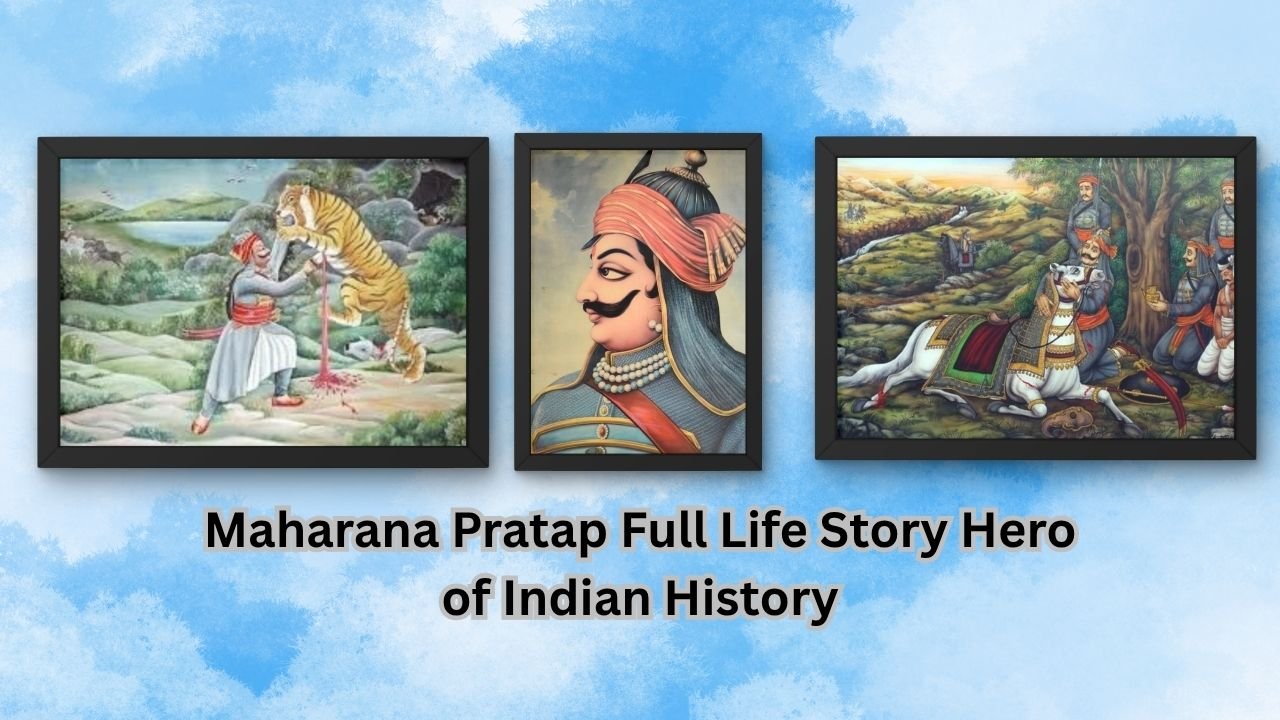
Though the Mughal army was much larger, Maharana Pratap fought with exceptional bravery. His loyal horse, Chetak, played a crucial role in saving his life during this fierce battle.
Chetak suffered grave injuries, yet still carried Maharana Pratap to safety before collapsing. This tale lives on as a powerful symbol of loyalty and valor.
Although the battle ended without a clear victor, Maharana Pratap’s indomitable spirit and unyielding bravery captured the hearts of his people, leaving a legacy of inspiration more powerful than any conquest.
Life in Forest and Struggles (1576–1585)
After the battle, Maharana Pratap had to live in the forests and mountains with his family. This was one of the most difficult periods of his life.
During these years:
- He lost control of many parts of Mewar.
- His family lived in poverty.
- They ate simple food, sometimes even grass bread.
- He had limited resources and army support.
Despite facing all these hardships, Maharana Pratap never surrendered to the Mughals. Determination and love for freedom fueled his continued resistance.
Rebuilding Mewar (1585–1597)
Around 1585, hope began to blossom again for Maharana Pratap. With renewed determination, he launched courageous campaigns, reclaiming much of Mewar’s lost glory. Each victory felt like a healing balm for the wounds of years past.
He named Chavand his new capital and dedicated himself to rebuilding his kingdom. He revitalized:
- Administration
- Agriculture
- Military defense
By the end of his journey, Maharana Pratap had breathed new life into most of Mewar, excluding Chittorgarh. His tireless efforts shone as demonstrations of leadership, love for his land, and dedication that touched every soul.
Death (1597) Place and Age
Maharana Pratap passed away on 19 January 1597 in Chavand, Mewar, leaving behind a grieving kingdom. At the age of 56, his departure was felt deeply by all whose lives he had touched.
The cause of his death is believed to be injuries from a hunting accident.
Even in his final days, he remained committed to Mewar’s independence. Before his death, he advised his son Amar Singh I to continue the struggle for freedom.
Conclusion
The life story of Maharana Pratap (1540–1597) is woven with courage, sacrifice, and unshakeable determination. From his humble beginnings at Kumbhalgarh to his darkest struggles in the forests, and finally to the rebuilding of Mewar, his unwavering values lifted not just him but all who believed in a brighter tomorrow.
He chose hardship not as a burden, but as the path to preserving dignity. His greatest strength was his unwavering self-respect, and the longing for freedom that lived in his soul.
Maharana Pratap’s legend is a shining emblem of bravery in Indian history. His life continues to inspire hearts, reminding all to stand tall in the face of adversity and nurture strength within.
FAQS
1) How many wives did Pratap have?
Maharana Pratap is believed to have had 11 wives. Among them, Ajabde Punwar was the most prominent and respected. His marriages were mainly for political alliances and to strengthen relationships with various Rajput families and kingdoms.
2) Who is stronger, Akbar or Pratap?
Akbar was stronger in terms of empire size, army, and resources. However, Maharana Pratap demonstrated greater personal bravery, determination, and resistance, choosing hardship over surrender, thereby strengthening his courage and character.
3) Who defeated the Mughals 17 times?
The claim that someone defeated the Mughals 17 times is often linked to Maharana Pratap, but it is not historically proven. He fought bravely against Akbar and resisted Mughal rule, though he recorded only 17 victories.
4) Who is the No. 1 Mughal emperor?
Akbar is widely considered the No. 1 Mughal emperor. He ruled from 1556 to 1605, greatly expanded the empire, promoted religious tolerance, improved administration, and built a strong, stable government that shaped India’s history for many years.
Read More: