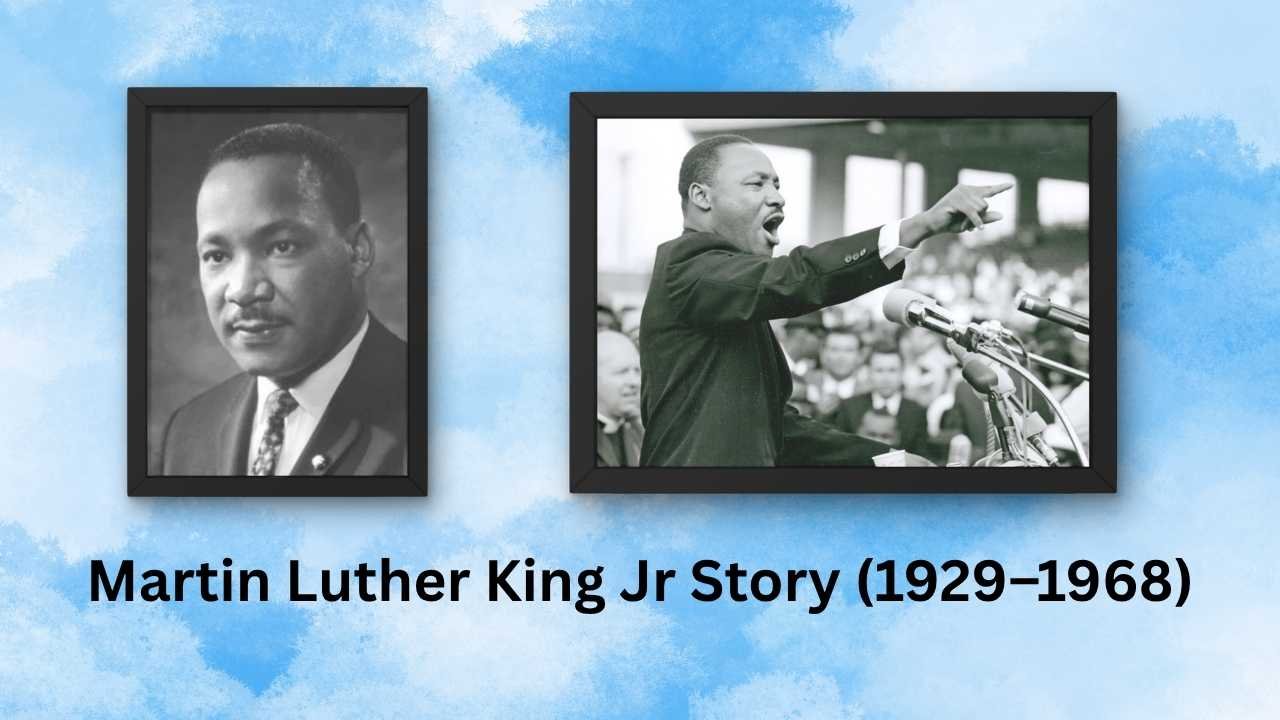
Martin Luther King Jr Story (1929–1968) Recognized as a leading figure in American history, Martin Luther King Jr. fought for equal rights and justice for African Americans by organizing peaceful protests. With powerful speeches and leadership, he transformed the United States. This article shares King’s journey from his birth in 1929 to his death in 1968.
Early Life of Martin Luther King Jr. (1929–1948)
Born on January 15, 1929, in Atlanta, Martin Luther King Jr. grew up as the son of Martin Luther King Sr., a church pastor, and Alberta Williams King.
Always eager to learn, Martin showed remarkable intelligence as a child. He attended local schools in Atlanta and consistently completed his education with excellent grades.
Education and College Years (1948–1955)
In 1948, Martin graduated from Morehouse College with a degree in sociology.
Later, he studied theology at Crozer Theological Seminary and earned another degree. In 1955, he received a Ph.D. from Boston University.
During his studies, Martin discovered the power of non-violent resistance an idea that would shape every step of his movement.
Marriage and Family (1953)
In 1953, Martin Luther King Jr. married Coretta Scott King. They had four children and worked together to support civil rights and equality.
The Montgomery Bus Boycott (1955–1956)
In 1955, Rosa Parks refused to give up her bus seat to a white passenger in Montgomery, Alabama.
Taking the lead in the Montgomery Bus Boycott, Martin Luther King Jr. unified African Americans, who collectively avoided city buses for over a year. The peaceful protest succeeded, and bus segregation was ultimately declared unconstitutional. Martin Luther King Jr Story (1929–1968)
This victory transformed Martin Luther King Jr. into a national beacon of hope.
Leadership in the Civil Rights Movement (1957–1963)
In 1957, King helped create the Southern Christian Leadership Conference (SCLC).
Traveling throughout the United States, King delivered speeches and organized peaceful protests. He encouraged countless people to stand up against injustice without violence.
King’s vision ignited hope in millions.
The Famous “I Have a Dream” Speech (1963)
On August 28, 1963, Martin Luther King Jr. stood before a sea of faces and delivered his legendary “I Have a Dream” speech during the March on Washington.
Drawn by King’s vision, over 250,000 people gathered at the event. In his speech, he spoke of equality, freedom, and a future in which skin color would not matter.
This speech stands as one of the most powerful moments in history.
Nobel Peace Prize (1964)
In 1964, Martin Luther King Jr. was honored with the Nobel Peace Prize for his courageous commitment to civil rights through non-violent action.
At 35, he became one of the youngest recipients of the award.
Civil Rights Act and Voting Rights Act
King’s efforts helped influence important laws in the United States:
- Civil Rights Act (1964)
- Voting Rights Act (1965)
These groundbreaking laws struck down racial discrimination and protected the right to vote for African Americans, moving the country closer to justice. Martin Luther King Jr Story (1929–1968)
Death of Martin Luther King Jr. (1968)
On April 4, 1968, darkness fell as Martin Luther King Jr. was assassinated in Memphis.
He was only 39 years old when he died.
Even after his death, King’s message of peace and equality continues to inspire people worldwide, though the nation was shocked by his passing.
Reflecting on his legacy, Martin Luther King Jr. achieved many remarkable milestones.
- Leader of the American Civil Rights Movement
- Organized peaceful protests against racial discrimination
- Led the Montgomery Bus Boycott
- Delivered the famous “I Have a Dream” speech
- Helped pass the Civil Rights Act of 1964
- Helped support the Voting Rights Act of 1965
- Won the Nobel Peace Prize in 1964
Legacy of Martin Luther King Jr.
Today, Martin Luther King Jr. stands as a lasting symbol of peace, justice, and equality.
Every year, the United States celebrates Martin Luther King Jr. Day to honor his life and contributions.
Conclusion
King’s life, spanning from 1929 to 1968, shows courage, leadership, and hope. By dedicating himself to peaceful activism, he transformed American history and inspires future generations.
Read More: