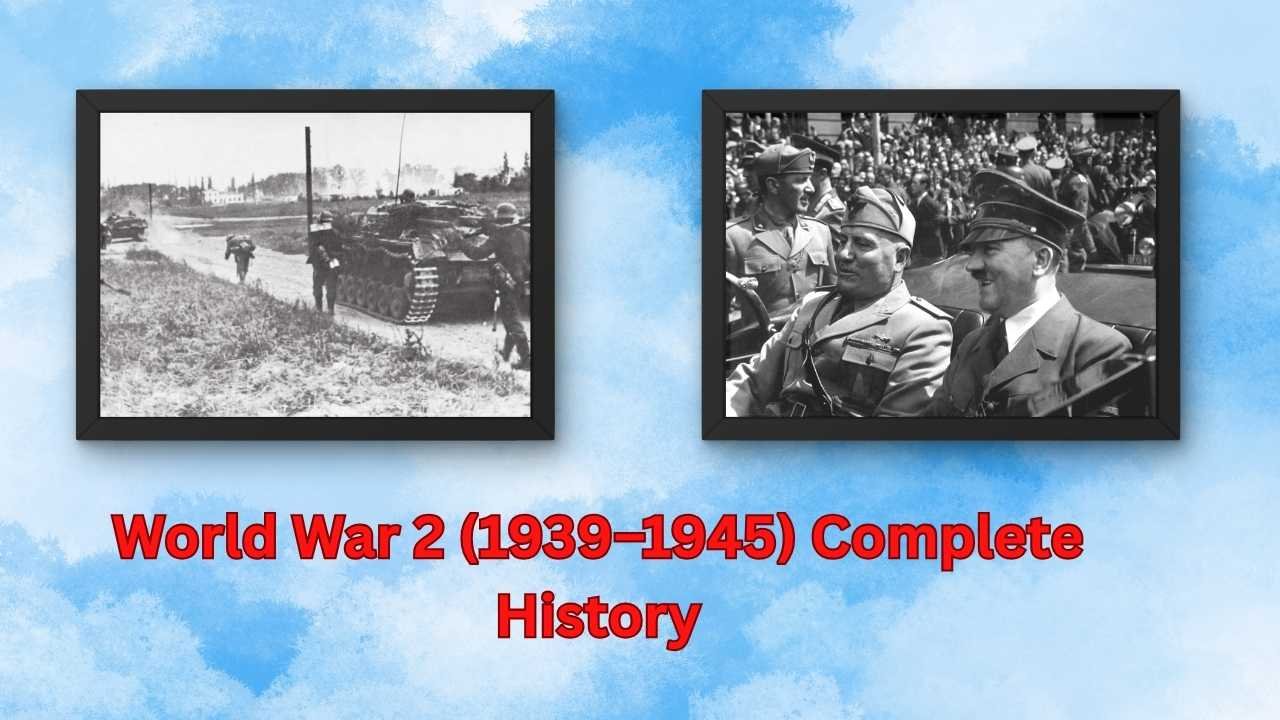
World War 2 (1939–1945) Complete History World War 2 was one of the largest and most important wars in human history. It lasted from 1939 to 1945 and involved many countries worldwide. It caused huge destruction, changed global politics, and affected millions of people.
The main countries involved were the Allied Powers (including Britain, the Soviet Union, the United States, China, and France) and the Axis Powers (Germany, Italy, and Japan). The war ended with the defeat of the Axis Powers and led to major changes in international relations.
What Caused World War 2?
Several factors led to World War 2:
- The harsh conditions imposed on Germany after World War 1.
- The rise of Adolf Hitler and the Nazi Party in Germany.
- Economic problems during the Great Depression.
- Expansionist policies of Germany, Italy, and Japan.
- Failure of international organizations to prevent aggression.
These issues created tensions that eventually led to a global conflict.
1939: The Beginning of World War 2
World War 2 officially began on September 1, 1939, when Germany invaded Poland.
Key Events in 1939:
- Germany attacked Poland using a fast military strategy called Blitzkrieg.
- Britain and France declared war on Germany on September 3, 1939.
- Poland was quickly occupied by Germany and the Soviet Union.
This marked the start of the war in Europe and set the stage for later fighting.
1940: Germany Expands Across Europe
In 1940, Germany achieved several military victories.
Major Events:
- Germany invaded Denmark and Norway.
- Germany conquered Belgium, the Netherlands, and Luxembourg.
- France fell to Germany in June 1940.
- The Battle of Britain began, with Germany attempting to defeat Britain through air attacks.
Britain successfully resisted German air attacks, preventing a German invasion.
1941: A Turning Point
The year 1941 changed the course of the war and broadened the conflict.
Important Events:
- Germany launched Operation Barbarossa and invaded the Soviet Union in June.
- Japan attacked Pearl Harbor in Hawaii on December 7, 1941.
- The United States entered World War 2 after the Pearl Harbor attack.
- Germany and Italy declared war on the United States.
The war became truly global as more countries joined the conflict and fighting spread.
1942: Intense Fighting Across the World
During 1942, major battles took place in Europe, Africa, and the Pacific.
Key Events:
- The Battle of Midway weakened Japan’s naval power.
- The Battle of El Alamein helped the Allies gain control in North Africa.
- The Battle of Stalingrad began between Germany and the Soviet Union.
These battles marked the beginning of Allied successes and a shift in momentum.
1943: The Allies Gain Momentum
The Allies started pushing back against Axis forces.
Major Events:
- Germany suffered a major defeat at the Battle of Stalingrad.
- Allied forces invaded Sicily and later Italy.
- Italian leader Benito Mussolini was removed from power.
- Italy eventually surrendered to the Allies.
The Axis Powers began losing control in many regions.
1944: D-Day and Liberation of Europe
The year 1944 was crucial for Allied victory and the liberation of Europe.
Important Events:
- On June 6, 1944, the Allies launched the D-Day invasion in Normandy, France.
- Allied forces liberated Paris in August 1944.
- Soviet forces advanced from the east against Germany.
D-Day is considered one of the most important military operations in history. World War 2 (1939–1945) Complete History
1945: The End of World War 2
World War 2 ended in 1945, after years of global fighting.
Key Events:
Germany Surrenders
- Soviet forces captured Berlin.
- Adolf Hitler died on April 30, 1945.
- Germany officially surrendered on May 8, 1945, known as Victory in Europe (VE) Day.
Japan Surrenders
- The United States dropped atomic bombs on Hiroshima and Nagasaki in August 1945.
- Japan surrendered on September 2, 1945.
- This marked the official end of World War 2 and the close of the conflict.
The Holocaust
One of the darkest parts of World War 2 was the Holocaust.
The Nazi regime systematically persecuted and killed millions of people, including:
- Jews
- Roma people
- Disabled individuals
- Political opponents
- Other minority groups
Approximately six million Jews were murdered during the Holocaust. World War 2 (1939–1945) Complete History
Impact of World War 2
World War 2 had a massive impact on the world, reshaping many countries.
Human Losses
- More than 60 million people died.
- Millions were injured or displaced.
Economic Damage
- Cities and industries were destroyed.
- Many countries faced years of rebuilding.
Political Changes
- Germany was divided after the war.
- The United States and the Soviet Union emerged as superpowers.
- The Cold War began.
Creation of the United Nations
In 1945, the United Nations (UN) was established to promote peace and prevent future global conflicts.
Important World War 2 Timeline
| Year | Major Event |
| 1939 | Germany invades Poland |
| 1940 | France falls; Battle of Britain |
| 1941 | Germany invades Soviet Union; Pearl Harbor attacked |
| 1942 | Battle of Midway; Battle of El Alamein |
| 1943 | Germany defeated at Stalingrad |
| 1944 | D-Day invasion; Paris liberated |
| 1945 | Germany and Japan surrender; war ends |
Why World War 2 Still Matters Today
World War 2 shaped the modern world. It changed international borders, influenced global politics, and led to the creation of important organizations such as the United Nations. Its lessons continue to influence diplomacy, military strategy, and human rights efforts worldwide.
Conclusion
World War 2 was a global conflict fought between 1939 and 1945. It involved many nations and included major events such as the invasion of Poland, Pearl Harbor, D-Day, and the surrender of Germany and Japan. The war caused immense suffering and also led to significant changes in world politics and international cooperation. Understanding World War 2 helps us learn valuable lessons about peace, conflict, and the importance of global unity.
Read More:
World War 1 Key Events, Causes, and Historical Significance
APJ Abdul Kalam Life Story Humble Beginnings Peoples President