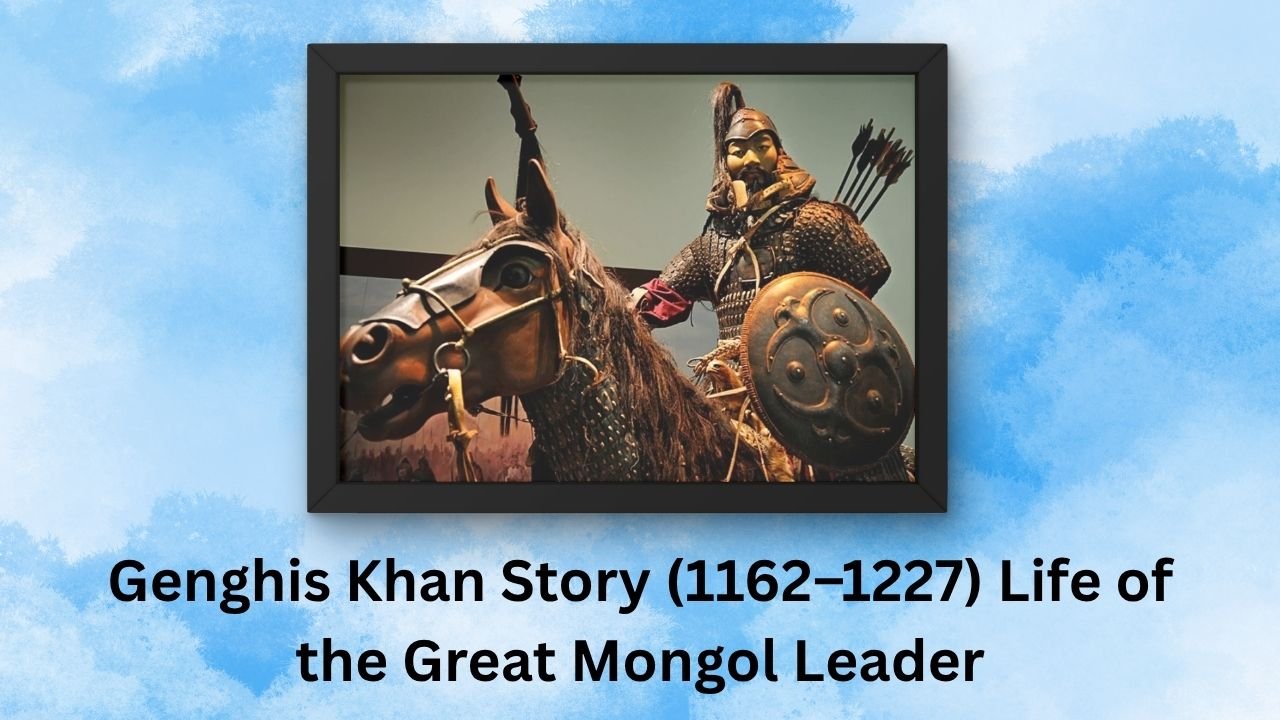
Genghis Khan Story (1162–1227) Life of the Great Mongol Leader Genghis Khan (1162–1227) stands as one of history’s most formidable military leaders, founding the Mongol Empire, the largest land empire ever created. His leadership, courage, and military skills enabled him to unite the Mongol tribes and conquer vast territories across Asia and Europe.
Early Life of Genghis Khan (1162–1180)
In 1162, beside the flowing Onon River in what is now Mongolia, a child named Temujin entered a rugged world. His father, Yesugei, a respected tribal chief, and his mother, Hoelun, faced a land marked by both opportunity and danger.
At only nine years old, Temujin faced tragedy when his father was poisoned by enemies. Following this loss, the tribe abandoned his family, forcing them to live in poverty and struggle for survival.
These difficult years taught Temujin how to be strong, brave, and determined. Genghis Khan Story (1162–1227) Life of the Great Mongol Leader
Rise to Power (1180–1206)
As Temujin matured, he forged alliances with various Mongol tribes. Engaging in numerous battles against rival leaders, he gradually gained followers.
Through his successes, he united most Mongol tribes. In 1206, they declared him Genghis Khan, meaning “Universal Ruler.”
With the title of Genghis Khan, Temujin’s destiny was set in motion, and the rise of the Mongol Empire began a tale that would echo across continents.
Expansion of the Mongol Empire (1206–1227)
Crowned Universal Ruler, Genghis Khan wasted no time. He set his sights on new horizons, launching a relentless torrent of military campaigns that would shake the world.
Conquest of China
He led his warriors fearlessly into the lands of the Jin Dynasty, where Mongol horsemen galloped beneath ancient walls and stormed city after city, sweeping Mongol power ever farther south.
Central Asia Campaign
In 1219, he launched a major invasion of Central Asia. His forces conquered large territories that are now part of Kazakhstan, Uzbekistan, Turkmenistan, and other regions.
Expansion into Europe
As they advanced into parts of Eastern Europe, the Mongol armies achieved rapid conquests. Their speed, discipline, and military tactics proved nearly unstoppable.
By the end of his journey, Genghis Khan stood as the master of one of the greatest empires the world had ever witnessed. Genghis Khan Story (1162–1227) Life of the Great Mongol Leader
Leadership and Military Skills
Renowned for his excellent leadership, Genghis Khan stood apart from other rulers of his era.
Some of his strengths included:
- Strong military organization
- Fast-moving cavalry armies
- Effective communication systems
- Rewarding talented soldiers regardless of their background
- Strict discipline among troops
By promoting individuals based on ability instead of family status, he built a loyal and powerful army.
Achievements of Genghis Khan
- Founded the Mongol Empire
He built the world’s largest continuous land empire.
- United the Mongol Tribes
Before him, Mongol tribes often fought; he united them.
- Improved Trade Routes
His empire helped secure the Silk Road, allowing safer trade between Asia and Europe.
- Established Laws
He introduced a legal code called the Yassa, which helped maintain order across the empire.
- Encouraged Cultural Exchange
The empire linked diverse cultures, religions, and people.
Family and Children
Having married Börte, who remained his chief wife throughout his life, Genghis Khan fathered several children. These included:
- Jochi
- Chagatai
- Ögedei
- Tolui
Later, his sons ruled different parts of the Mongol Empire, expanding it even further.
Death of Genghis Khan (1227)
Genghis Khan died in 1227 during a military campaign against the Western Xia kingdom in China.
The exact cause of his death remains uncertain. Some historians believe he died from injuries suffered during battle, while others suggest illness.
Age at Death
- Born: 1162
- Died: 1227
- Age: About 65 years
Legacy of Genghis Khan
Genghis Khan’s legacy stretched over centuries, as the empire he built helped weave East and West together. Through war and wisdom, his influence shaped politics, culture, and the art of war itself for generations to come.
Today, he is remembered as one of the most powerful and influential leaders ever known.
Conclusion
Genghis Khan’s story is a sweeping journey from hardship and obscurity to glory—of a boy who rose from the windswept steppe to command a mighty empire. Through courage, vision, and sheer determination, he altered the course of history itself.
His life endures as an important chapter in world history, inspiring historians and readers worldwide.
FAQs About Genghis Khan
Who was Genghis Khan?
Genghis Khan was the founder and first ruler of the Mongol Empire, born in 1162 in Mongolia.
What was Genghis Khan’s real name?
His real name was Temujin.
When did Genghis Khan become ruler?
He was declared Genghis Khan in 1206 after uniting the Mongol tribes.
How did Genghis Khan die?
The exact cause is unknown, but he died during a military campaign in 1227.
Why is Genghis Khan famous?
He is famous for founding the world’s largest connected land empire.
Read More: