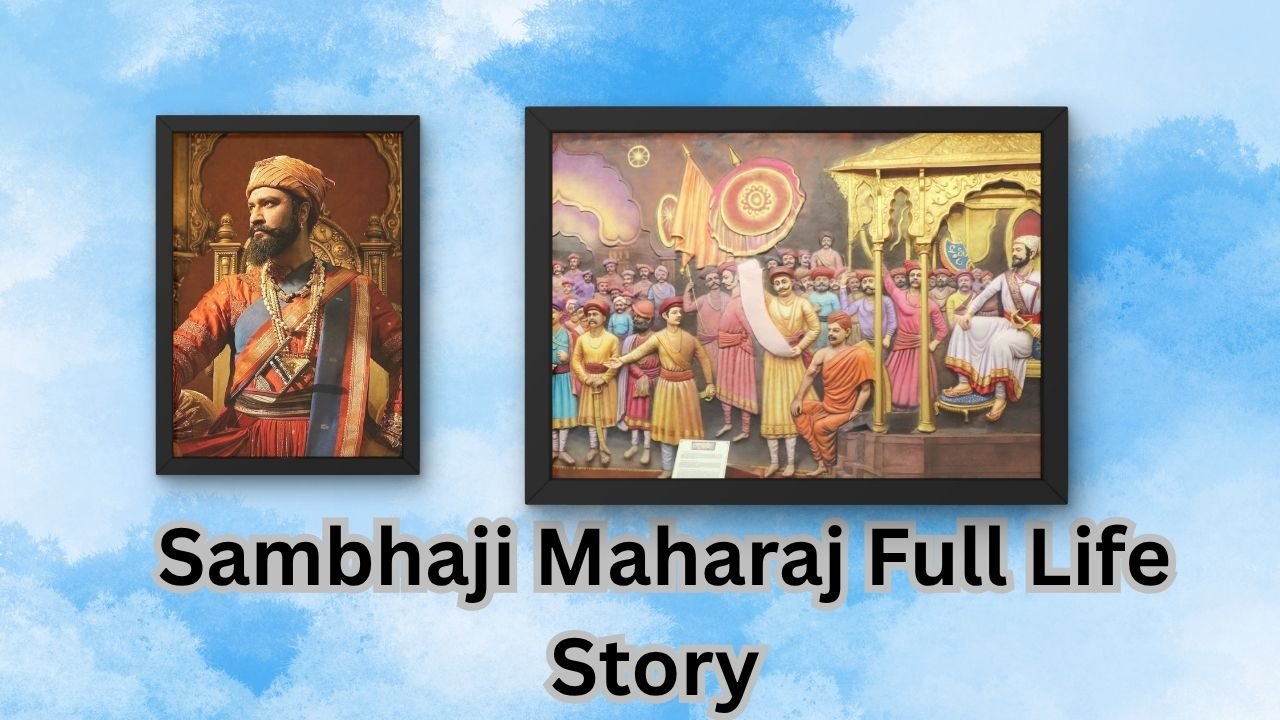
Sambhaji Maharaj Full Life Story renowned as the second Chhatrapati of the Maratha Empire and the courageous son of Shivaji Maharaj, lived between 1657 and 1689. His life was marked by struggle and sacrifice. In particular, during a tumultuous period, he continually fought the Mughal Empire to protect his kingdom, setting the stage for a remarkable life.
Early Life (1657–1674)
On 14 May 1657, Sambhaji Maharaj was born at Purandar Fort in Maharashtra. Early hardships shaped his childhood, and the loss of his mother, Saibai, made his beginnings especially difficult. Despite this, his resilience started to shape his story.
He was raised by his grandmother, Jijabai, who instilled in him strong values, bravery, and a love for the kingdom. As a result, from childhood, Sambhaji showed signs of intelligence and leadership, continuing to develop under her guidance.
Parents and Family
Shivaji Maharaj, a great warrior and founder of the Maratha Empire, was Sambhaji’s father. Sambhaji’s mother, Saibai, exemplified kindness and religious devotion.
In addition, Sambhaji also had stepmothers and step-siblings. Notably, his half-brother Rajaram succeeded Sambhaji as king. These family dynamics led to internal conflicts during Sambhaji’s reign, affecting his rule and further complicating his path to the throne.
Siblings
Sambhaji’s younger half-brother, Rajaram I, was at the center of political differences among their respective supporters after Shivaji’s death.
Despite ongoing differences with his half-brother and their supporters, Sambhaji became the rightful ruler, overcoming obstacles to claim the throne. This transition, following a period of intense internal conflict, marked a critical turning point in his life and reign.
Education
Exceptionally educated, Sambhaji Maharaj mastered Marathi, Sanskrit, and Persian. His expertise encompassed politics, governance, and military strategy.
He even wrote a Sanskrit book called Budhbhushanam, which demonstrates his deep knowledge and intelligence. Furthermore, alongside academic pursuits, he began training in horse riding, sword fighting, and war tactics early in life, blending scholarship with preparation for leadership.
Marriage and Children
Sambhaji Maharaj married Yesubai, a strong and supportive queen, further strengthening the royal lineage.
Together, they had a son named Shahu I, who later became an important ruler of the Maratha Empire. Thus, his direct descendants continued his influence on history.
His family thus played a key role in continuing the Maratha legacy after his death, ensuring that his dedication and vision resonated for generations.
Visit to Mughal Court and Escape (1666)
In 1666, Sambhaji accompanied Shivaji Maharaj to Mughal emperor Aurangzeb’s court in Agra. This episode became a turning point in their lives.
However, Aurangzeb put both under house arrest, creating a dangerous situation. Despite the risk, Shivaji and Sambhaji devised a clever escape and returned to their kingdom.
After this incident, Sambhaji became more aware of Mughal politics and dangers, shaping his future actions and perspectives. This newfound awareness proved crucial as his responsibilities within the Maratha Empire grew.
Struggles and Challenges (1670–1680)
During this decade, Sambhaji’s life was fraught with political and personal trials. Several ministers withdrew support, and frequent discord strained his bond with his father. These tensions would play a vital role in shaping Sambhaji’s path to power.
Due to these political issues, he was even briefly kept away from power. Nevertheless, he proved his capability through bravery and leadership. Enduring these struggles only made him stronger and better equipped for future responsibilities as a ruler.
Becoming the King (1681)
After Shivaji Maharaj’s death in 1680, a significant power struggle ensued in the Maratha Empire. This confrontation would decide the next ruler.
Subsequently, Sambhaji Maharaj became the king in 1681 after defeating rival groups. At this time, the Mughal Empire under Aurangzeb was determined to destroy the Maratha. His coronation, therefore, signaled the beginning of a period defined by both toughness and heroism and set the stage for renewed conflict.
Wars and Leadership (1681–1689)
During his reign, which lasted about 8 years, Sambhaji Maharaj devoted most of his time to warfare. In these challenging times, his focus was on defense and expansion, constantly responding to threats from powerful adversaries.
He relentlessly confronted not only Aurangzeb’s Mughal army, but also the Portuguese and the Siddis. In the face of overwhelming opposition, Sambhaji fiercely defended his dominion.
His leadership helped the Maratha Empire survive during one of its most dangerous periods. Although the Mughals possessed a much larger army, Sambhaji’s courage and determination kept the Maratha resistance alive, ensuring the struggle’s continuity.
How Many Years Did Sambhaji Fight?
Sambhaji Maharaj fought for nearly 8 years (1681–1689) as king. During this period, he demonstrated relentless perseverance despite constant conflict, establishing a pattern of unwavering commitment.
His involvement in warfare began much earlier in his youth, weaving battle and the defense of his kingdom into the fabric of his life and preparing him for the challenges of kingship.
In 1689, at Sangameshwar in Maharashtra, Mughal forces captured Sambhaji Maharaj. This event closed a crucial chapter and marked the tragic end of his resistance. Sambhaji Maharaj Full Life Story
He was brought before Aurangzeb and asked to surrender and convert to his religion. Sambhaji refused. Ultimately, after enduring severe torture, he was executed on 11 March 1689 at Tulapur near Pune, ending his courageous struggle.
Age at Death
At the time of his death, Sambhaji Maharaj was 31 years old. This young age underscores the intensity of his short reign and emphasizes the impact of his rapid rise and fall. Sambhaji Maharaj Full Life Story
His martyrdom remains one of the most legendary acts in Indian history.
Place of Death
Currently, a memorial stands at Tulapur, Maharashtra, where Sambhaji Maharaj was executed. For this reason, the site is considered sacred by many people who respect his bravery and sacrifice, further preserving his memory. Sambhaji Maharaj Full Life Story
Language and Skills
Sambhaji Maharaj knew several languages, including:
- Marathi (native language)
- Sanskrit
- Persian
Thus, he was not only a warrior but also a scholar and writer. This rare combination of talents helped him in both administration and diplomacy, enhancing his effectiveness as a ruler.
Legacy
Sambhaji Maharaj’s life is a symbol of courage and sacrifice. Even after his death, the Maratha Empire did not fall; in fact, it grew stronger and later successfully challenged the Mughal Empire, carrying forward his legacy.
His legacy was carried forward by his son, Shahu I, and later by Maratha leaders. Sambhaji is commemorated as an unwavering king who upheld his ideals to his final breath.
Conclusion
In conclusion, the full life story of Sambhaji Maharaj (1657–1689) teaches us about bravery, leadership, and sacrifice. From his early life struggles to his heroic death, he remained dedicated to protecting his empire. Despite ruling for only eight years, Sambhaji Maharaj left an unforgettable mark on Indian history. For this reason, he is always remembered as a true warrior, a protector of the Maratha Empire.
FAQS
1) Why did Akbar leave Sambhaji Maharaj?
Akbar (Mughal prince), who rebelled against Aurangzeb, initially sought refuge with Sambhaji Maharaj. However, amid political instability, limited backing, and fear of Mughal reprisal, Akbar departed for Persia seeking safety and allies.
2) How many wives does Sambhaji Maharaj have?
Sambhaji Maharaj’s principal wife was Yesubai, widely recognized as his queen. Some accounts hint at other consorts, but Yesubai remains the most significant among his wives.
3) Why did Sambhaji betray Shivaji?
Sambhaji Maharaj did not truly betray Shivaji Maharaj. He briefly joined the Mughals in 1678 due to court conflicts and frustration, but soon returned, proving loyalty. It was a political misunderstanding, not a real betrayal.
4) Did Sambhaji’s daughter marry a Mughal?
No, Sambhaji Maharaj had no confirmed daughter who married into the Mughal family. His well-known son was Shahu I. Some claims exist, but reliable historical records do not support such a marriage.
Read More: