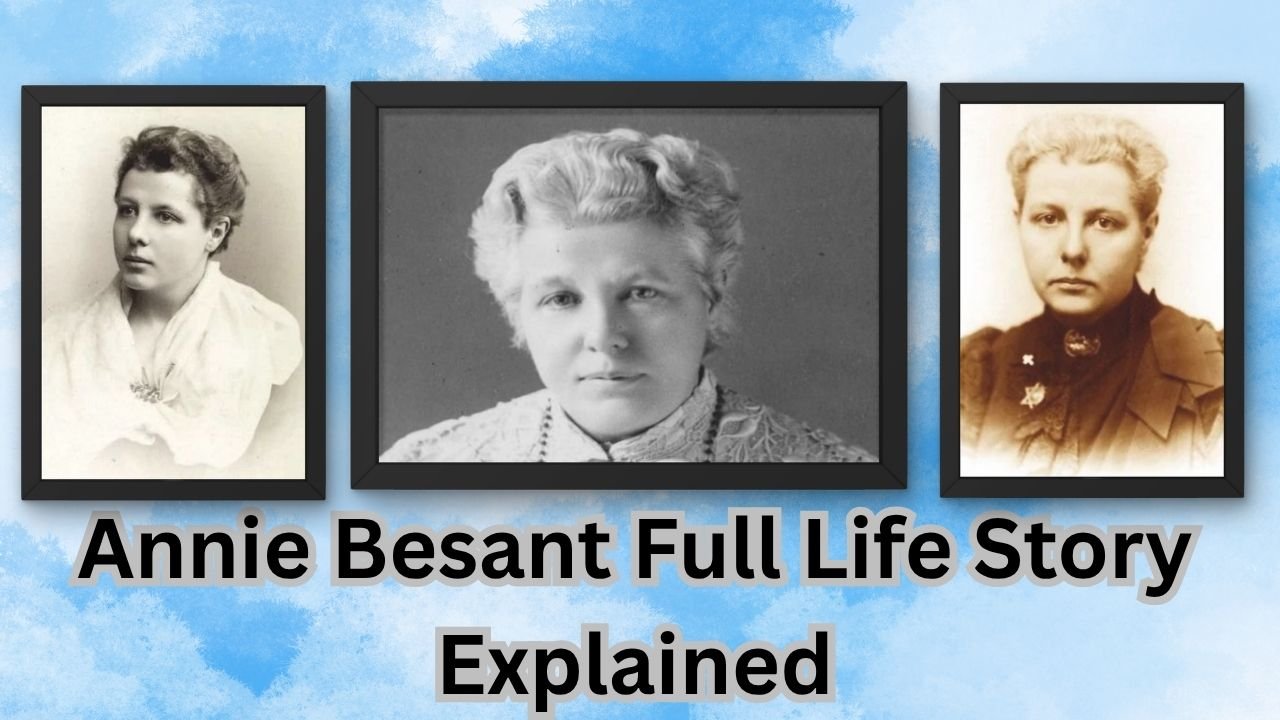
Annie Besant Full Life Story Explained (1847–1933) was a famous social reformer, writer, educationist, and freedom fighter. Although born in England, she later became one of the strongest supporters of India’s freedom. Throughout her life, she worked for self-rule, promoted education, and fought for women’s rights. Her journey stands as an inspiring story of courage, knowledge, and service.
Annie Besant Early Life (1847–1867)
Born on October 1, 1847, in London, England, Annie Besant faced a challenging childhood after losing her father at a young age. Her mother, determined and hardworking, raised her alone. Bright and curious, Annie loved reading and soon developed a keen interest in religion, philosophy, and social issues.
Moreover, the lessons from her early life inspired her with the value of hard work and independence. These qualities empowered her to rise as a strong leader and inspiring speaker.
Parents
Annie Besant’s parents played an important role in her life:
- Father: William Page Wood, a doctor who passed away early
- Mother: Emily Morris, a strong and caring woman
Despite her father’s death, her mother courageously embraced full responsibility for her upbringing. This powerful example inspired Annie, instilling in her enduring values shaped by her mother’s unwavering strength.
Siblings
There is very little detailed information about Annie Besant’s siblings. Most historical records focus on her individual life and achievements. She was mainly raised under her mother’s care and guidance.
Annie Besant Education
Privately educated, Annie Besant was a dedicated self-learner who devoted much of her time to reading books. She explored subjects like literature, religion, philosophy, and history.
As a result of her education, she became a powerful writer and speaker. She believed that education was the key to personal and social development, a belief that later shaped her work in India. Annie Besant Full Life Story Explained
Annie Besant Marriage (1867)
In 1867, Annie married Rev. Frank Besant, who was a clergyman in the Church of England. At first, their marriage seemed normal, but soon problems arose because Annie had independent, progressive ideas, while her husband held traditional beliefs.
Because of these differences, they separated in 1873. Although this was a difficult time for Annie, it gave her the freedom she needed to pursue her dreams and embrace new possibilities. Annie Besant Full Life Story Explained
Children
Annie Besant had two children:
- Arthur Digby Besant
- Mabel Besant
After the separation, she faced emotional struggles, especially regarding the custody of her children. Despite these challenges, she continued her work and became stronger.
Social Activism in England (1870s–1893)
Between 1870 and 1893, Annie Besant became very active in social reform movements in England. She supported workers’ rights, women’s rights, and education for all.
Through her involvement with organizations fighting injustice and inequality, Annie spoke and wrote passionately to spread awareness. Her fearless words and actions earned her a reputation as a truth-teller.
During this time, she also became interested in spiritual ideas, which eventually led her to India.
Arrival in India (1893)
When Annie Besant arrived in India in 1893, she was moved and inspired by the rich culture, religion, and traditions she encountered. Her profound admiration and heartfelt connection inspired her to dedicate herself to serving the people of India.
She joined the Theosophical Society, which promoted spiritual knowledge and the unity of all religions. In 1907, she became its president and worked from its headquarters in Adyar, Chennai.
Role in Indian Freedom Movement (1914–1917)
Building on her previous activism, Annie Besant played a crucial role in India’s freedom struggle, believing strongly that Indians should have the right to govern themselves.
- In 1916, she started the Home Rule Movement to demand self-government for India.
- To further the Home Rule Movement, she spread awareness through speeches, writings, and public meetings.
- In 1917, she became the first woman president of the Indian National Congress.
Through her leadership, Annie inspired many Indians to join the freedom movement. Her dedication gave people confidence and hope.
Contribution to Education (1898–1920s)
Continuing her belief in the power of knowledge, Annie Besant believed with all her heart that education is the bedrock of a powerful and vibrant nation. She dreamed of nurturing generations that would shape a brighter future.
- In 1898, she founded the Central Hindu College in Varanasi.
- Later, in 1916, it became part of Banaras Hindu University with the help of Madan Mohan Malaviya.
In line with her educational vision, she promoted a combination of modern education and Indian culture. She wanted students to be both knowledgeable and morally strong. Annie Besant Full Life Story Explained
Work for Women’s Rights
Annie Besant was a strong supporter of women’s rights. She believed that women should have equal opportunities in education, work, and politics.
Because of her advocacy, women were encouraged to become independent and participate in society. Her work helped improve the position of women in both England and India.
Books and Writings
A talented writer, Annie Besant produced many books and articles covering religion, politics, and social issues. By explaining complex ideas in simple language, she made them accessible to her readers.
Some of her works focused on spirituality, while others discussed freedom and equality. In both cases, her writings inspired many people to think and act for a better society.
Languages She Spoke
Annie Besant was fluent in English, which she used for her speeches and writings. She also knew Sanskrit and studied Indian religious texts. Her understanding of Indian culture made her closer to the people of India.
Awards and Honors
During her lifetime, Annie Besant received great respect and recognition:
- Leader of the Home Rule Movement (1916)
- President of the Indian National Congress (1917)
- President of the Theosophical Society (1907)
While formal awards were uncommon in her time, Annie Besant was widely recognized as a great leader and reformer.
Death, Place, and Age (1933)
Annie Besant died on September 20, 1933, in Adyar, Chennai, India. She was 85 years old at the time of her death.
In her final years, Annie remained in India, continuing her work for education and social reform.
Conclusion
Annie Besant (1847–1933) was a remarkable woman who, through determination and vision, changed lives and shaped history. Her journey from humble beginnings in England to becoming a guiding star of India’s freedom movement continues to inspire all who learn her story.
She worked tirelessly for the upliftment of society, especially for women and students. Because of her dedication, her contributions are still remembered with respect today. Annie Besant remains a symbol of courage, knowledge, and service.
FAQS
1) What did Annie Besant say about Hinduism?
Annie Besant praised Hinduism as a deep and scientific religion. She said it contained great spiritual wisdom and truth. Because of these views, she believed Hindu philosophy could guide humanity and admired its tolerance, ancient knowledge, and respect for all forms of life.
2) What happened to Annie Besant?
During her later years, Annie Besant worked in India for education and social reform. She died on September 20, 1933, in Adyar, Chennai, at the age of 85, after dedicating her life to service, freedom, and spiritual work.
3) Was Annie Besant a Russian?
No, Annie Besant was not Russian. She was born in London, England, in 1847. Later, she moved to India, where she became a key leader in the freedom movement, education, and social reform activities.
4) What is the difference between Sarojini Naidu and Annie Besant?
Sarojini Naidu was an Indian poet and nationalist leader, known as the “Nightingale of India.” Annie Besant was a British-born figure who focused on education, the Home Rule Movement, and social reform in India’s freedom struggle.
Read More: