Kumara Gupta I Life Story (c. 415–455 CE) I was one of the most important rulers of the Gupta Empire. He ruled from around 415 CE to 455 CE, a period known as the Golden Age of India. His reign is remembered for peace, strong administration, cultural growth, and support for education.
Early Life of Kumara Gupta I (Late 4th Century CE)
Kumara Gupta, I was born in the late 4th century CE into the powerful Gupta dynasty. He grew up in a royal environment where he learned leadership and responsibility from a young age.
Growing up during a period when the Gupta Empire was already strong and prosperous provided Kumara Gupta I with a solid foundation for his future rule, seamlessly connecting his upbringing to his later achievements.
Parents of Kumara Gupta I
Kumara Gupta, I was the son of Chandragupta II, one of the greatest Gupta rulers. His father expanded the empire and made it powerful.
Although detailed records are scarce, some historical sources suggest that his mother was Queen Dhruvadevi.
Thus, being part of such a strong royal family greatly influenced his personality and leadership qualities, connecting his lineage to his role as a ruler.
Education and Training
Kumara Gupta I, as a prince, received an exceptional education.
Education Included:
- Sanskrit language and literature
- Religious texts like the Vedas
- Political science and governance
Training Included:
- Military skills and warfare
- Horse riding and weapon handling
- Leadership and administration
This combination of education and training prepared him well, forming the basis for his capabilities as a wise king and directly supporting his effectiveness as a ruler. Kumara Gupta I Life Story (c. 415–455 CE)
Marriage and Children
Historical records about his marriage are unclear. However, it is believed that Kumara Gupta I had royal wives as per tradition.
He had sons, the most famous of whom was Skandagupta, who later became emperor.
In line with tradition, his children were also trained in administration and warfare to ensure the royal legacy would continue into the next generation.
Languages Known
Kumara Gupta, I was well-educated and likely knew:
- Sanskrit (the main language of administration and literature)
- Prakrit (used by common people)
During the Gupta period, Sanskrit gained special importance and was widely used in inscriptions and official records, demonstrating the language’s enduring influence.
Battles and Military Activities (c. 415–455 CE)
Unlike earlier Gupta rulers, Kumara Gupta I experienced a reign marked by relative peace. Kumara Gupta I Life Story (c. 415–455 CE)
Key Points About His Military Rule:
- He maintained control over a vast empire.
- He successfully defended his kingdom.
- He faced threats from tribes such as the Pushyamitras toward the end of his reign.
Although he was not known for many major conquests, he maintained enough strength to protect his empire, illustrating his approach to leadership.
Rise to Power (c. 415 CE)
Kumara Gupta, I became king around 415 CE after the death of my father, Chandragupta II.
Upon taking the throne, he adopted the royal title Mahendraditya, meaning “Great King.” His smooth rise to power was facilitated by the stability and strength he inherited from the empire’s earlier successes.
Reign and Expansion (c. 415–455 CE)
Kumara Gupta ruled for about 40 years, one of the longest reigns in the Gupta dynasty.
Features of His Reign:
- Maintained peace across the empire
- Strengthened internal administration
- Avoided unnecessary wars
- Preserved the vast territory inherited from his father
Because of this focus, his reign emphasized stability and development rather than expansion, defining the direction of his rule.
Administration and Governance
Kumara Gupta was known for his efficient administration.
Main Features:
- Strong central authority
- Provinces governed by officials
- Village-level administration through local councils
- Fair taxation system
By ensuring law and order through his governance, Kumara Gupta I helped foster significant economic growth across the empire, joining policies with outcomes. Kumara Gupta I Life Story (c. 415–455 CE)
Religion and Culture
Kumara Gupta, I followed Hinduism, especially the worship of Lord Vishnu.
He exhibited tolerance toward other faiths, including Buddhism and Jainism.
Cultural Contributions:
- Supported temple building
- Encouraged scholars and poets
- Promoted Sanskrit literature
His reign saw the continuation of India’s cultural richness.
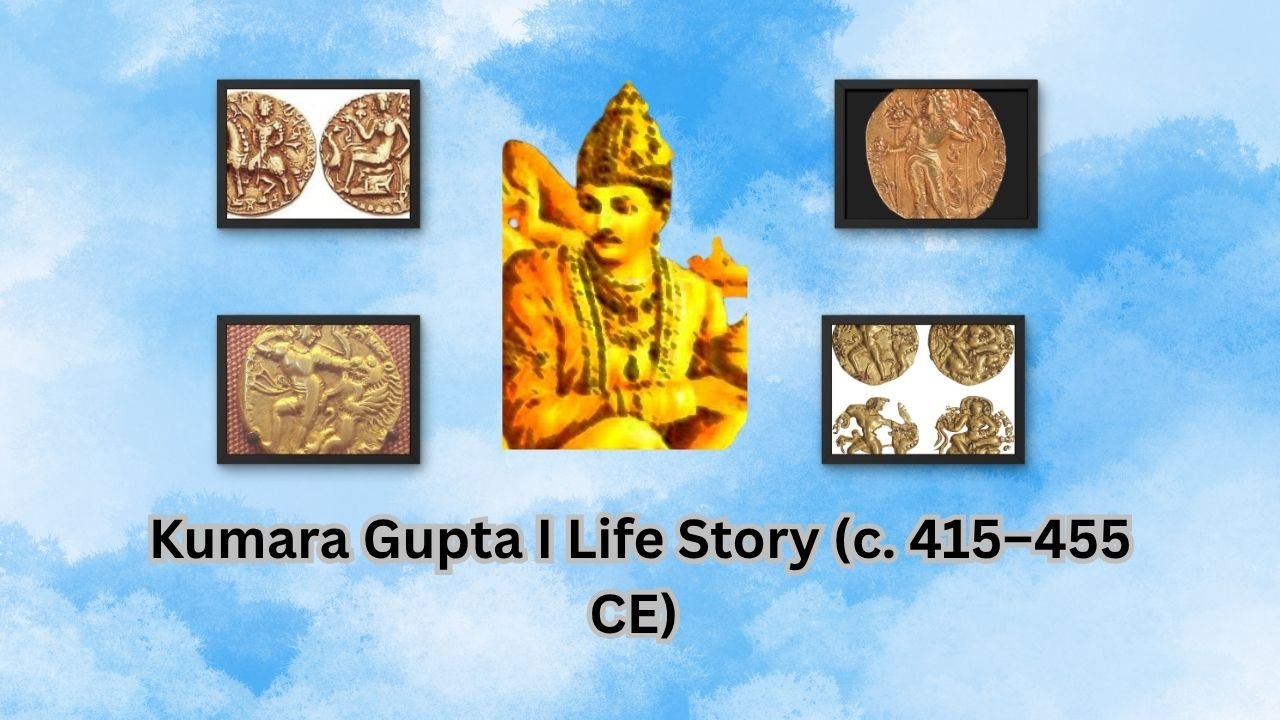
Coins and Economic Strength
Kumara Gupta, I issued a large number of gold, silver, and copper coins.
Importance of His Coins:
- Show economic prosperity
- Display artistic designs
- Include images of gods and royal symbols.
These coins not only serve as important historical sources but also reflect the considerable wealth and artistic tradition of the Gupta Empire during its time, linking currency to cultural achievement. Kumara Gupta I Life Story (c. 415–455 CE)
Contribution to Education (5th Century CE)
Historians credit Kumara Gupta I with founding Nalanda University in the 5th century CE. Kumara Gupta I Life Story (c. 415–455 CE)
Why Nalanda Was Important:
- One of the earliest universities in the world
- Students came from different countries.
- Subjects included science, medicine, and philosophy.
This notable achievement demonstrates his enduring vision for education and knowledge in his empire, serving as a bridge between his personal priorities and broader societal impact.
Challenges in Later Years (c. 450 CE)
Around 450 CE, Kumara Gupta I encountered both internal and external difficulties as his reign neared its conclusion.
Major Challenges:
- Attacks by the Pushyamitras
- Signs of weakening central control
Despite these problems, the empire remained largely stable during his lifetime, showing his ability to maintain unity in challenging times.
Death of Kumara Gupta I (c. 455 CE)
Kumara Gupta died around 455 CE.
Death Place and Age:
- The exact place of death is not clearly known.
- Although the exact age at his death remains uncertain, historians suggest he reached late middle age.
After his death, the succession continued smoothly when his son, Skandagupta, became the new ruler, ensuring the dynasty’s continuation.
Achievements of Kumara Gupta I
Kumara Gupta, I made many important contributions:
- Ruled successfully for about 40 years (415–455 CE)
- Maintained peace and stability in the empire
- Strengthened administration and governance
- Promoted education and founded Nalanda University
- Encouraged art, culture, and religion
- Issued high-quality coins showing economic strength
Conclusion
Kumara Gupta, I was a wise and capable ruler who preserved the greatness of the Gupta Empire. His reign from 415 CE to 455 CE is remembered as a period of peace, development, and cultural progress.
Moreover, his enduring support for education, especially through the establishment of Nalanda University, remains one of his greatest contributions to Indian history, linking his actions to historical memory.
FAQs
1) Who was Kumara Gupta I?
Kumara Gupta, I was a Gupta emperor who ruled from 415 CE to 455 CE.
2) Who were his parents?
His father was Chandragupta II. His mother is believed to be Dhruvadevi.
3) What was his main achievement?
His major achievement was maintaining peace and establishing Nalanda University.
4) Which language did he use?
He mainly used Sanskrit for administration and literature.
5) Who succeeded Kumara Gupta I?
He was succeeded by Skandagupta.
6) When did he die?
He died around 455 CE.
Read More: