Purugupta Life Story Gupta Emperor of Ancient India Purugupta was an important ruler of the Gupta Empire in ancient India. He lived in the 5th century CE and is known as one of the later Gupta emperors. His rule came during a difficult time, when the Gupta Empire was beginning to weaken due to foreign attacks and internal problems.
Even though Purugupta was not as famous as rulers such as Samudragupta or Chandragupta II, he played an important role in preserving the Gupta dynasty. His life story helps us understand the last strong phase of the Gupta Empire and the beginning of its decline.
Early Life of Purugupta
Purugupta was born into the royal Gupta family around the 5th century CE. He was the son of Kumaragupta I, who ruled the Gupta Empire from about 415 CE to 455 CE. His mother was Anantadevi.
Purugupta grew up in the royal court, surrounded by privilege. As a prince, he observed the inner workings of the empire from an early age. He was groomed for leadership and learned the responsibilities of kingship.
At that time, the Gupta Empire was still powerful and rich. India was enjoying growth in art, education, religion, trade, and culture.
Parents of Purugupta
Father: Kumaragupta I
Kumaragupta I was a strong Gupta ruler who kept the empire stable for many years. He followed the tradition of supporting education, religion, and administration.
Mother: Anantadevi
Anantadevi was Purugupta’s mother. Historical records mention her name in connection with the Gupta royal family.
Purugupta’s Gupta heritage established his right to rule after earlier kings.
Education of Purugupta
Like other royal heirs of the Gupta era, Purugupta likely received an exceptional education. Gupta emperors valued scholarship and discipline.
He may have studied:
- Sanskrit language
- Political science
- Administration
- Hindu scriptures
- War strategy
- Military training
- Ethics and kingship
He may also have learned archery, horsemanship, swordsmanship, and other aristocratic skills. This education equipped him for sovereignty. Purugupta Life Story Gupta Emperor of Ancient India
Marriage and Children
Very little is known clearly about Purugupta’s wife. Ancient records provide few details about his marriage.
However, it is believed that he married according to royal traditions. He likely had children from the Gupta royal family.
His most important son was probably Narasimhagupta, also known as Baladitya, who later became a ruler of the Gupta Empire.
Because the records are limited, historians know little about Purugupta’s family life. Still, it is clear that his descendants continued the Gupta dynasty. Purugupta Life Story Gupta Emperor of Ancient India
Language of Purugupta
The main language of the Gupta court was Sanskrit. Purugupta and other members of the royal family likely used Sanskrit in official matters, religious discussions, and inscriptions.
In daily life, people across the empire also spoke local languages and dialects. But Sanskrit remained the language of education, literature, and royal records.
The Gupta Empire During His Youth
Purugupta grew up during the later years of the Golden Age of India. The Gupta Empire had many achievements in:
- Literature
- Mathematics
- Astronomy
- Art
- Sculpture
- Temple building
- Trade
- Education
This was the time when scholars like Kalidasa and Aryabhata became famous. Cities were active, universities were growing, and temples were being built.
When Purugupta was young, the Gupta Empire still held great importance, but problems were beginning to emerge.
Rise to Power
After the death of Kumaragupta I around 455 CE, the empire faced instability. His son, Skandagupta, became ruler and defended the empire against Hun invasions.
Following Skandagupta’s rule, Purugupta ascended to the throne around 467 CE, marking the start of his reign, which likely lasted until about 473 CE.
Purugupta came to power during a period of weakness for the empire. The territory was shrinking, and many challenges awaited him. Purugupta Life Story Gupta Emperor of Ancient India
Challenges During His Rule
Purugupta ruled during a very difficult period. He had to deal with many problems.
1. Hun Attacks
The Huns were foreign invaders who attacked northwestern India. These attacks created fear, damage, and instability.
2. Weakening Empire
The Gupta Empire had already become weaker before Purugupta became king. Many provinces were harder to control.
3. Economic Problems
Wars and disorder reduced trade and tax collection. This affected the empire’s wealth.
4. Local Independence
Some provincial leaders and governors began asserting greater autonomy. This weakened the emperor’s authority.
Purugupta struggled with these mounting issues, but the empire was already declining.
Administration and Governance
Purugupta followed the traditional Gupta style of rule. The Gupta administration was organized and respected.
The empire was divided into provinces and districts. Local officials helped collect taxes, maintain order, and manage villages.
His government likely focused on:
- Law and order
- Tax collection
- Agriculture
- Trade protection
- Religious support
- Local administration
The Gupta system of governance remained well-organized compared to other kingdoms, despite overall decline.
Religion and Culture
Purugupta practiced Hinduism, the dominant faith among Gupta sovereigns. He esteemed Brahmins and upheld religious customs.
The Gupta age was famous for strong cultural growth. During Purugupta’s time, many old traditions continued, such as:
- Worship of Hindu gods
- Sanskrit literature
- Temple culture
- Religious donations
- Respect for scholars and priests
Buddhism and Jainism also existed, and the Gupta period is noted for religious tolerance.
Coins and Inscriptions
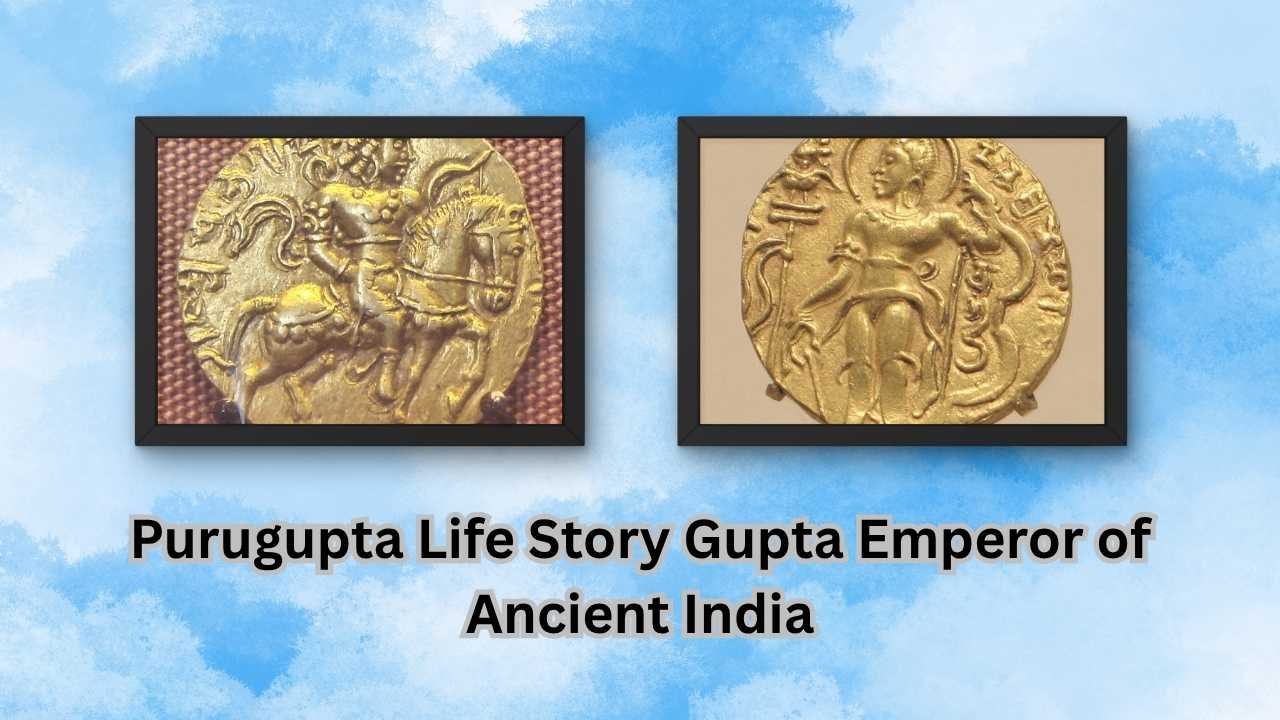
Very few coins of Purugupta have been found. This suggests that the empire may have been economically weaker during his reign.
Most of what we know about him comes from inscriptions and royal records. One important source is the Bhitari seal, which mentions his name and family line.
These records are crucial, as they allow historians to piece together an understanding of the later Gupta period.
Later Gupta Empire
After Purugupta’s reign, the Gupta dynasty continued, but this marked another transition as the empire gradually fragmented into smaller regions and lost central power.
The later Gupta rulers could not restore the empire’s former glory. Still, they carried forward the Gupta royal line for some time. Purugupta Life Story Gupta Emperor of Ancient India
The empire’s decline happened because of:
- Foreign invasions
- Internal weakness
- Economic loss
- Reduced military power
- Independent regional rulers
Purugupta’s reign marked a crucial transition in Indian history.
Death of Purugupta
Purugupta likely died around 473 CE.
Death Place
The exact place of his death is not known. Ancient sources do not clearly mention where he died.
Age
His exact age is also unknown because his birth year is unclear. Most historians only know that he ruled in the 5th century CE.
Even though we do not know the exact details of his death, his name remains important in Gupta history.
Achievements of Purugupta
Purugupta’s reign may not have been long or very powerful, but he still achieved significant milestones.
1. Continued the Gupta Dynasty
He helped keep the Gupta royal family alive during a time of decline.
2. Maintained Royal Rule
He remained a legitimate Gupta emperor and continued the dynasty’s tradition.
3. Supported Culture
He lived in a period where Sanskrit, religion, and ancient Indian culture remained important.
4. Preserved Administration
He helped maintain the Gupta system of government during hard times.
5. Connected the Past and Future
His rule served as a bridge between the Gupta Empire’s strength and its later decline.
Importance in Indian History
Purugupta is important because he represents the later stage of the Gupta Empire. His story shows how even great empires face change and decline.
He may lack the fame of earlier Gupta rulers, but his historical impact endures.
He is remembered for:
- Continuing the Gupta lineage
- Ruling during a difficult time
- Being part of the last strong phase of Gupta power
- Helping historians understand the decline of the empire
Purugupta’s life gives us a clear picture of how Indian history changed after the Gupta golden age.
Conclusion
Purugupta was a later Gupta ruler who presided over a particularly challenging period in the 5th century CE. His biography illustrates the struggles of a once-great empire as it seeks to endure.
He was the son of Kumaragupta I, who likely ruled from 467 CE to 473 CE, and helped continue the Gupta line. Even though many details about his personal life, marriage, and death are still unclear, his place in Indian history remains valuable.
Purugupta stands as a symbol of the later Gupta period, when greatness slowly turned to decline, yet the empire’s legacy remained strong in Indian memory.
FAQs About Purugupta
Who was Purugupta?
Purugupta was a Gupta emperor who ruled in the 5th century CE.
Who was the father of Purugupta?
His father was Kumaragupta I.
Who was the mother of Purugupta?
His mother was Anantadevi.
When did Purugupta rule?
He likely ruled from around 467 CE to 473 CE.
What language was used in his time?
Sanskrit was the main language of the Gupta court.
What religion did Purugupta follow?
He followed Hinduism.
Who was Purugupta’s son?
His son was likely Narasimhagupta, also called Baladitya.
Where did Purugupta die?
The exact place of Purugupta’s death is not known.
What was the age of Purugupta at death?
His exact age is not known.
Why is Purugupta important?
He is important because he continued the Gupta dynasty during a time of decline.
Read More: