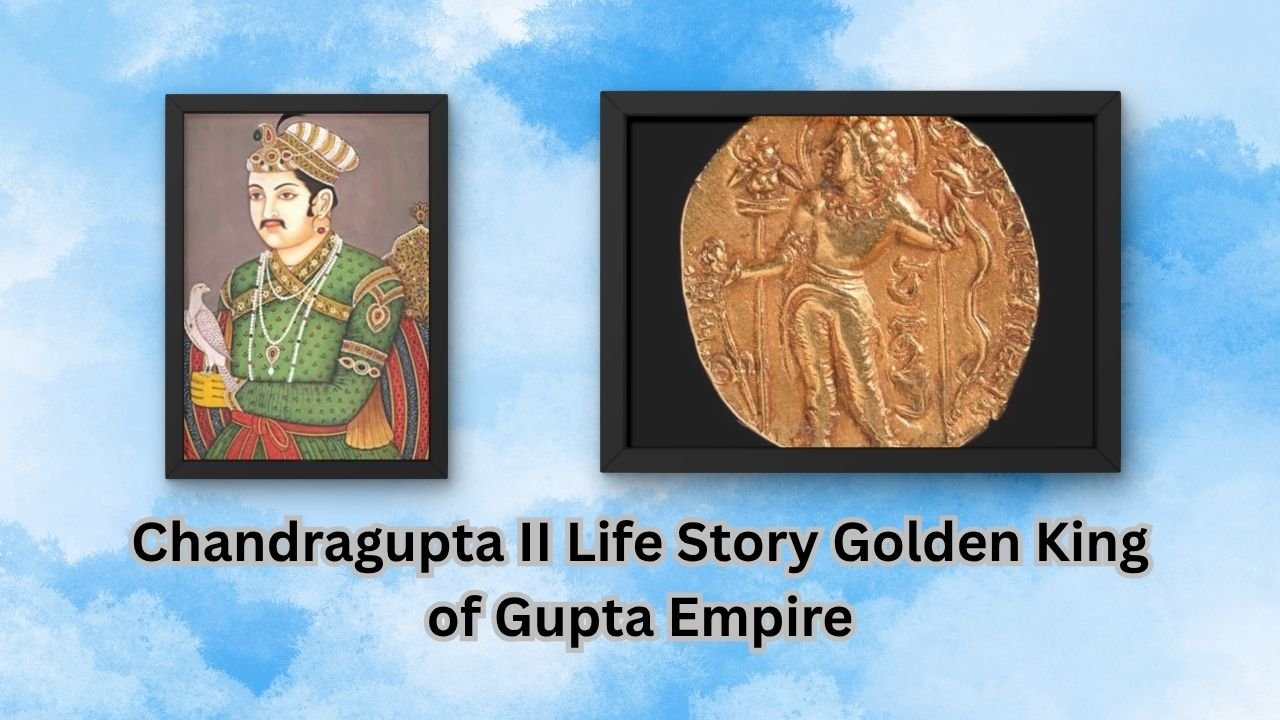
Chandragupta II Life Story Golden King of Gupta Empire Chandragupta II stands among the greatest rulers of ancient India. Celebrated as Vikramaditya, a title reserved for the bravest and wisest kings, he ascended the throne around 380 CE and guided the Gupta Empire to an era of peace, prosperity, and cultural brilliance. His reign is now remembered as the Golden Age of India, a beacon of progress and splendor.
Early Life of Chandragupta II (c. 375 CE)
Born around 375 CE in the Gupta Empire, Chandragupta II grew up in a royal household that instilled leadership and discipline in him from an early age.
Watching his father rule a powerful empire, he found inspiration to become a strong king himself.
Parents
- Father: Samudragupta, a great conqueror known as the “Napoleon of India.”
- Mother: Dattadevi
Thanks to his father’s success, Chandragupta II inherited an empire that was both strong and stable.
Education and Trainings
Chandragupta II received a complete royal education:
- Learned politics, administration, and diplomacy
- Studied Hindu scriptures and philosophy
- Trained in warfare like archery, sword fighting, and horse riding
- Gained knowledge in governance and law
Because of this education, he grew into a wise and capable ruler.
Language
During his rule, Sanskrit was the main language of administration and culture.
He supported the growth of Sanskrit literature, poetry, and learning.
Marriage and Children
By marrying strategically, Chandragupta II secured strong alliances.
- His chief queen was Dhruvadevi.
- To strengthen political ties, he arranged for his daughter Prabhavatigupta to marry a Vakataka ruler.
His important children:
- Kumaragupta I his successor
- Other royal family members who helped in governance
Rise to Power (c. 380 CE)
Chandragupta II became king around 380 CE upon his father’s death.
According to some historical sources, he may have replaced his elder brother to ascend the throne. Proving his strength and intelligence, he quickly established himself after becoming king.
Battles and Military Strength (c. 380–410 CE)
Chandragupta II was a skilled warrior. His most famous battles were against the Western Kshatrapas.
Major Battles:
- Defeated the Western Kshatrapas around 395–400 CE
- Captured regions like Gujarat, Malwa, and Saurashtra
- Strengthened control over trade routes
As a result of these victories, his empire became larger and wealthier.
Expansion of the Gupta Empire (c. 380–415 CE)
Under Chandragupta II’s visionary rule, the Gupta Empire reached a zenith of glory.
- Expanded across northern and western India
- Controlled important ports for trade
- Built strong relations with other kingdoms
Through his expansion, the empire gained both wealth and influence.
Administration and Governance
Chandragupta II earned a reputation for wise and just governance, guiding his people with a steady hand.
- Maintained law and order
- Collected fair taxes
- Encouraged trade and business
- Built roads and supported infrastructure
Under his administration, society remained peaceful and stable.
Religion and Culture
Chandragupta II followed Hinduism, especially devotion to Lord Vishnu.
He supported:
- Religious tolerance
- Temple construction
- Art, music, and literature
During his reign, culture reached new heights of development.
The Nine Gems (Navaratnas)
His court glittered with the brilliance of the Nine Gems scholars, poets, and thinkers whose wisdom illuminated the kingdom.
Important members include:
- Kalidasa – one of the greatest poets in Sanskrit literature
- Varahamihira – famous scientist and astrologer
Through their work, these scholars advanced literature, science, and overall knowledge.
Achievements of Chandragupta II
Chandragupta II achieved great success in many fields:
- Expanded the empire to its greatest size
- Defeated powerful enemies
- Promoted education, art, and science
- Strengthened trade with foreign regions
- Created peace and prosperity
History remembers his rule as a golden period for India.
Visit of Fa-Hien (c. 405 CE)
During Chandragupta II’s illustrious reign, the Chinese traveler Faxian embarked on a journey across India.
He described India as:
- Peaceful and safe
- Economically strong
- Rich in culture and religion
His writings provide valuable insights into that time. Chandragupta II Life Story Golden King of Gupta Empire
Chandragupta II died around 415 CE, marking the end of an influential period.
- Death Place: Believed to be in the Gupta Empire (exact location unknown)
- Age: Around 40–45 years
After his death, his son Kumaragupta I became emperor. Chandragupta II Life Story Golden King of Gupta Empire
Legacy
Chandragupta II left a strong legacy:
- One of the greatest rulers of India
- Creator of the Golden Age of the Gupta Empire
- Supporter of art, culture, and science
- A model of good governance
For many years, his achievements influenced Indian history.
Conclusion
The story of Chandragupta II’s life highlights how a wise and powerful ruler can guide a nation to peace and prosperity. From his early days to his impressive achievements, he remains among the most respected kings in Indian history.
FAQS
1) Who was Chandragupta II?
Chandragupta II was a Gupta emperor who ruled from around 380 CE to 415 CE and was known as Vikramaditya.
2) Why is Chandragupta II called Vikramaditya?
He was given this title because of his bravery, wisdom, and successful rule.
3) What were the major achievements of Chandragupta II?
He expanded the empire, defeated enemies, promoted culture, and created peace and prosperity.
4) Who were the Navaratnas?
There were nine great scholars in his court, including Kalidasa and Varahamihira.
5) When did Chandragupta II die?
He died around 415 CE.
6) What did Fa-Hien say about his rule?
Fa-Hien described India as peaceful, rich, and well-governed during his time.
Read More: