Skandagupta Story Brave Gupta Emperor Skandagupta’s story stands as a defining moment in Indian history. He was one of the strongest rulers of the Gupta Empire and is best known for defending India against foreign invasions, especially the Huns. His reign (c. 455–467 CE) came at a time when the empire was facing serious threats.
Early Life of Skandagupta (c. 415–455 CE)
Skandagupta was born around 415 CE into the royal Gupta family. He was the son of the famous emperor Kumaragupta I. His early life was spent in a politically and culturally vibrant environment.
From a young age, he was trained in:
- Warfare and military strategy
- Administration and leadership
- Religious and cultural values
Although detailed records of his childhood are limited, inscriptions suggest that he was brave, intelligent, and disciplined. Skandagupta Story Brave Gupta Emperor
Parents of Skandagupta
- Father: Kumaragupta I (ruled c. 415–455 CE)
- Mother: Not clearly mentioned in historical records
Kumaragupta was a powerful ruler who maintained the Gupta Empire’s strength. Skandagupta inherited his father’s leadership qualities and sense of duty.
Education of Skandagupta
As a prince, Skandagupta received a royal education that included:
- Study of politics and governance
- Military training (weapons, war tactics)
- Knowledge of religion and scriptures
- Learning classical languages
This well-rounded education shaped Skandagupta into both a skilled warrior and an effective ruler, preparing him for the challenges he would later face as emperor.
Marriage and Children
There is very little historical information available about Skandagupta’s marriage or children. Unlike some other Gupta rulers, inscriptions do not clearly mention his queen or heirs.
This lack of clear succession may have contributed to internal conflicts after his death. Skandagupta Story Brave Gupta Emperor
Language and Communication
During Skandagupta’s time, Sanskrit was the primary language of administration, inscriptions, and literature.
- Royal orders were issued in Sanskrit.
- Scholars and poets used Sanskrit for writing.
- It was a symbol of culture and knowledge.
By upholding Sanskrit as the chief language, Skandagupta continued this tradition, reinforcing his empire’s cultural identity.
Rise to Power (c. 455 CE)
Skandagupta became emperor around 455 CE following his father’s death. His rise to power was not simple.
Key Points:
- There may have been internal conflicts for the throne.
- He proved his strength through military success.
- He quickly established control over the empire.
His decisive early victories not only secured his position but also won him widespread respect and authority within the empire. Skandagupta Story Brave Gupta Emperor
Battles of Skandagupta
Skandagupta forged a legacy as a fearless general and indomitable warrior.y.
Important Battles:
- Internal conflicts after succession (c. 455 CE)
- Wars against invading tribes
- Major battles against the Huns (c. 460 CE)
It was this strong leadership in times of conflict that secured Skandagupta’s place among the greatest Gupta rulers. Skandagupta Story Brave Gupta Emperor
Skandagupta and the Hun Invasion (c. 460 CE)
One of the most thrilling chapters in Skandagupta’s saga is his decisive triumph over the formidable Huns.s.
Who were the Huns?
The Hun thundered in from Central Asia, feared as merciless warriors who swept across lands, threatening India during the 5th century C.E.
Skandagupta’s Role:
- He fought and defeated the Huns around 460 CE.
- He stopped their expansion into India.
- He protected the Gupta Empire from destruction.
This victory is recorded in inscriptions like the Junagadh inscription.
Administration and Governance
Skandagupta was not only a warrior on the field but also a masterful steward of the empire.r.
Features of His Governance:
- Strong central authority
- Efficient tax system
- Maintenance of law and order
- Appointment of governors in provinces
Despite ongoing external threats, Skandagupta made sure the empire remained stable.
Economic Strength and Coins
During Skandagupta’s early rule, the economy displayed significant strength.
Economic Highlights:
- Trade and agriculture were supported.
- Irrigation systems were maintained.
- Important public works were repaired.
Coins:
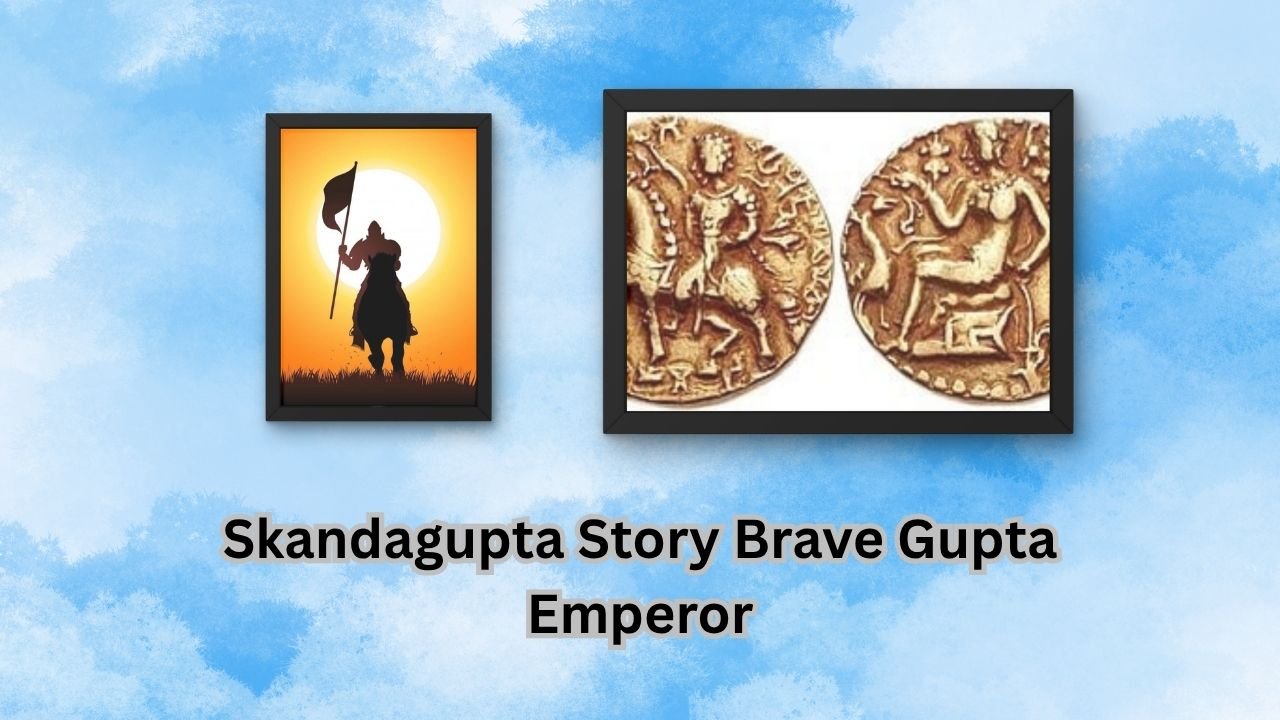
- Issued gold and silver coins
- Coins showed royal symbols and strength.
- Later coins had reduced gold content due to war expenses.
In later years, continuous wars placed economic pressure on the empire.
Religion and Culture
Skandagupta was a Hindu and a devotee of Lord Vishnu.
Cultural Contributions:
- Support for temples and religious practices
- Respect for scholars and traditions
- Continuation of Gupta cultural excellence
Often called the Golden Age of India, the Gupta period owed much to Skandagupta, whose actions preserved the era’s brilliance.
Challenges During His Reign
Skandagupta faced many serious challenges:
Major Problems:
- Repeated invasions by the Huns
- Internal conflicts in the empire
- Economic decline due to military expenses
Over time, these mounting pressures steadily weakened the once-mighty empire.
Death of Skandagupta (c. 467 CE)
Skandagupta died around 467 CE after ruling for about 12 years.
- Death Year: c. 467 CE
- Death Place: Not clearly known
- Age: Approximately 50 years
Following his death, weak successors led the Gupta Empire into decline.
Achievements of Skandagupta
Skandagupta made many important contributions:
- Defeated the Huns and protected India
- Maintained the unity of the Gupta Empire
- Strengthened administration
- Supported religion and culture
- Continued the legacy of his father
For these reasons, Skandagupta is often remembered as the last great ruler of the Gupta dynasty.
Legacy of Skandagupta
Bravery and responsibility define Skandagupta’s enduring legacy.
- He delayed the fall of the Gupta Empire.
- He protected Indian civilization from foreign invasion.
- He is remembered as a strong and courageous ruler.
His life serves as a lasting reminder of the importance of strong leadership in times of difficulty.s.
Conclusion
The legacy of Skandagupta (c. 455–467 CE)stands as a shining testament to courage, visionary leadership, and unwavering dedication. mid crises that threatened the very heart of the Gupta Empire, he stood firm, rallying all his strength to safeguard its legacy.n.
Even though the empire declined after his death, his contributions remain unforgettable. Skandagupta remains an inspiring figure in Indian history.
FAQs About Skandagupta
-
Who was Skandagupta?
Skandagupta was a Gupta emperor who ruled from around 455 to 467 CE.
-
Who were his parents?
His father was Kumaragupta I. His mother’s name is not clearly known.
-
Why is Skandagupta famous?
He is famous for defeating the Huns and protecting India.
-
When did Skandagupta rule?
He ruled from approximately 455 CE to 467 CE.
-
What language was used during his time?
Sanskrit was the main language for administration and culture.
-
When did Skandagupta die?
He died around 467 CE.
-
What are his main achievements?
His achievements include military victories, strong governance, and the protection of Indian culture.
Read More