Kumaragupta II Life Story was one of the later rulers of the Gupta Empire in ancient India. He ruled during the 5th century CE, when the Gupta Empire was slowly weakening after its golden age. Even though his reign was short, Kumaragupta II played an important role in continuing the Gupta dynasty during difficult times.
This empire is celebrated for its achievements in art, culture, education, science, and religion. In this prestigious lineage, Kumaragupta II sought to uphold the family’s legacy while guiding the empire through turbulent times.
Early Life of Kumaragupta II
Kumaragupta II was born during the mid-5th century CE into the royal Gupta family. Historians believe he was the son of Purugupta, a later Gupta ruler.
As a young prince, Kumaragupta II grew up in a royal environment where he learned about leadership, administration, religion, and military skills. During his childhood, the Gupta Empire was already facing political troubles and foreign invasions. These challenges helped shape his understanding of how to rule an empire.
Parents of Kumaragupta II
Most historians agree that Kumaragupta II’s father was Purugupta, while his mother’s identity remains uncertain.
Within this respected lineage, Kumaragupta II not only inherited royal traditions but also the responsibilities crucial to maintaining the empire during difficult times, a commitment that influenced his later rule.
Education of Kumaragupta II
As with other princes of his era, Kumaragupta II received a high standard of education. This preparation played an important role as he faced the mounting pressures on the Gupta Empire.
He likely studied:
- Sanskrit language
- Hindu scriptures
- Political science
- Warfare and military training
- Diplomacy
- Economics and administration
The Gupta rulers supported famous educational centers such as Nalanda University. Kumaragupta II probably learned from experienced scholars and teachers. Kumaragupta II Life Story
Marriage of Kumaragupta II
There is very little historical information available about the marriage of Kumaragupta II. Historians believe he may have married into another royal family to strengthen political ties, a common practice among ancient Indian kings.
However, historical sources do not clearly identify his wife or queens by name.
Children of Kumaragupta II
Historical records about Kumaragupta II’s children are limited. Some historians believe he may have had sons who were connected to the later Gupta royal line, but there is no confirmed evidence available.
Because historical records from the late Gupta period are scarce, many details about Kumaragupta II’s family remain uncertain. This lack of information underscores the challenge of reconstructing his life, as seen throughout subsequent sections.
Rise to Power
Kumaragupta II ascended the throne around 473 CE, following Purugupta. This transition marked a period when the empire’s previous strength, seen under rulers like Samudragupta and Chandragupta II, had diminished.
His rise to power happened during a difficult political situation because:
- The Huns were attacking India.
- Regional rulers were becoming independent.
- The economy was weakening.
- Internal conflicts existed in the royal family.
Despite these considerable obstacles, Kumaragupta II accepted the role of emperor. He worked to maintain order, setting the stage for subsequent developments in governance and policy. Kumaragupta II Life Story
Kumaragupta II and the Gupta Empire
The Gupta Empire had once been one of the strongest empires in India. Earlier rulers such as:
- Samudragupta
- Chandragupta II
- Kumaragupta I
expanded the empire and increased its power.
However, during the reign of Kumaragupta II, the empire began to decline. Foreign invasions and local rebellions weakened Gupta authority. Even then, Kumaragupta II tried to preserve the remaining territories and continue the Gupta administration.
Administration and Governance. Maintaining tradition, Kumaragupta II administered the empire using the established Gupta system, which divided the empire into provinces, districts, and villages.
His administration focused on:
- Tax collection
- Maintaining law and order
- Managing agriculture and land
- Encouraging trade
- Supporting religious institutions
Local governors and officers helped the king manage the empire’s various regions.
Even during its decline, the Gupta administration remained more organized than many other kingdoms of the time.
Religion and Cult: While the Gupta rulers mainly practiced Hinduism, they also respected Buddhism and Jainism.
During Kumaragupta II’s reign:
- Hindu temples continued to be built.
- Sanskrit literature remained important.
- Art and sculpture developed.
- Religious tolerance continued
This era is often labeled India’s “Golden Age,” highlighting the cultural achievements and continuity evident even in the time of Kumaragupta II. The influence is further evidenced in other key historical artifacts, such as coins.
Coins of Kumaragupta II
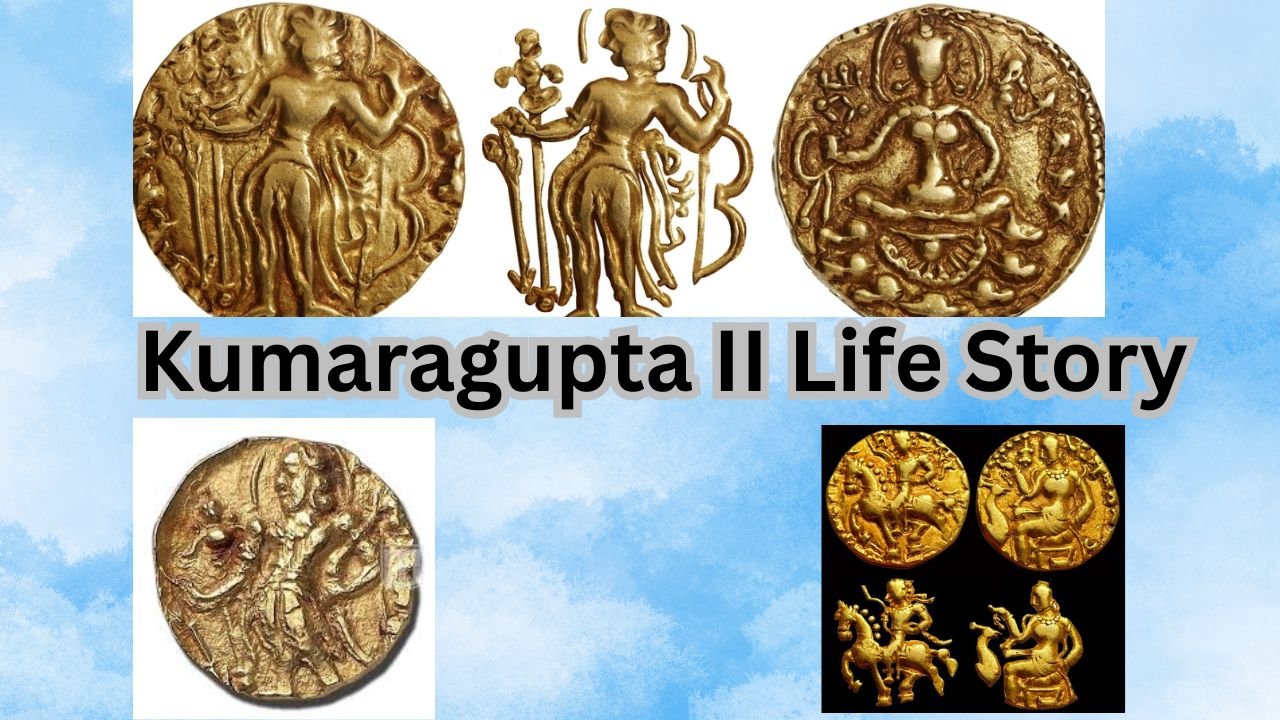
Coins are among the main historical sources for Kumaragupta II. Several coins with his name and royal symbols have been discovered.
These coins include:
- Gupta royal images
- Sanskrit inscriptions
- Hindu religious symbols
The discovery of these coins not only supports the historical timeline of Kumaragupta II’s reign but also sets the stage for examining the challenges he faced.
Challenges During His Reign. Many challenges confronted Kumaragupta II throughout his reign.
Through their incursions, the Huna weakened the Gupta Empire significantly in northwestern India.
Internal Family Conflict. Power struggles among different Gupta family members led to instability throughout the empire.
Economic Problems Trade dwindled, and the empire’s economy suffered due to wars and invasions.
Loss of Territories
Several regions became independent and ceased to follow Gupta authority.
Altogether, these problems tested Kumaragupta II’s leadership skills and highlighted the complexities of his reign, as reflected in the military strategies and efforts he undertook.
Military Efforts
Although detailed military records are unavailable, Kumaragupta II likely worked hard to defend the empire against invasions and rebellions.
The Gupta army included:
- Infantry soldiers
- Cavalry forces
- War elephants
- Skilled archers
This decrease in military might contrasted sharply with the strength of earlier Gupta rulers, foreshadowing the challenges in Kumaragupta II’s final years and the circumstances surrounding his death.
Historians believe Kumaragupta II died around 476 CE.
Death Place
The exact place of Kumaragupta II’s death is not known with certainty because historical records from the later Gupta period are limited.
Age at Death
His exact age at death is also unknown. Historians estimate that he may have died in middle age.
After his death, the task of leading the weakened Gupta Empire fell to his successors, marking the start of a new phase in the dynasty, a phase that is explored in evaluating his achievements and legacy.
Achievements of Kumaragupta II
Despite a short reign, Kumaragupta II achieved significant milestones: continuing the dynasty, maintaining the administration, preserving parts of the empire, supporting culture and religion, and issuing coins.:
- Continued the Gupta dynasty
- Maintained administration during difficult times
- Preserved parts of the empire
- Supported the Gupta culture and religion
- Issued royal coins
Through these efforts, Kumaragupta II helped preserve the Gupta Empire during trying times and left a mark that historians continue to study to understand his importance in Indian history.
Importance in Indian History Kumaragupta II stands out in Indian history for ruling during the Gupta Empire’s transition. Kumaragupta II Life Story
His reign helps historians understand:
- The decline of great empires
- Political struggles in ancient India
- The impact of foreign invasions
- The later Gupta period
While Kumaragupta II may not be as renowned as earlier emperors, his contributions offer key insights into the later Gupta period and prepare readers to appreciate his enduring relevance, summarized below.
Conclusion
Kumaragupta II ruled during one of the most difficult periods of the Gupta Empire. Even as the empire weakened, he tried to maintain stability and uphold the traditions of the Gupta dynasty.
The life of Kumaragupta II offers a window into the challenges faced by rulers during periods of upheaval and external threats. These insights are further reflected in questions often asked about his reign.
FAQs About Kumaragupta II
1) Who was Kumaragupta II?
Kumaragupta II was a later ruler of the Gupta Empire during the 5th century CE.
2) When did Kumaragupta II rule?
He is believed to have ruled from around 473 CE to 476 CE.
3) Who were the parents of Kumaragupta II?
Most historians believe his father was Purugupta. Information about his mother is not clearly available.
4) What religion did Kumaragupta II follow?
He mainly followed Hinduism, like most Gupta rulers.
5) Why is Kumaragupta II important?
He helped continue the Gupta dynasty during a period of political decline and foreign invasions.
6) What were the main challenges during his reign?
The empire faced Huna invasions, economic decline, internal conflicts, and territorial losses.
7) Are coins of Kumaragupta II available?
Yes, historians have discovered coins of Kumaragupta II that provide valuable historical information.
Read More: