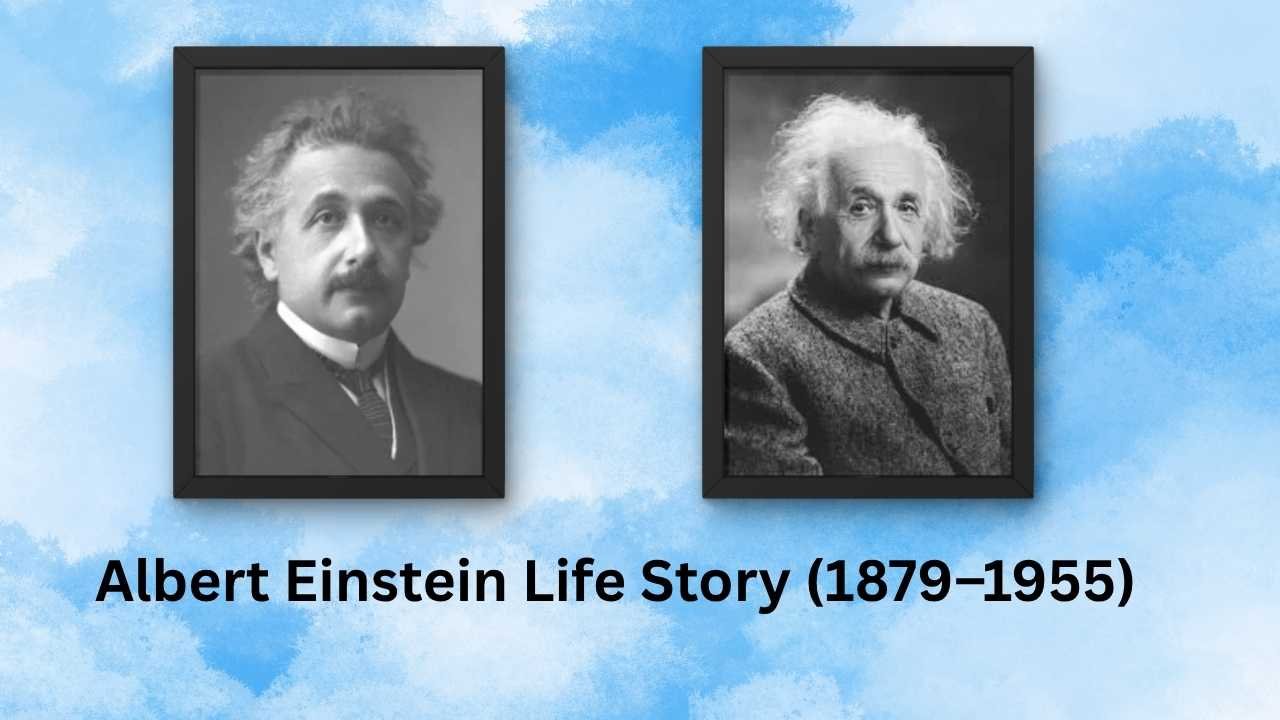
Albert Einstein Life Story (1879–1955) Considered one of history’s greatest scientists, Albert Einstein developed the Theory of Relativity, changing the way people understand space, time, and energy. His groundbreaking discoveries helped shape the course of modern science and technology.
Early Life of Albert Einstein (1879–1894)
Albert Einstein was born on March 14, 1879, in Ulm, Germany. His father, Hermann Einstein, was an engineer and businessman, and his mother, Pauline Einstein, was a homemaker.
Quiet and curious, Albert enjoyed solving puzzles and exploring science and mathematics as a child. Although he spoke later than his peers, he later excelled academically.
Education of Albert Einstein (1895–1900)
In 1895, Einstein moved to Switzerland to continue his education. He attended the Swiss Federal Polytechnic School in Zurich.
Graduating in 1900 with a diploma in mathematics and physics, Einstein initially struggled to secure a teaching job, working in various positions before finding stable employment.
Albert Einstein’s Early Career (1902–1904)
In 1902, Einstein started working at the Swiss Patent Office in Bern, Switzerland. While working there, he continued studying scientific problems during his free time.
The job allowed Einstein to spend considerable time reflecting deeply on physics and developing fresh ideas.
The Miracle Year (1905)
The year 1905 is known as Einstein’s “Miracle Year.”
During this year, he published four important scientific papers:
- Photoelectric Effect
- Brownian Motion
- Special Theory of Relativity
- Mass-Energy Equation (E = mc²)
Thanks to these groundbreaking discoveries, Einstein quickly gained fame throughout the scientific community. Albert Einstein Life Story (1879–1955)
Einstein’s Rise to Fame (1909–1915)
In 1909, Einstein became a university professor.
In 1915, he completed the General Theory of Relativity, which explained gravity in a new way. This theory became one of the most important achievements in modern physics.
Praised by scientists worldwide, his work inspired and impressed the academic community.
Nobel Prize Winner (1921)
In 1921, Albert Einstein received the Nobel Prize in Physics for his work on the photoelectric effect.
Receiving this award established him as one of the world’s most respected scientists.
Travels and Global Recognition (1920s–1930s)
During the 1920s, Einstein traveled to many countries, giving lectures and sharing his scientific ideas.
Becoming a symbol of intelligence and progress, Einstein’s work and opinions were often featured in newspapers worldwide.
Moving to the United States (1933)
When Adolf Hitler came to power in 1933, Einstein, who was Jewish, left Germany for the United States.
At Princeton University in New Jersey, he continued his scientific research after relocating to the United States.
Einstein and World War II (1939)
In 1939, Einstein signed a letter that warned the United States government about Germany’s potential for developing atomic weapons.
This letter helped encourage research that later became the Manhattan Project.
Despite contributing to scientific knowledge, Einstein ultimately supported peace and opposed nuclear weapons. Albert Einstein Life Story (1879–1955)
Personal Life
Albert Einstein married Mileva Marić in 1903. They had three children.
The couple divorced in 1919.
Later that year, Einstein married his cousin Elsa, who remained with him until her death in 1936.
Major Achievements of Albert Einstein
Some of Einstein’s greatest achievements include:
- Theory of Relativity
- General Relativity
- Special Relativity
- E = mc² Equation
- Research on the Photoelectric Effect
- Nobel Prize in Physics (1921)
- Contributions to Quantum Theory
- Advancement of Modern Physics
Albert Einstein’s Death (1955)
Albert Einstein died on April 18, 1955, in Princeton, New Jersey, United States.
He was 76 years old at the time of his death.
Even after his passing, Einstein’s scientific ideas have continued to influence physics, astronomy, engineering, and technology. Einstein’s legacy reminds us that the pursuit of knowledge can shape the future and inspire all who follow.
Albert Einstein Timeline
| Year | Event |
| 1879 | Born in Ulm, Germany |
| 1895 | Moved to Switzerland for education |
| 1900 | Graduated in Physics and Mathematics |
| 1902 | Joined the Swiss Patent Office |
| 1905 | Published four revolutionary scientific papers |
| 1915 | Completed General Theory of Relativity |
| 1921 | Won the Nobel Prize in Physics |
| 1933 | Moved to the United States |
| 1939 | Warned about atomic weapon research |
| 1955 | Died in Princeton, New Jersey |
Conclusion
Albert Einstein was one of the most brilliant minds in human history. From his birth in 1879 to his death in 1955, he transformed the world of science with groundbreaking discoveries. His theories and inventions continue to inspire students, scientists, and thinkers worldwide. Einstein’s life story teaches us the extraordinary power of curiosity, resilience, and daring to dream reminding us that with determination, anyone can make a difference in the world.
FAQs About Albert Einstein’s Life Story
1) When was Albert Einstein born?
Albert Einstein was born on March 14, 1879.
2) What is Albert Einstein famous for?
He is famous for the Theory of Relativity and the equation E = mc².
3) When did Albert Einstein win the Nobel Prize?
He won the Nobel Prize in Physics in 1921.
4) Where did Albert Einstein die?
He died in Princeton, New Jersey, United States.
5) How old was Albert Einstein when he died?
He was 76 years old.
Read More: