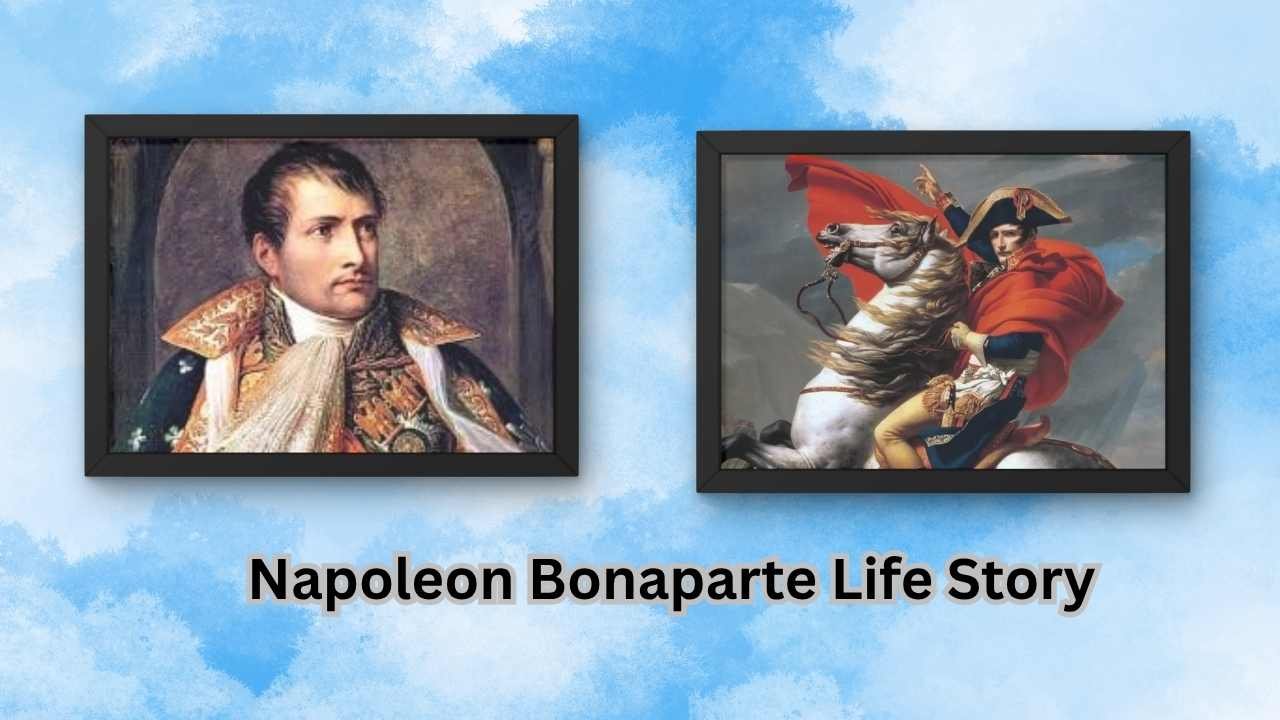
Napoleon Bonaparte Life Story was one of the greatest military leaders in world history. He became Emperor of France and changed the course of European history through his wars, leadership, and reforms. Napoleon was famous for his intelligence, bravery, and strong ambition. His life story is full of victories, struggles, and dramatic events.
Early Life of Napoleon Bonaparte (1769)
Napoleon Bonaparte was born on 15 August 1769 in Ajaccio, Corsica, an island off the coast of Italy that later became part of France. His father’s name was Carlo Bonaparte, and his mother’s name was Letizia Ramolino. Napoleon came from a middle-class family.
From an early age, Napoleon displayed sharp intellect and seriousness. He devoured books on history and warfare. At just 9, he traveled to France to pursue his studies.
Education of Napoleon
Napoleon studied at military schools in France. He learned mathematics, science, geography, and military strategy. In 1785, he completed his studies and was promoted to second lieutenant in the French army.
Even as a student, Napoleon exhibited discipline and clear leadership traits.
French Revolution and Rise to Power (1789–1799)
The French Revolution started in 1789. During this period, Napoleon supported the revolution and quickly rose to prominence in the army.
Important Events During His Rise
- 1793 – Napoleon enabled French forces to seize Toulon.
- 1795 – He quashed a royalist insurrection in Paris.
- 1796 – Napoleon was appointed commander of French forces in Italy.
- 1798 – He launched a military expedition to Egypt.
Napoleon’s triumphs elevated him to national hero status in France.
Marriage of Napoleon (1796)
In 1796, Napoleon married Josephine de Beauharnais, a charismatic widow who captured his heart and became his trusted companion. Their relationship was filled with passion and trials, but as fate would have it, the couple had no children together, leading Napoleon to a difficult decision to divorce her in 1810.
He later wed Marie Louise of Austria, and they had a son, Napoleon II.
Napoleon Becomes Emperor of France (1804)
In 1804, at Notre-Dame Cathedral in Paris, Napoleon crowned himself Emperor of France, marking a momentous chapter in European history.
This event made him one of the most powerful rulers in Europe.
Reforms Introduced by Napoleon
Napoleon introduced many important reforms:
- Created the Napoleonic Code
- Improved education system
- Built better roads and banks
- Reformed administration and law
The Napoleonic Code influenced legal systems in many countries.
Napoleon’s Military Campaigns (1805–1812)
Napoleon won many famous battles and expanded the French Empire.
Major Victories
Battle of Austerlitz (1805)
At the Battle of Austerlitz in 1805, Napoleon defeated Russia and Austria in one of his most outstanding victories.
Battle of Jena (1806)
French forces decisively defeated Prussia.
Battle of Wagram (1809)
Napoleon once more subdued Austrian forces.
At his peak, Napoleon controlled much of Europe.
Napoleon’s Invasion of Russia (1812)
In 1812, with his empire at its height, Napoleon set out on an audacious invasion of Russia, marching over 600,000 soldiers into the heart of winter and uncertainty.
Yet the severe Russian winter, famine, and scarce supplies decimated his army. This debacle became one of his greatest failures. Napoleon Bonaparte Life Story
Fall of Napoleon (1814)
Following the Russian calamity, multiple European powers united against Napoleon.
In 1814, he was defeated and exiled to the island of Elba.
The Hundred Days and Waterloo (1815)
In 1815, Napoleon escaped from Elba and returned to France, beginning the brief period known as the Hundred Days.
However, he was finally defeated at the Battle of Waterloo in 1815 by British and allied forces led by the Duke of Wellington.
After this defeat, Napoleon was exiled to the remote island of Saint Helena.
Death of Napoleon Bonaparte (1821)
Napoleon Bonaparte died on 5 May 1821 on the island of Saint Helena.
- Age at Death: 51 years
- Death Place: Saint Helena Island
- Cause of Death: Believed to be stomach cancer
With his death, history marked the end of one of its most powerful rulers.
Achievements of Napoleon Bonaparte
Important Achievements
- Became Emperor of France
- Won many famous battles
- Introduced the Napoleonic Code
- Improved French education and administration
- Spread revolutionary ideas across Europe.
Napoleon is remembered as a brilliant military leader and powerful ruler.
Leadership and Personality
Napoleon was known for:
- Strong leadership
- Quick decision-making
- Military intelligence
- Confidence and ambition
He motivated his troops and earned respect from both supporters and adversaries.
Legacy of Napoleon Bonaparte
Many historians consider him one of the greatest military commanders.
Books, movies, and documentaries continue to tell the story of his remarkable life. Napoleon Bonaparte Life Story
Conclusion
Napoleon Bonaparte’s life is a tale of immense ambition, authority, conquest, and fall. Rising from a Corsican boy to Emperor of France, he reshaped Europe’s history. His strategic genius and reforms secured his place among the world’s most iconic leaders.
FAQs About Napoleon Bonaparte
1) When was Napoleon Bonaparte born?
Napoleon Bonaparte was born on 15 August 1769 in Ajaccio, Corsica.
2) Who were Napoleon Bonaparte’s parents?
His father was Carlo Bonaparte, and his mother was Letizia Ramolino.
3) Why is Napoleon Bonaparte famous?
Napoleon is famous for being a great military leader, Emperor of France, and creator of the Napoleonic Code.
4) When did Napoleon become Emperor of France?
Napoleon became the Emperor of France in 1804.
5) What was Napoleon’s greatest victory?
The Battle of Austerlitz (1805) is considered one of Napoleon’s greatest victories.
6) Why did Napoleon invade Russia?
Napoleon invaded Russia in 1812 to expand his control and weaken Russia’s power.
7) What happened at the Battle of Waterloo?
In 1815, Napoleon was defeated by allied European forces at the Battle of Waterloo, ending his rule.
8) Who defeated Napoleon at Waterloo?
Napoleon was defeated by forces led by the Duke of Wellington and Prussian allies.
9) Where did Napoleon die?
Napoleon died on the island of Saint Helena.
10) When did Napoleon Bonaparte die?
Napoleon died on 5 May 1821 at the age of 51.
11) What is the Napoleonic Code?
The Napoleonic Code was a legal system introduced by Napoleon that influenced laws in many countries.
12) Who was Napoleon’s wife?
Napoleon first married Josephine de Beauharnais and later married Marie Louise of Austria.
13) Did Napoleon have children?
Yes, Napoleon had a son named Napoleon II.
14) What language did Napoleon speak?
Napoleon mainly spoke French, but he also knew Italian because he was born in Corsica.
15) What is Napoleon Bonaparte’s legacy?
Napoleon’s legacy includes military strategy, legal reforms, educational improvements, and political influence across Europe.
Read More :