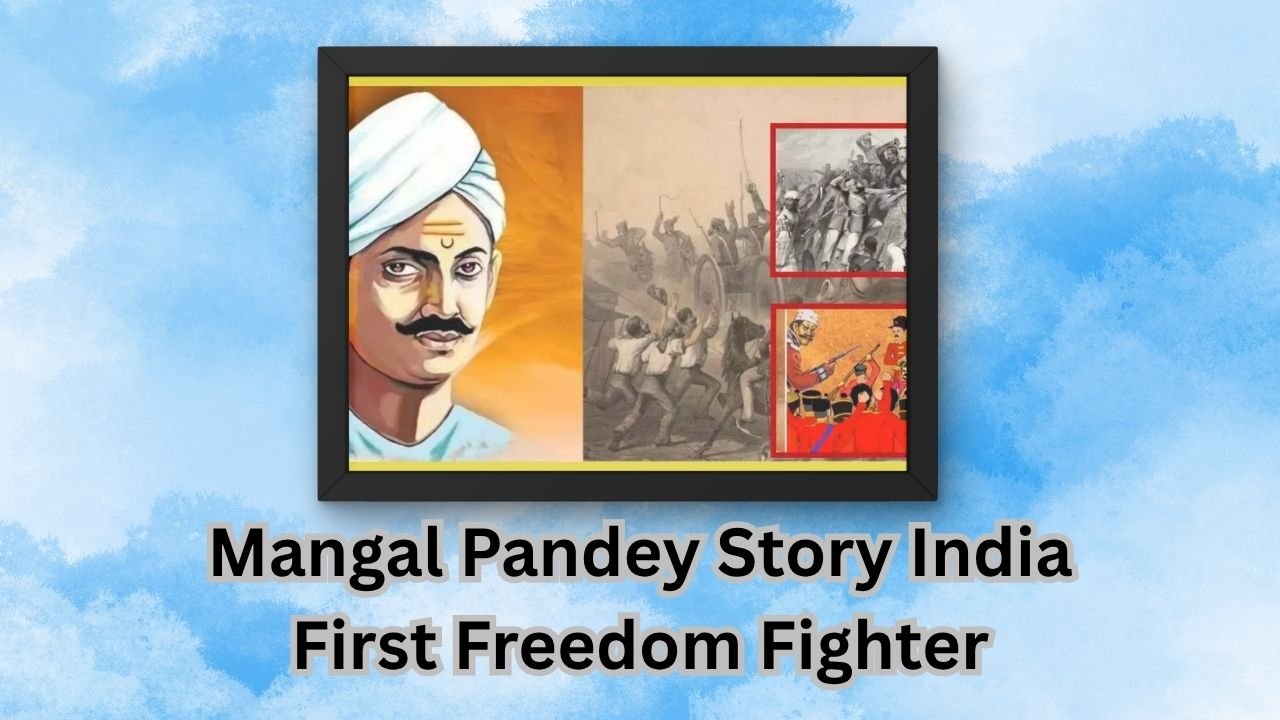
Mangal Pandey Story India First Freedom Fighter was one of the first heroes who ignited the flame of India’s freedom struggle. He is best remembered for his fearless role in the 1857 revolt, which became a symbol of defiance against British rule. His life from 1827 to 1857 tells a story of unwavering courage, heartfelt sacrifice, and a passionate devotion to his faith and sense of justice.
Mangal Pandey Early Life (1827–1840)
Mangal Pandey was born on 19 July 1827 in Nagwa village, Ballia district, Uttar Pradesh, India. He was born into a Brahmin family that followed traditional Hindu customs.
During these years, Mangal Pandey embraced the warmth and simplicity of village life, absorbing discipline, respect, and deep religious values. This nurturing atmosphere gave him a resilient spirit and a deep-seated fearlessness from a very young age.
Parents and Family Background (1827–1849)
Mangal Pandey father is believed to have been Divakar Pandey, a respected figure in their village. Very little is known about his mother; she is believed to have been caring and religious. There are no reliable records about possible siblings, and most details about his family background remain limited.
Between 1827 and 1849, his parents played a vital role in molding his character. They instilled in him values such as honesty, courage, and reverence for religion qualities that would later motivate his stand against British rule.
Siblings Information
No confirmed historical record describes whether Mangal Pandey had siblings. Some accounts suggest the possibility of brothers or sisters, but no names or detailed information are available. Existing historical sources focus on his military and freedom-fighting role rather than personal family details. Mangal Pandey Story India First Freedom Fighter
Education (1830–1845)
Mangal Pandey did not receive the modern formal education we have today. From 1830 to 1845, he likely received a traditional education in his village.
He likely learned the basics of reading, writing, and religious texts. Rather than focusing on advanced subjects, his studies emphasized values, discipline, and cultural wisdom quite unlike the modern education system. Mangal Pandey Story India First Freedom Fighter
Languages he probably knew:
- Hindi (or Bhojpuri, Awadhi dialect) is his mother tongue, spoken in his home region (Ballia, Uttar Pradesh).
- Sanskrit (basic knowledge) As a Brahmin, he may have learned some Sanskrit for religious purposes.
- English, while likely very limited, might have been picked up in the British East India Company army, just enough to understand a few commands.
Joining the British Army (1849)
In 1849, Mangal Pandey joined the army of the British East India Company as a sepoy in the 34th Bengal Native Infantry.
Joining as a sepoy marked a significant turning point for Pandey. Like many Indians searching for stable employment, he began with dedication and discipline. Unaware of what awaited him, his role in the army would soon take an unexpected turn.
Growing Anger Against British (1856–1857)
Between 1856 and early 1857, Indian soldiers’ anger at British policies grew steadily. The introduction of new Enfield rifle cartridges particularly ignited their discontent.
Supposedly greased with cow and pig fat, these cartridges offended the religious beliefs that both Hindu and Muslim soldiers cherished.
Mangal Pandey fiercely opposed this practice. His strong religious values and inner pride would not allow him to accept such disrespect. Burning with anger and wounded in spirit, his resentment against British rule only grew deeper during this time.
Revolt at Barrackpore (29 March 1857)
On 29 March 1857, at Barrackpore in Bengal, Mangal Pandey openly challenged British authority, sparking a revolt.
He attacked British officials and defiantly refused to obey their commands. This moment of blazing rebellion became one of the earliest sparks of the struggle. Mangal Pandey’s fearless courage inspired fellow soldiers to find their own voices of resistance. What started as a single act of bravery soon exploded into a sweeping rebellion that lit up the entire country.
Arrest and Trial (March–April 1857)
Following the Barrackpore incident, British officers quickly arrested Mangal Pandey. Put on trial for attacking his superiors, he faced swift punishment, as the British government hoped to stop the growing rebellion among soldiers.
Execution and Death (8 April 1857)
Mangal Pandey faced his death sentence with remarkable dignity, meeting his execution on 8 April 1857 with unfaltering bravery. His sacrifice sent waves of sorrow and fierce pride throughout the nation. Hanged at Barrackpore (now in West Bengal), his final stand transformed this place into hallowed ground the site where the nation’s first great uprising was set ablaze.
His execution burned his memory into the nation’s soul, turning him into a martyr whose name would echo in the hearts of freedom fighters for generations.
Legacy and Importance
Mangal Pandey’s life (1827–1857) is remembered as a symbol of courage and sacrifice. His role in the 1857 revolt made him one of the first freedom fighters of India.
Even though details about his family and education remain limited, his courageous actions left a major impact on Indian history.
Today, he is honored not only through statues and memorials, but truly lives on in the hearts of people who draw courage from his story. He continues to spark bravery in the face of injustice.
Conclusion
Mangal Pandey’s journey shows us that true courage can transform history. From his first steps in 1827 to his ultimate sacrifice in 1857, he remained steadfast to his deepest beliefs.
His parents, values, and experiences shaped him into a brave soldier who challenged British rule. The revolt he began at Barrackpore sparked India’s first war of independence.
Mangal Pandey will forever remain a true hero in the hearts of every Indian,
FAQS
1) Which soldier was hanged to death on 8 April 1857?
shining reminder that courage and sacrifice can shape a nation’s destiny. Hanged with honor on 8 April 1857, Mangal Pandey, the sepoy who stood against the tide, played an unforgettable role in starting the 1857 revolt against British rule in India.
2) Which British officer did Mangal Pandey attack?
On 29 March 1857 at Barrackpore, Mangal Pandey attacked Lieutenant Baugh and Sergeant-Major Hewson, British officers, marking one of the first acts of resistance in the 1857 revolt.
3) Was Pandey a hero or a rebel?
Mangal Pandey is seen as both a rebel and a hero. The British called him a rebel for opposing their rule, but Indians consider him a hero who bravely fought for freedom and inspired the 1857 uprising.
4) What is the caste of Mangal Pandey?
Born into a Brahmin family in Uttar Pradesh, Mangal Pandey came from a community renowned for religious duties and learning. His Brahmin upbringing influenced his discipline, beliefs, and his strong stand against actions that hurt religious sentiments.
Read More: