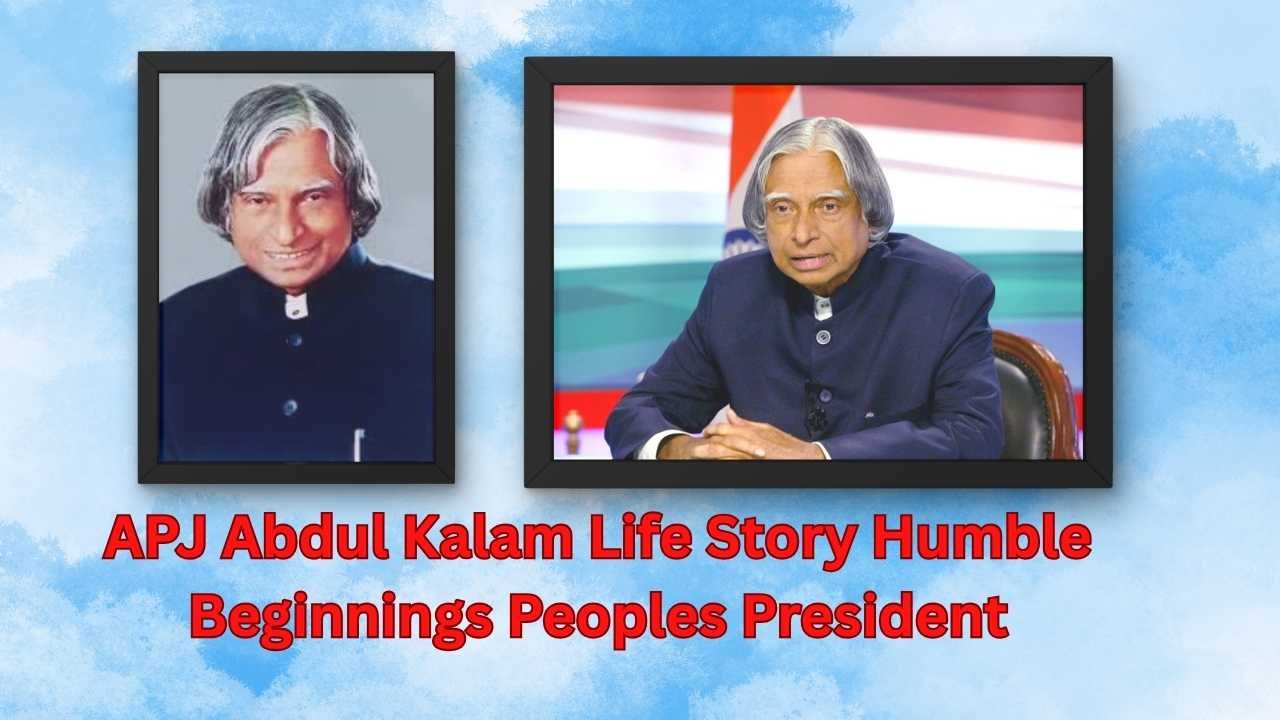
APJ Abdul Kalam Life Story Humble Beginnings Peoples President P. J. Abdul Kalam was one of India’s most respected scientists, educators, and leaders, known as the “Missile Man of India” and the “People’s President.” He dedicated his life to science, technology, education, and national development, rising from a poor family in a small town to become India’s President an inspiring modern success story.
Early Life (1931–1950)
Birth and Family Background
Avul Pakir Jainulabdeen Abdul Kalam was born on 15 October 1931 in the island town of Rameswaram, located in the state of Tamil Nadu.
Kalam’s father, Jainulabdeen, owned boats that ferried pilgrims between Rameswaram and neighboring locations. His mother, Ashiamma, was a supportive homemaker who managed the family despite financial difficulties.
The family was poor, and Kalam faced economic hardship from an early age. To help provide for his family, he sold newspapers after school. These challenges instilled discipline, diligence, and responsibility in him.
Childhood Influences
Kalam grew up in a diverse community where people of various faiths coexisted harmoniously. He absorbed values such as honesty, simplicity, and respect from his parents and teachers.
One of Kalam’s teachers encouraged him to dream big and pursue an interest in science, which greatly influenced his future career path.
Education (1950–1960)
School Education
Kalam completed his schooling in Rameswaram and later attended schools in nearby towns. He was an average student academically but showed great curiosity and dedication.
He loved mathematics and science and spent many hours studying and learning new concepts.
College Studies
After finishing school, he enrolled at St. Joseph’s College and earned a degree in Physics in 1954.
- He then joined the Madras Institute of Technology to study Aeronautical Engineering.
Studying engineering posed financial challenges, but support from relatives and scholarships enabled him to continue his education.
At MIT, Kalam developed an interest in aircraft design and aerospace engineering, which laid the foundation for his scientific career.
Early Career and Scientific Journey (1960–1980)
Joining DRDO
In 1960, after completing his engineering degree, Kalam joined the Defense Research and Development Organization (DRDO) as a scientist.
His initial projects involved designing small military aircraft and defense technologies. Although he gained valuable experience, he wanted to work on larger and more impactful scientific missions.
Moving to ISRO
A major turning point came in 1969 when Kalam joined the Indian Space Research Organization (ISRO).
At ISRO, he was Project Director for India’s first indigenous satellite launch vehicle program. APJ Abdul Kalam Life Story Humble Beginnings Peoples President
SLV-3 Success
One of his most significant achievements was leading the development of the:
- SLV-3
The first launch attempt in 1979 failed, which proved a challenging moment for Kalam and his team. However, he learned from the setback and persevered.
In July 1980, SLV-3 successfully launched the:
- Rohini Satellite
This triumph marked India’s entry into the ranks of nations capable of independently launching satellites.
Contributions to Science and Technology (1980–2000)
Missile Development Program
After his success in the space program, Kalam returned to DRDO and led India’s missile development efforts.
He became the chief architect of the:
- Integrated Guided Missile Development Program (IGMDP)
This ambitious project resulted in several important missile systems:
- Agni Missile
- Prithvi Missile
- Akash Missile
- Nag Missile
- Trishul Missile
Because of these achievements, Kalam earned the nickname “Missile Man of India.” APJ Abdul Kalam Life Story Humble Beginnings Peoples President
Pokhran-II Nuclear Tests
In 1998, Kalam played a key leadership role in the:
- Pokhran-II Nuclear Tests
The successful tests showcased India’s strategic and technological capability and reinforced national defense.
Scientific Adviser
Kalam later served as:
- Chief Scientific Adviser to the Government of India
- Principal Scientific Adviser to the Government of India
In these roles, he championed technological innovation and self-reliance in science and defense.
Presidency of India (2002–2007)
Election as President
In 2002, Abdul Kalam was elected as the 11th President of India.
His election was widely applauded because he was not a career politician. Instead, he was a scientist renowned for integrity, humility, and patriotism. APJ Abdul Kalam Life Story Humble Beginnings Peoples President
The People’s President
During his presidency, Kalam became known as the “People’s President.”
Unlike many political leaders, he regularly interacted with:
- Students
- Teachers
- Scientists
- Young entrepreneurs
He believed that the youth of India would shape the nation’s future.
Vision for India
Kalam promoted the vision of transforming India into a developed nation through:
- Education
- Science
- Technology
- Innovation
- Good governance
He encouraged young people to dream big and work hard, believing the youth would shape India’s future.
One of his most famous quotes was:
“Dream, dream, dream. Dreams transform into thoughts and thoughts result in action.”
Major Contributions as President
During his presidency, he:
- Encouraged scientific research
- Promoted digital and technological development
- Supported rural development initiatives
- Motivated millions of students across the country
- Strengthened the connection between science and public policy
His simple lifestyle and accessibility made him one of the most beloved Presidents in Indian history.
Challenges and Obstacles
Throughout his life, Kalam faced numerous challenges:
Financial Hardships
Growing up in a poor family meant he had to work while studying.
Educational Struggles
Engineering education was expensive, and obtaining resources was difficult.
Scientific Failures
The initial failure of the SLV-3 launch could have ended the project, but Kalam remained determined.
Complex National Projects
Missile development and nuclear programs involved technical difficulties, international scrutiny, and political pressures.
Despite these obstacles, Kalam regarded failures as opportunities for growth and improvement.
Author, Teacher, and Mentor (2007–2015)
After finishing his presidential term in 2007, Kalam returned to his passion for teaching.
He delivered lectures at many educational institutions and inspired students across India.
Books Written by Kalam
Some of his most famous books include:
- Wings of Fire
- Ignited Minds
- India 2020
- My Journey
- The Luminous Sparks
These books continue to motivate readers around the world.
Awards and Honors
Abdul Kalam earned numerous awards for his contributions to science and the nation.
Major Awards
- Padma Bhushan (1981)
- Padma Vibhushan (1990)
- Bharat Ratna (1997)
He also received honorary doctorates from many universities worldwide.
Final Years and Death (2015)
Even in his eighties, Kalam remained energetic as a teacher and motivational speaker.
On 27 July 2015, he was delivering a lecture at:
- Indian Institute of Management Shillong
During the lecture, he collapsed due to a cardiac arrest and passed away at the age of 83.
The nation mourned his loss, and he was given a state funeral.
Legacy and Impact
APJ Abdul Kalam’s legacy extends far beyond science and politics.
Impact on Science
Strengthened India’s missile and space programs.
Advanced indigenous defense technology.
Promoted scientific innovation and research.
Impact on Education
Inspired millions of students.
Encouraged scientific thinking and creativity.
Advocated lifelong learning.
Impact on Society
Became a symbol of humility and integrity.
Demonstrated that success is possible regardless of economic background.
United people across social, cultural, and religious boundaries.
National Significance
Kalam helped shape modern India’s technological growth and inspired generations to contribute to nation-building.
Conclusion
P. J. Abdul Kalam remains one of India’s most admired figures. From selling newspapers in Rameswaram to leading missile programs and serving as President, his life was a remarkable journey of determination, learning, and service. His contributions continue to inspire millions as a timeless role model for future generations.
Read More:
Virat Kohli Life Story From Childhood to Cricketing Greatness