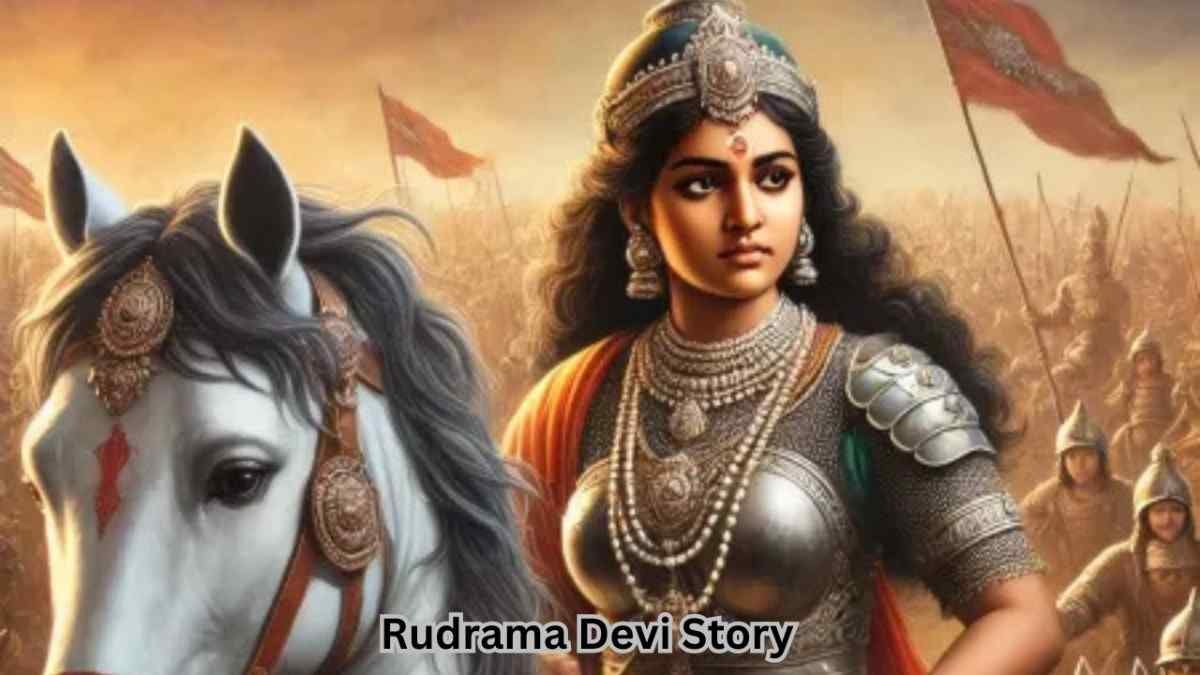
Rudrama Devi Story was one of the most powerful women rulers in Indian history. She ruled the Kakatiya dynasty during the 13th century. Her life story is full of courage, leadership, and determination.
Early Life of Rudrama Devi
Rudrama Devi was born around 1259 CE in Warangal. She was the daughter of King Ganapati Deva. Since the king had no sons, he decided to raise Rudrama Devi like a prince.
She wore male attire and was trained in royal duties just like a prince. This helped her gain respect among soldiers and ministers.
Royal Family and Lineage
Rudrama Devi came from a respected royal lineage:
- Father: Ganapati Deva (King of Kakatiya dynasty)
- Mother: Somaladevi (Queen)
- Grandfather: Mahadeva (previous ruler)
The Kakatiya family was known for strong administration, architecture, and military power.
Married Life and Royal Duties
After her marriage, Rudrama Devi balanced both her personal life and royal duties.
- She continued learning administration and warfare
- Supported her father, King Ganapati Deva, in ruling the kingdom
- Maintained strong leadership qualities
Unlike many women of that time, she remained active in politics and governance.
Children of Rudrama Devi (c. 1260s–1270s CE)
Rudrama Devi had three daughters:
- Mummadamma
- Rudramamba
- Ruyyamma
She did not have a son, which was important in royal succession during that period.
Family and Succession (1270s–1280s CE)
Since Rudrama Devi Story had no male heir, the question of succession became important.
Her daughter Mummadamma’s son, Prataparudra II, was chosen as the future king.
During the 1270s–1280s CE, Rudrama Devi trained him to become a capable ruler.
Early Education (c. 1260–1265 CE)
During 1260 to 1265 CE, Rudrama Devi began her early education in Warangal.
Unlike other girls of her time, she was trained like a prince. Her father, Ganapati Deva, made sure she received the best education.
She learned:
- Basic reading and writing
- Royal customs and traditions
- Discipline and leadership values
Military Training (c. 1262–1268 CE)
Between 1262 and 1268 CE, Rudrama Devi received a strong military education.
She was trained in:
- Sword fighting
- Horse riding
- Archery
- Battlefield strategies
This training made her a brave warrior and helped her lead armies in the future.
Administrative Education (c. 1265–1270 CE)
From 1265 to 1270 CE, Rudrama Devi learned how to manage a kingdom.
Her education included:
- Governance and administration
- Tax system and revenue management
- Law and justice
- Diplomacy and political strategy
She often attended court sessions with her father to gain practical knowledge. Rudrama Devi Story
Advanced Leadership Training (c. 1268–1272 CE)
During 1268 to 1272 CE, Rudrama Devi received advanced leadership training.
She learned:
- Decision-making skills
- Handling public issues
- Managing ministers and the army
- Crisis management
This period prepared her to become a future ruler.
Role of Her Father in Education
King Ganapati Deva played a major role in her education.
- He personally trained her in governance
- He allowed her to participate in royal decisions
- He encouraged her to think like a king
His guidance helped her gain confidence and experience.
Declared as Successor (c. 1269 CE)
Around 1269 CE, King Ganapati Deva officially declared Rudrama Devi as his heir.
This was a bold and unusual decision because, at that time, women were rarely allowed to rule kingdoms. Many nobles and people did not accept this decision at first.
To strengthen her position, she was given a male title, “Rudradeva Maharaja.”
Facing Opposition (1269–1272 CE)
Between 1269 and 1272 CE, Rudrama Devi faced strong opposition:
- Some nobles refused to accept a female ruler
- Feudal lords challenged her authority
- Social traditions were against women’s leadership
However, she used her intelligence and courage to overcome these challenges.
Becoming the Queen (c. 1273 CE)
Around 1273 CE, after the death of King Ganapati Deva, Rudrama Devi officially became the ruler of the Kakatiya Empire.
Her coronation marked a historic moment, as she became one of the few women to rule a large kingdom in India.
Early Years of Rule (1273–1280 CE)
From 1273 to 1280 CE, Rudrama Devi worked hard to establish her authority:
- She controlled rebellions by local chiefs
- Strengthened the administration
- Built trust among her people and army
Her strong leadership proved that she was capable of ruling successfully.
Strengthening the Kingdom (1273–1280 CE)
Between 1273 and 1280 CE, Rudrama Devi focused on making her kingdom strong and stable.
Key Actions:
- Controlled rebellions and restored peace
- Organized a strong administrative system
- Appointed loyal officers and ministers
- Strengthened defense systems
Her leadership helped bring stability to the empire. Rudrama Devi Story
Military Achievements (1275–1285 CE)
From 1275 to 1285 CE, Rudrama Devi proved her strength as a warrior queen.
- She personally led her army in battles
- Defeated enemies who tried to invade her kingdom
- Protected the borders of the Kakatiya Empire
Her bravery earned her respect from both her soldiers and enemies.
Development and Welfare Works (1275–1288 CE)
During 1275 to 1288 CE, Rudrama Devi worked for the development of her kingdom.
Major Achievements:
- Strengthened the famous Warangal Fort
- Improved irrigation systems for farmers
- Encouraged agriculture and trade
- Developed roads and infrastructure
These works improved the lives of her people.
Internal Enemies Rebellions by Feudal Lords (1273–1280 CE)
After becoming queen around 1273 CE, Rudrama Devi faced strong opposition from internal enemies.
Main Opponents:
- Feudal chiefs (Nayakas) who did not accept a female ruler
- Local nobles who wanted power
What Happened:
- Many chiefs started revolts against her rule
- They tried to weaken her authority
Her Response:
- Rudrama Devi personally led her army
- Defeated the rebels and restored order
Her victory over internal enemies proved her strength as a ruler.
External Enemies Neighboring Kingdoms (1275–1285 CE)
Between 1275 and 1285 CE, Rudrama Devi faced threats from nearby kingdoms.
Important Enemies:
- Yadava dynasty (Devagiri rulers)
- Pandya dynasty
- Other regional powers in South India
Reasons for Conflict:
- Expansion of territory
- Control over trade routes
- Weakness expected due to a woman ruler
Her Response:
- Strengthened border defenses
- Led armies in battles
- Used smart war strategies to defeat enemies
She successfully protected the Kakatiya Empire from invasions.
Defense of Warangal (c. 1280 CE)
The capital, Warangal, was an important target for enemies.
Situation:
- The enemies tried to capture Warangal
- It was a major political and economic center
Her Action:
- Strengthened the fort and army
- Defended the capital successfully
This showed her strong planning and defensive skills. Rudrama Devi Story
Death of Rudrama Devi (c. 1289 CE)
Rudrama Devi died around 1289 CE. According to historical sources, she likely died while fighting in a battle.
Her death is believed to have happened during a conflict with rebel chiefs or enemy forces. This shows her bravery, as she remained active on the battlefield even in her final moments.
Place of Death
The exact place of Rudrama Devi’s death is not fully confirmed, but it is widely believed to be near Chandupatla village in present-day Telangana.
Important Location:
- Chandupatla
An inscription found in this area mentions her death, which supports this belief.
Historical Evidence
Historians have found inscriptions that give clues about her death:
- The Chandupatla inscription mentions her name
- It indicates that she died during a battle
- It connects her death to that region
These records help us understand her final days.
After Her Death
After Rudrama Devi died in 1289 CE, her grandson Prataparudra II became the ruler of the Kakatiya dynasty.
He continued her legacy and ruled the kingdom after her.
Legacy of Her Death
Rudrama Devi’s death is remembered as heroic because:
- She died as a warrior, not just a ruler
- She protected her kingdom till her last breath
- She became a symbol of courage and sacrifice
Her life and death continue to inspire people across India.
FAQS
1) Who defeated Rudramadevi?
A single known enemy did not clearly defeat Rudrama Devi. She likely died around 1289 CE during a battle against rebel chiefs or invading forces. Historical records do not confirm one specific person who defeated her.
2) Who did Rudramadevi marry?
Rudrama Devi married Veerabhadra, a prince of the Eastern Chalukya family, around the 1260s CE. Their marriage was a political alliance, strengthening ties between royal families and supporting the stability of the Kakatiya kingdom.
3) How many years did Rani Rudrama Devi live?
Rudrama Devi lived for about 30 years, from around 1259 CE to 1289 CE. Though her life was short, she achieved great success as a ruler and became one of the most respected and brave queens in Indian history.
4) Is Narasimha Reddy a true story?
Uyyalawada Narasimha Reddy is based on a true story. He was a real freedom fighter who led a rebellion against British rule in 1846 in Andhra Pradesh. His life inspired movies, though films may add fictional elements.
5) Was Rudrama Devi a good ruler?
Rudrama Devi was a good and capable ruler. She maintained peace, strengthened her kingdom, improved irrigation and trade, and led armies bravely. Her leadership and courage made her one of the most respected and successful queens in Indian history.
Read More: