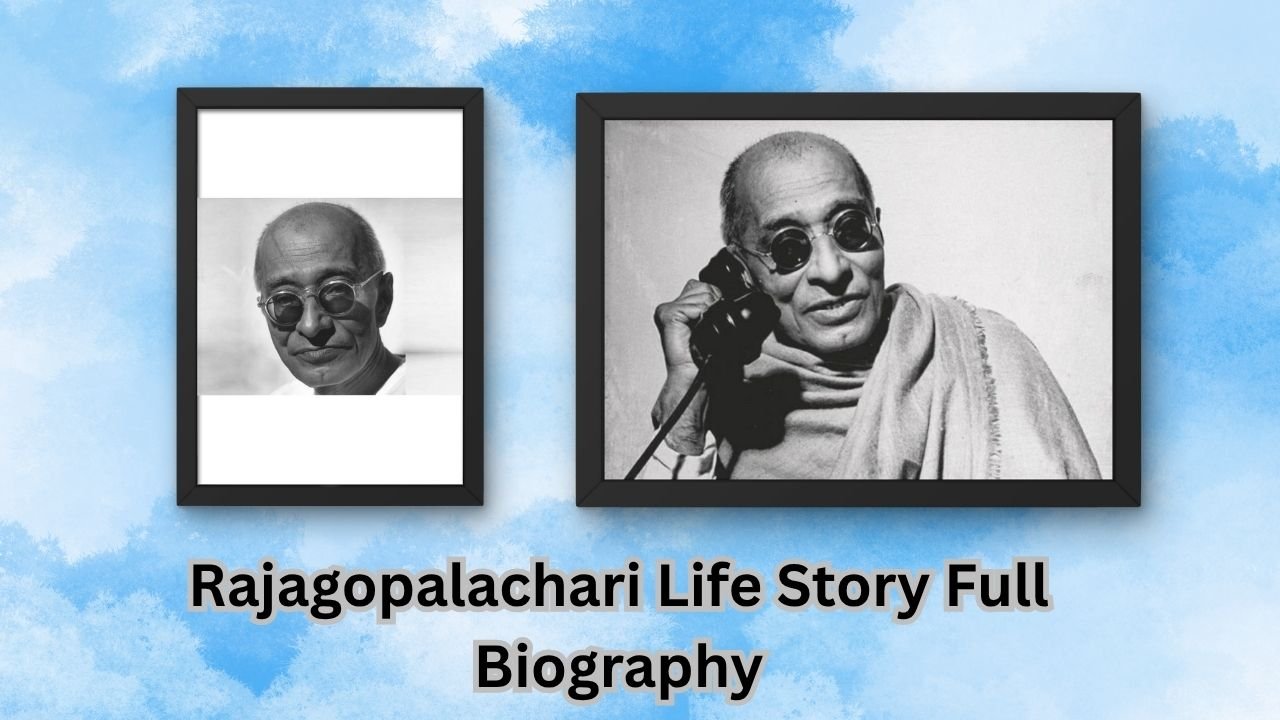
Rajagopalachari Life Story Full Biography, Chakravarti Rajagopalachari, or Rajaji, was one of India’s greatest leaders, freedom fighters, lawyers, and writers. He was a key figure in the independence movement and later became India’s first and last Governor-General. A close associate of Mahatma Gandhi, he was noted for his intelligence, honesty, and simple living.
Early Life (1878)
Rajagopalachari was born on December 10, 1878, in the small village of Thorapalli, Tamil Nadu. He was born into a traditional South Indian Brahmin family. From a young age, Rajaji showed great intelligence and curiosity for learning.
His childhood was simple, but his thinking was always sharp and mature. He was deeply influenced by moral values and discipline, which later shaped his leadership personality.
Parents
Rajaji’s parents played an important role in his upbringing:
- Father: Chakravarti Venkataryan, a court official (Munsiff)
- Mother: Singaramma, a caring and religious woman
His father valued discipline and education; his mother taught him kindness and spirituality.
Education (1880s–1897)
Rajagopalachari completed his early schooling in Hosur. He later joined Central College, Bangalore, where he excelled academically.
After that, he moved to Madras (now Chennai) to study law. He completed his law degree around 1897, showing strong academic performance.
His studies developed his logical thinking, communication, and leadership skills.
Marriage and Children
Rajaji married Alamelu Mangalamma at a young age, in accordance with the customs of the time. Their marriage was strong and supportive.
The couple had several children. One of his daughters, Lakshmi, married Devdas Gandhi, the son of Mahatma Gandhi. This created a close personal bond between Rajaji and Gandhi.
Despite public life, Rajaji maintained strong family values and care at home. Rajagopalachari Life Story Full Biography
Career as a Lawyer (1897–1919)
After finishing his studies, Rajaji launched his legal career in Salem in 1897. He quickly gained respect as one of the region’s preeminent lawyers.
He was known for:
- Sharp legal knowledge
- Honest practice
- Clear arguments in court
His successful legal career brought financial stability, but he chose to leave it to serve the nation. Rajagopalachari Life Story Full Biography
Entry into Freedom Movement (1919–1920)
Rajaji’s path changed after meeting Mahatma Gandhi, whose ideals deeply influenced him. Around 1919, inspired to act, Rajaji joined the Indian freedom movement with passion and resolve.
In 1920, he joined the Non-Cooperation Movement, giving up his legal career to fight for freedom.
He strongly believed in:
- Non-violence
- Truth
- Self-discipline
Salt Satyagraha Leader (1930)
Following his beliefs, Rajaji took a frontline role during the Salt Satyagraha in 1930.
This protest challenged British salt taxes. Rajaji’s leadership demonstrated courage and determination, inspiring many people to join the freedom struggle.
Chief Minister of Madras (1937–1939, 1952–1954)
Rajaji became the Chief Minister of Madras Presidency in 1937 after the elections.
During his leadership, he:
- Improved education
- Promoted social reforms
- Worked for better governance
However, in 1939, he resigned in protest after the British government dragged India into World War II without consulting Indian leaders.
He returned to office as Chief Minister from 1952 to 1954, continuing his commitment to reforms and dedicated administration, further building on his legacy.
Role in Independence (1940–1947)
Throughout the 1940s, Rajaji was a key figure in India’s path to independence, using his skills to navigate challenging negotiations and policies.
In 1944, he introduced the C. R. Formula to resolve political differences between the Indian National Congress and the Muslim League.
Though the attempt was not fully successful, his efforts reflected a commitment to peaceful resolution and unity.
Governor of West Bengal (1947–1948)
Appointed Governor of West Bengal after India’s independence in 1947, Rajaji was tasked with guiding the state during a turbulent post-partition period.
This was a tumultuous period due to partition. Rajaji worked relentlessly to uphold peace and stability.
First Indian Governor-General (1948–1950)
In 1948, Rajaji was selected as Governor-General, succeeding Lord Mountbatten and ushering in a new era of Indian leadership. Rajagopalachari Life Story Full Biography
He served in this position until 1950, when India became a republic.
He was:
- The first Indian to hold this post.
- The last Governor-General of India
This was one of his greatest achievements.
Later Political Life (1950–1967)
Rajaji’s public engagement continued after independence, as he remained active and influential in Indian politics through the following decades.
- Became Chief Minister again (1952–1954)
- Founded the Swatantra Party in 1959
The Swatantra Party opposed excessive government control and supported free-market policies.
Rajaji was known for his independent thinking and was not afraid to express his views, even when they differed from others’.
Writer and Scholar
Rajaji was also a great writer and scholar. He wrote simple and easy-to-understand versions of Indian epics, such as:
- Ramayana
- Mahabharata
His writings helped people understand Indian traditions, culture, and values.
He also wrote essays on politics, philosophy, and society.
Death (1972)
Chakravarti Rajagopalachari passed away on December 25, 1972.
- Age: 94 years
- Death Place: Madras (Chennai), Tamil Nadu, India
His passing marked the end of an era of great leadership and wisdom.
Achievements and Legacy
Rajaji’s life was full of achievements and contributions:
- First and last Indian Governor-General (1948–1950)
- Freedom fighter and close associate of Mahatma Gandhi
- Leader in the Salt Satyagraha (1930)
- Chief Minister of Madras (1937–1939, 1952–1954)
- Founder of the Swatantra Party (1959)
- Awarded the Bharat Ratna in 1954
- Famous writer and thinker
Conclusion
The life story of Chakravarti Rajagopalachari exemplifies dedication, intellect, and leadership. From a rural village in Tamil Nadu to Governor-General, his journey inspires.
Rajaji’s impact on India’s freedom, governance, and literature continues to motivate generations. His life underscores the value of honesty, courage, and commitment to society.
FAQS
1) Why did Rajagopalachari resign?
Chakravarti Rajagopalachari resigned in 1939 as Chief Minister of Madras to protest the British decision to involve India in World War II without consulting Indian leaders, showing his strong stand for self-rule and respect for Indian political rights.
2) What was Rajaji’s mother tongue?
Chakravarti Rajagopalachari’s mother tongue was Tamil. He was born in Tamil Nadu and spoke Tamil fluently. He also knew English and Sanskrit well and used these languages in his writings, speeches, and political work throughout his life.
3) How many languages do you speak?
Chakravarti Rajagopalachari spoke three main languages fluently: Tamil (his mother tongue), English, and Sanskrit. He used Tamil for daily life, English for administration and writing, and Sanskrit for studying scriptures and Indian philosophy during his intellectual pursuits.
4) Was Rajagopalachari no changer?
Chakravarti Rajagopalachari was a “No-Changer” in the 1920s. He supported Mahatma Gandhi’s idea of boycotting British institutions and focusing on constructive work such as khadi, village industries, and social reforms rather than entering legislative councils under colonial rule.
Read More: