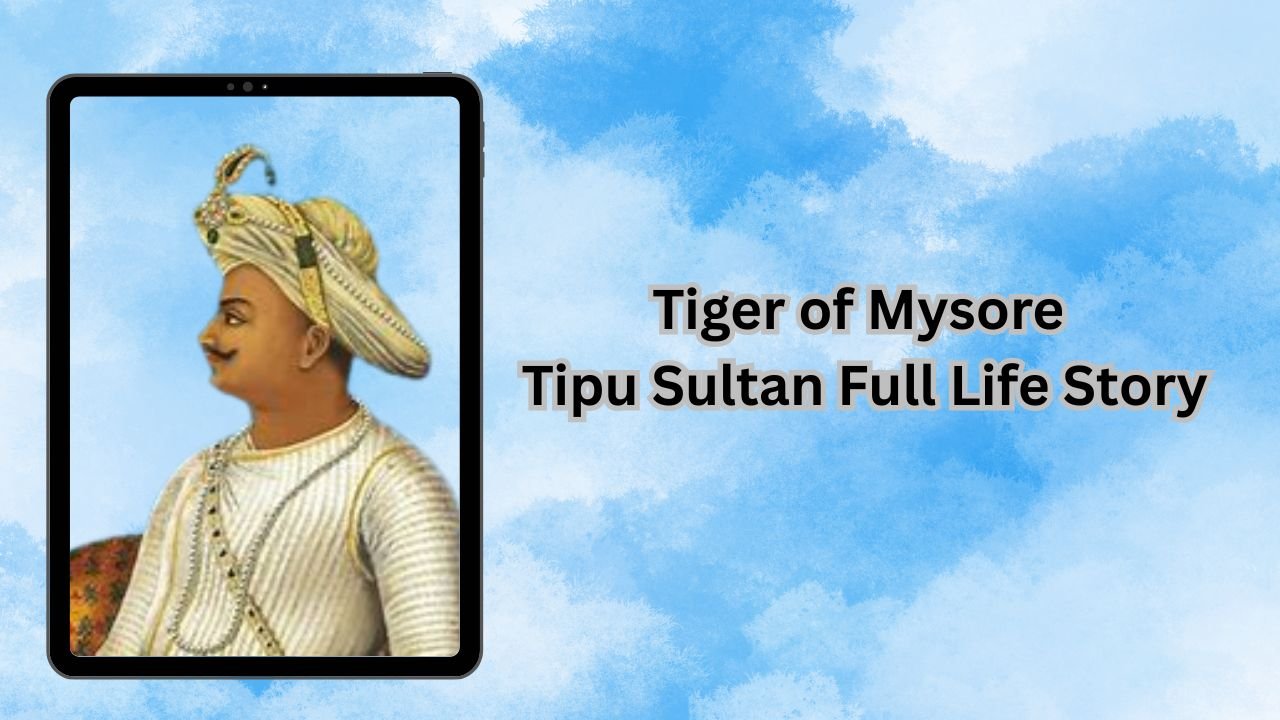
Tiger of Mysore Tipu Sultan Full Life Story was a famous ruler of India, known as the “Tiger of Mysore.” He was a brave king who fought against the British to protect his kingdom. His life story is full of courage and patriotism.
Tipu Sultan Early Life (1751–1766)
Tipu Sultan was born on 20 November 1751 in Devanahalli. His father was Hyder Ali, and his mother was Fakhr-un-Nissa.
From childhood, he learned war skills, horse riding, and leadership. By the age of 15, he started helping his father in battles.
Parents of Tipu Sultan (18th Century)
Tipu Sultan was the son of Hyder Ali and Fakhr-un-Nissa, born in Devanahalli on 20 November 1751.
- Father: Hyder Ali (c. 1720 – 1782)
He was the ruler of Mysore and a powerful military leader. He trained Tipu in warfare and leadership. - Mother: Fakhr-un-Nissa (18th century)
She was also known as Fatima Fakhr-un-Nissa. She supported Tipu Sultan and guided him in his early life.
Siblings of Tipu Sultan
Tipu Sultan had brothers and sisters, but little is known about them.
- His younger brother was Abdul Karim (18th century), a member of the royal family but not a ruler.
- Other siblings are mentioned in historical records, but their names and details are limited.
Even though he had siblings, Tipu Sultan became Hyder Ali’s primary heir due to his talent and leadership.
Wives of Tipu Sultan (Marriage Years)
Tipu Sultan had multiple wives, which strengthened political ties.
- Ruqaiya Banu Begum (married c. 1774) – One of his main wives
- Khadija Zaman Begum (18th century)
- Other wives were also part of the royal household.
His marriages helped strengthen political and royal relationships.
Children of Tipu Sultan (1780s–1790s)
Tipu Sultan had several sons, such as Fateh Hyder and Abdul Khaliq.
Some known sons include:
- Fateh Hyder (born c. 1770s)
- Abdul Khaliq
- Muiz-ud-din
After Tipu Sultan’s death in 1799, some of his sons were taken into British custody by the British East India Company. Tiger of Mysore Tipu Sultan Full Life Story
Early Education (1756–1765)
His education started at an early age under the guidance of royal teachers.
- Learned Persian (the official language of administration)
- Studied Arabic for religious knowledge
- Learned Kannada and Urdu for communication
- Gained knowledge in history, politics, and religion
By the age of 10, he had already developed strong learning skills.
Religious and Moral Education (1756–1766)
Tipu Sultan was taught Islamic teachings along with moral values.
- Studied the Quran and religious texts
- Learned about ethics, justice, and discipline
- Developed a strong sense of duty and responsibility
This education helped him become a fair and disciplined ruler.
Military Training (1760–1769)
Under his father, Hyder Ali, Tipu Sultan received practical military education.
- Training in sword fighting and archery
- Skills in horse riding and battlefield tactics
- Learning war strategies and leadership
- Participated in real battles like the First Anglo-Mysore War (1767–1769)
This hands-on experience made him a strong warrior at a young age.
Advanced Knowledge and Skills (1766–1782)
As he grew older, Tipu Sultan continued learning:
- Studied administration and governance
- Learned about the economy and trade systems
- Showed interest in science and technology, especially weapons
- Supported the use of rockets in warfare (1780s)
His education was practical and focused on improving his kingdom. Tiger of Mysore Tipu Sultan Full Life Story
Becoming the Ruler of Mysore (1782)
After his father’s death in 1782, Tipu Sultan became the ruler of Mysore.
- He was declared king by his army and officials.
- Took charge during an ongoing war
- Continued fighting against the British East India Company
His quick action helped maintain stability in the kingdom.
Early Challenges as a Ruler (1782–1784)
After becoming king, Tipu Sultan faced many challenges:
- Continued the Second Anglo-Mysore War (1780–1784)
- Faced strong enemies like the British and their allies
- Needed to protect his kingdom from attacks
In 1784, he signed the Treaty of Mangalore, which ended the war and was seen as a success for Mysore. Tiger of Mysore Tipu Sultan Full Life Story
Rule and Achievements (1782–1799)
During his rule, Tipu Sultan made many changes:
- Introduced new coins and a new calendar (1786)
- Developed trade and agriculture
- Built strong forts and improved roads
- Used modern weapons and rockets in wars (1780s)
He wanted Mysore to become a powerful and independent kingdom.
Wars Against the British (1767–1799)
Wars showed his courage and determination to protect his kingdom.
First Anglo-Mysore War (1767–1769)
The First Anglo-Mysore War (1767–1769) was fought over land disputes between Mysore and the British. Tipu Sultan, with his father Hyder Ali, led Mysore’s army. The war ended with the Treaty of Madras, which restored territories captured by both sides.
- Fought by Tipu Sultan, along with his father, Hyder Ali
- Mysore forces performed strongly against the British.
- Ended with the Treaty of Madras (1769)
- Both sides agreed to return captured territories.
This war gave Tipu Sultan early battle experience.
Second Anglo-Mysore War (1780–1784)
The Second Anglo-Mysore War (1780–1784) began due to rising tensions with the British and their allies. Tipu Sultan led Mysore’s forces, achieving victories. The Treaty of Mangalore ended the war, and territories remained mostly unchanged.
- Started due to conflicts with the British and their allies
- Tipu Sultan played a major role in the battles.
- Mysore forces defeated British troops in several fights.
- Ended with the Treaty of Mangalore (1784)
This treaty was a success for Mysore and showed Tipu Sultan’s strength.
Third Anglo-Mysore War (1790–1792)
In the Third Anglo-Mysore War (1790–1792), Mysore faced the British, Marathas, and Nizam of Hyderabad. Despite Tipu Sultan’s resistance, Mysore was forced to give up territory by the Treaty of Seringapatam.
- The British joined with the Marathas and the Nizam of Hyderabad.
- Tipu Sultan fought bravely but faced strong opposition.
- Ended with the Treaty of Seringapatam (1792)
- Tipu Sultan had to give up some of his territory.
This war weakened Mysore but did not break Tipu’s spirit.
Fourth Anglo-Mysore War (1799)
The Fourth Anglo-Mysore War (1799) was the final conflict between Mysore and British-led forces. Tipu Sultan defended Srirangapatna but was killed in battle. After his death, Mysore came under British control.
- British forces attacked Mysore with strong support.
- The main battle took place at Srirangapatna.
- Tipu Sultan fought bravely to defend his capital.
- He died on 4 May 1799 during the battle.
This war ended Mysore’s resistance against British rule.
Death of Tipu Sultan (4 May 1799)
Tipu Sultan died on 4 May 1799 during the battle of Srirangapatna.
- He fought bravely until his last breath.
- He was killed near the fort of Srirangapatna.
- He refused to surrender to the British.
His death marked the end of a strong resistance against British rule in South India.
Place of Death
Tipu Sultan died in Srirangapatna, which was the capital of the Mysore kingdom.
Today, this place is an important historical site, and many people visit it to remember his bravery.
After His Death (1799)
After Tipu Sultan’s death:
- Mysore came under British control.
- His family members were taken by the British.
- The power of the British East India Company increased in South India.
His death changed the region’s history.
Legacy
Tipu Sultan is remembered as one of the first Indian rulers to resist British rule. His courage, leadership, and patriotism continue to inspire new generations. Tipu Sultan’s unwavering dedication to his people and his kingdom serves as a lasting reminder of the power of resilience and the spirit of independence. Even today, his legacy urges people to face adversity with bravery and to cherish freedom as a priceless gift. His story remains a guiding light, encouraging all to strive for justice and national pride.
FAQS
1) Who finally defeated Tipu?
Tipu Sultan was finally defeated by the forces of the British East India Company, led by Lord Wellesley, during the Fourth Anglo-Mysore War in 1799 at Srirangapatna.
2) Is Tipu Sultan a king or not?
Tipu Sultan was a king. He ruled the Kingdom of Mysore from 1782 to 1799. Known as the “Tiger of Mysore,” he was a powerful ruler who fought bravely against the British to protect his kingdom.
3) What language did Tipu Sultan speak?
Tipu Sultan spoke several languages, including Persian, which was the official court language. He also knew Kannada, Urdu, and Arabic. Persian was mainly used for administration, while other languages helped him communicate with people and soldiers.
Read More: