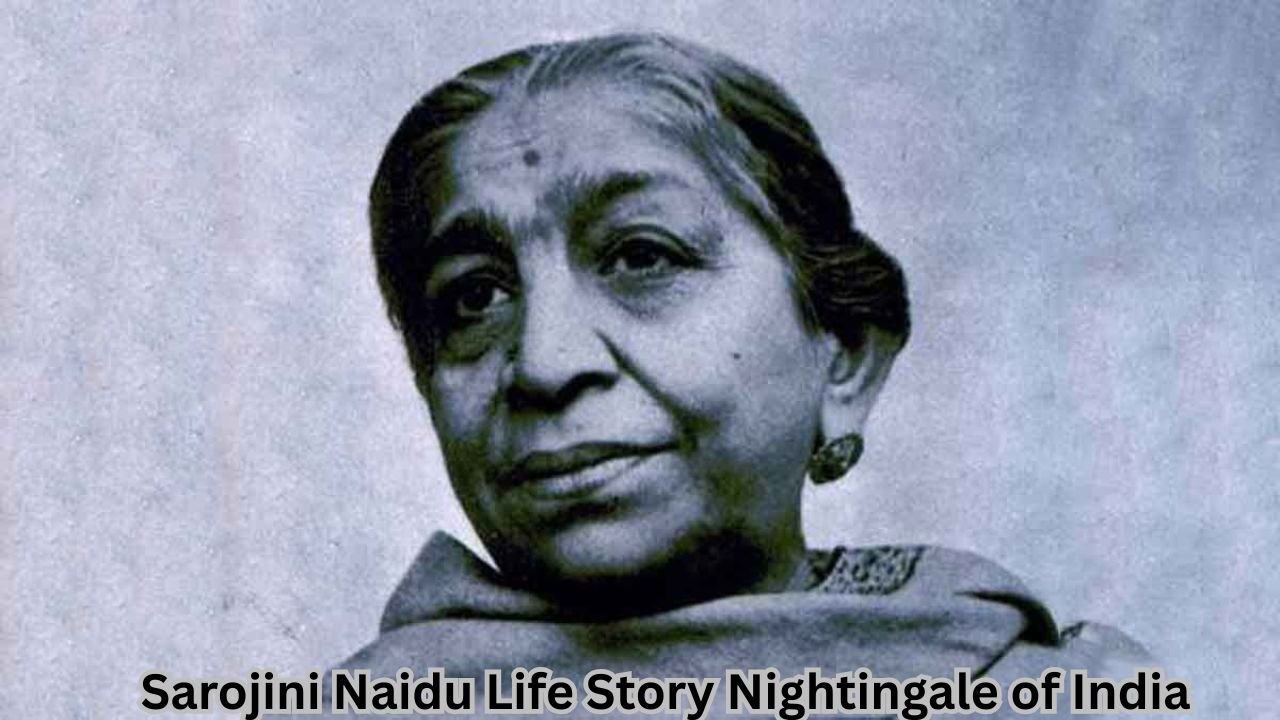
Sarojini Naidu, Life Story, Nightingale of India, was one of India’s most well-known freedom fighters and poets. Renowned for her beautiful poems and inspiring speeches, she was often called the “Nightingale of India.” Not only did she play a key role in India’s independence movement, but she also became a historic figure remembered for her impact.
Sarojini Naidu Early Life (1879–1895)
Sarojini Naidu was born in Hyderabad on February 13, 1879. Her father, Aghorenath Chattopadhyay, was a scientist, and her mother was a poet.
In 1891, when she was just 12 years old, she topped the matriculation exam. Early on, she began writing poetry and soon earned recognition for her remarkable talent.
Family Background
Sarojini Naidu came from a highly educated and talented family:
- Her father, Aghorenath Chattopadhyay, a scientist, philosopher, and educationist, founded Nizam College in Hyderabad.
- Her mother, Varada Sundari Devi, was a poet who wrote in Bengali.
Her parents always encouraged her to study and think freely. By expressing her ideas through writing, she found her voice. Their support motivated her from a young age and continued to inspire her throughout her life, too.
Siblings (Brothers and Sisters)
Sarojini Naidu had several talented siblings who became well-known in different fields:
- Virendranath Chattopadhyay – A freedom fighter and revolutionary who worked against British rule.
- Harindranath Chattopadhyay – A famous poet, writer, and actor.
- Suhasini Chattopadhyay – One of the first women communist leaders in India.
- Mrinalini Chattopadhyay – An educationist who contributed to social development.
Being part of a talented family helped Sarojini develop confidence and leadership.
Languages She Spoke
Sarojini Naidu was fluent in several languages. The main languages she spoke include:
- English – Her primary language for writing poetry and delivering speeches
- Hindi – Used during the freedom movement to connect with people
- Bengali – Her mother tongue
- Urdu – Commonly spoken in her birthplace
- Telugu – Spoken in the region where she was born
Knowing many languages made her a strong communicator and helped her connect with people from diverse backgrounds. of her talent, Sarojini Naidu went to England in 1895 to continue her studies.
Higher Education in England (1895–1898)
Due to her exceptional talent, Sarojini Naidu went to England in 1895 for higher studies.
- She studied at King’s College London.
- Later, she joined Girton College.
During this time, she improved her English writing skills and learned about Western literature and culture. This period helped her become a better poet. Sarojini Naidu Life Story Nightingale of India
Influence of Education on Her Career (1898 onwards)
After completing her education around 1898, Sarojini Naidu returned to India.
- Her education helped her write well-known poetry books, such as The Golden Threshold (1905).
- Her education gave her the confidence to speak in public and join the freedom movement.
Fluency in English made her a strong speaker in India and globally. globally,
Marriage (1898)
In 1898, Sarojini Naidu married Dr. Govindarajulu Naidu, who was a respected doctor. Their marriage across different castes was rare and brave at that time in India.
Despite social barriers, the family’s support enabled a happy marriage based on love and respect. Their.
Family Life and Support (1898–1915)
After getting married, Sarojini Naidu focused on both her family and her love for poetry. She worked hard to balance both parts of her life.
- Her husband encouraged her writing and public life.
- She continued growing as a poet, eventually becoming involved in social and political activities as well.
This support helped her succeed in many areas of her life.
Children (1898–1910)
Sarojini Naidu had four children, who also achieved success in different fields:
- Padmaja Naidu – Born in 1900, she became a freedom fighter and later served as the Governor of West Bengal.
- Jayasurya Naidu – He was involved in public service and administration.
- Randheer Naidu – He served in administrative roles.
- Leilamani Naidu – She contributed to social and cultural activities.
She taught her children the value of discipline and strong moral values, guiding them to become responsible adults.
Early Poetry Career (1890s–1905)
Sarojini Naidu began writing poetry as a child and was recognized for her talent by the 1890s. Her poems were inspired by Indian culture, traditions, and nature, which were important to her. With help from mentors in England, she improved her writing and got ready to publish her first poetry book.
- The Golden Threshold (1905). The Golden Threshold, her first poetry book, was published in 1905.
- The book established her as a famous poet.
- The poems talk about Indian life, traditions, love, and nature.
- It includes popular poems such as “Palanquin Bears” and “Indian Weaves.”
This book marked the start of her writing career. Sarojini Naidu Life Story Nightingale of India
- The Bird of Time (1912)
Her second book, The Bird of Time, was published in 1912.
- It contains poems about time, life, and death, as well as patriotic themes. Each poem shows a different side of her as a poet. The book showed how she grew as a poet. made her even more respected as one of India’s top poets.
- strengthened her position as one of India’s leading poets.
- The Broken Wing (1917)
The Broken Wing, published in 1917, is one of her strongest works.
- It includes poems about freedom. How she became more involved in the movement. This book connects her poetry with her activism and love for her country. especially after meeting Mahatma Gandhi in 1915.
After meeting Mahatma Gandhi in 1915, she joined the freedom movement and used her speeches to inspire unity and motivate others.
Non-Cooperation Movement (1920–1922)
During 1920–1922, Sarojini Naidu actively supported the Non-Cooperation Movement led by Mahatma Gandhi.
- She promoted self-rule. Her leadership and courage in the country.
President of the Indian National Congress (1925)
In 1925, Sarojini Naidu became the first Indian woman to serve as President of the Indian National Congress.
This was a historic achievement, showing the growing role of women in Indian politics.
Civil Disobedience Movement (1930)
In 1930, Sarojini Naidu played a key role in the Civil Disobedience Movement.
- She participated in protests against British laws.
- After the arrest of Mahatma Gandhi, she took leadership in some movements.
- She was arrested and put in jail by the British government. Her bravery inspired many women to join. The movement grew and became stronger as more women joined, took part, and were encouraged by her leadership.
Round Table Conference (1931)
In 1931, Sarojini Naidu accompanied Mahatma Gandhi to London for the Round Table Conference.
- She represented Indian interests.
- She spoke of freedom and equality, demonstrating her importance in national politics.
Quit India Movement (1942)
In 1942, supported the Quit India Movement and was jailed, remaining dedicated to freedom despite hardships.
Contribution to Women’s Empowerment
Throughout her freedom struggle, she showed that women can be leaders and make a difference in society. She encouraged society to take part in the protest. She proved that women can lead and change society, and her achievements opened doors for generations to come. to come.
Political Achievements (1947–1949)
After India gained independence in 1947, Sarojini Naidu became the first woman Governor of Uttar Pradesh.
- She served as Governor from 1947, working for welfare and unity, inspiring others to serve society.
This was a historic achievement in Indian politics.
Death (1949)
Sarojini Naidu passed away on March 2, 1949.
- She died at the age of 70.
- Her death was a great loss to the nation, and her legacy still inspires people today.
Sarojini Naidu died in Lucknow while serving as the Governor of Uttar Pradesh. She spent her last days there, serving the nation. He spent her final days there, serving the nation as Governor of Uttar Pradesh.
Here are some frequently asked questions about her life:
1) Is Sarojini Naidu a Hindu?
Sarojini Naidu was born into a Bengali Hindu family in 1879. Her parents followed Hindu traditions, and she grew up in a Hindu cultural environment. However, she believed in unity and respected all religions throughout her life.
2) What is Sarojini Naidu most famous for?
Sarojini Naidu is best known as the “Nightingale of India,” for her beautiful poetry and powerful speeches. She also played a key role in India’s freedom struggle and became the first woman Governor of Uttar Pradesh.
3) What is the mother tongue of Sarojini Naidu?
SarojiNaidu’s mother tongue was Bengali. Her mother, Varada Sundari Devi, spoke and wrote in Bengali as well.
4) What was SarojiNaidu’su’s famous quote?
Sarojini Naidu once said, ” Country’s greatness lies in its undying ideals of love and sacrifice.” This quote shows her belief in patriotism, unity, and selfless service to the nation.
Read More: