Alexander the Great Full Story was one of the greatest military leaders in world history. He built a massive empire before the age of 33 and became famous for his courage, intelligence, and leadership. Alexander’s life story is still studied by historians, students, and military experts worldwide.
Early Life of Alexander
Alexander was born in 356 BCE in Pella, the capital city of Macedonia. Macedonia was an ancient kingdom near Greece.
From a young age, Alexander demonstrated bravery, keen intelligence, and ambition. Horses, hunting, and learning about warfare fascinated him. Legends say he tamed a wild horse named Bucephalus while still a boy.
Alexander was trained from an early age to become a warrior and ruler.
Parents of Alexander
Alexander’s father was Philip II of Macedon, one of the strongest kings in Macedonian history. Philip II created a powerful army and expanded his kingdom through wars and diplomacy.
Alexander’s mother was Olympias. She was very religious and strongly influenced Alexander’s personality and confidence.
Their influence would continue to guide Alexander throughout his life as he faced important decisions. Alexander the Great Full Story
Education of Alexander
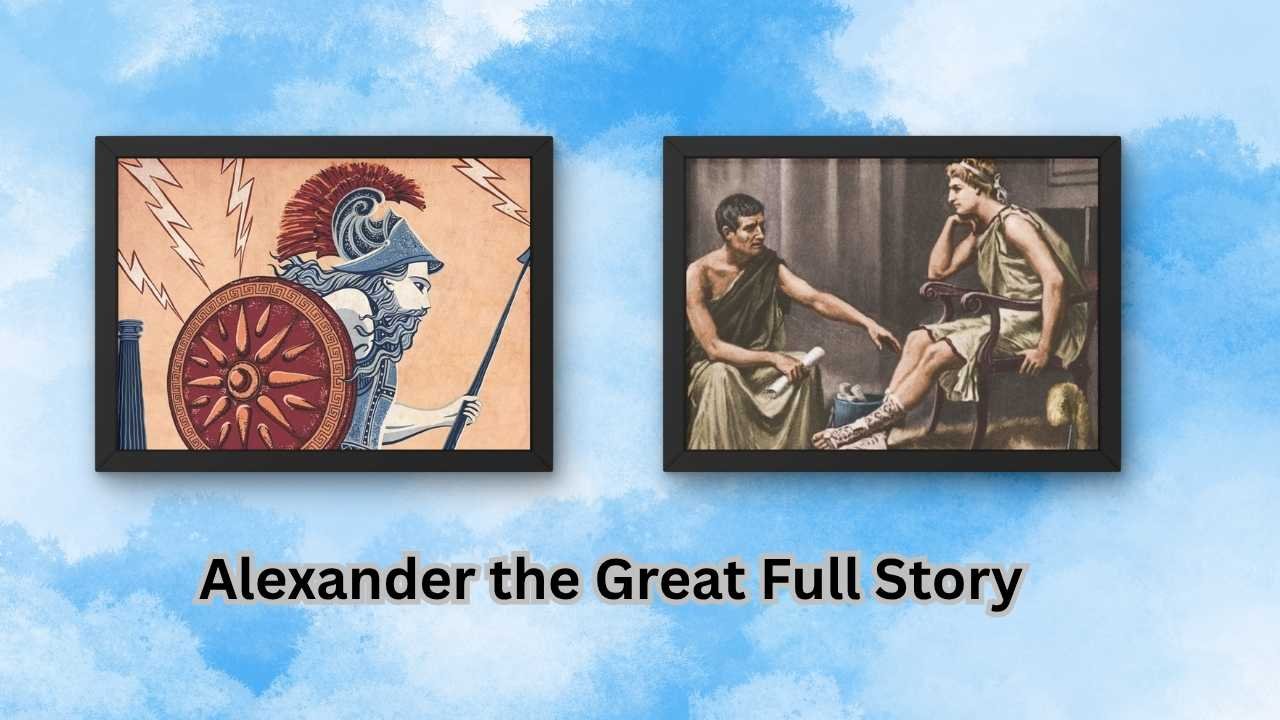
The year 343 BCE marked a major turning point when Alexander became the student of Aristotle, one of Greece’s most famous philosophers.
Aristotle taught Alexander subjects such as:
- Philosophy
- Science
- Medicine
- Literature
- Politics
- Geography
As you will see in later sections, this education was vital in making Alexander a skilled military leader and wise ruler.
Marriage of Alexander
Throughout his life, Alexander married several women, the most famous being Roxana, whom he wed in 327 BCE.
In later years, he also took Persian princesses as wives to strengthen his empire’s political alliances.
Through his marriages and his son, Alexander IV, his family ties influenced his legacy in the years after his passing.
Languages Spoken by Alexander
Alexander mainly spoke:
- Greek
- Macedonian
Because of his education, he was highly skilled in Greek. Greek culture and language spread widely through his empire after his conquests. Alexander the Great Full Story
Rise to Power
When King Philip II was assassinated in 336 BCE, Alexander ascended the throne of Macedonia at just 20 years old.
Despite doubts about his youth, Alexander quickly defeated rebellions across Greece and secured his position as king.
With these victories behind him, Alexander began planning the conquest of the Persian Empire.
Alexander’s Military Campaigns
In 334 BCE, Alexander’s military campaigns against the Persian Empire began in earnest.
He defeated the Persian king Darius III in several important battles:
Battle of Granicus (334 BCE)
Alexander won his first major victory against Persia.
Battle of Issus (333 BCE)
Victory at the Battle of Issus in 333 BCE allowed Alexander to defeat Darius III and gain control over vast territories of Persia.
Battle of Gaugamela (331 BCE)
This battle made Alexander the ruler of the Persian Empire.
Alexander’s innovative strategies would later become models studied in military schools today, connecting his legacy to modern education. Alexander the Great Full Story
Journey to Egypt
Alexander entered Egypt in 332 BCE, where the people greeted him as a liberator because of their discontent with Persian rule.
Alexander founded the famous city of Alexandria, which later became an important center of education and trade.
In Egypt, priests declared that Alexander was the son of the god Amun.
Alexander’s Invasion of India
Alexander invaded northwestern India in 326 BCE.
He fought against Porus in the famous Battle of the Hydaspes River.
Although Alexander emerged victorious, King Porus’s courageous resistance earned his respect, so Porus was allowed to continue governing his kingdom.
After years of war, Alexander’s soldiers grew tired and refused to advance further into India. Because of this, Alexander decided to return.
Leadership and Personality
Alexander was famous for:
- Courage
- Confidence
- Strategic thinking
- Leadership skills
- Ambition
By often fighting alongside his soldiers, Alexander earned their deep loyalty and lasting respect.
His respect for different cultures also set an example that would influence the diverse lands within his empire.
Alexander’s Empire
By 323 BCE, Alexander had created one of the largest empires in ancient history.
His empire stretched across:
- Greece
- Egypt
- Persia
- Mesopotamia
- Parts of Central Asia
- Northwestern India
Through these accomplishments, Alexander’s empire played a key role in connecting many civilizations and spreading Greek culture across Asia and the Middle East. This era became known as the Hellenistic Age, linking the West and East in new ways.
Awards and Honors of Alexander
In ancient times, modern awards did not exist as they do today. However, Alexander received many honors and titles, including:
- King of Macedonia
- Pharaoh of Egypt
- Lord of Asia
- Son of Amun (honorary religious title)
These titles highlight his legendary reputation, which continued to grow even after his death.
Death of Alexander
Alexander died in 323 BCE in Babylon.
The ancient city of Babylon, near present-day Iraq, was the place where Alexander died. Iraq.
Age at Death
Alexander was only 32 years old when he died.
The precise reason for Alexander’s death remains unknown, though historians suggest he may have succumbed to
- Fever
- Malaria
- Illness
- Poisoning theories
After Alexander’s death, the lack of a clear successor led to his vast empire being divided among his generals, shaping the political landscape for years to come.
Achievements of Alexander the Great
Some major achievements of Alexander include:
- Conquering the Persian Empire
- Creating one of the world’s largest empires
- Spreading Greek culture and language
- Founded many cities, including Alexandria
- Becoming one of history’s greatest military leaders
Importance in World History
Alexander the Great changed the course of world history forever.
His conquests helped increase:
- Trade
- Cultural exchange
- Education
- Spread of Greek ideas
Many famous leaders admired Alexander, including:
- Napoleon Bonaparte
- Julius Caesar
His military tactics are still studied worldwide.
Conclusion
Conclude that Alexander the Great’s life is one of bravery, ambition, and exceptional leadership. Despite his early death, his achievements ensured he would be remembered among history’s most famous rulers.
Through his empire, military victories, and enduring cultural influence, Alexander’s legacy continues to inspire people even today.
FAQs About Alexander the Great
Who was Alexander the Great?
Alexander the Great was the king of Macedonia and one of the greatest military conquerors in world history.
When was Alexander born?
Alexander was born in 356 BCE in Pella, Macedonia.
Who were Alexander’s parents?
His parents were King Philip II of Macedon and Olympias.
Who taught Alexander?
The famous philosopher Aristotle taught Alexander.
When did Alexander invade India?
Alexander invaded India in 326 BCE.
How did Alexander die?
The exact cause of Alexander’s death is unknown, but he died in Babylon in 323 BCE.
How old was Alexander when he died?
Alexander was 32 years old at the time of his death.
Why is Alexander called “The Great”?
He is called “The Great” for his military victories, leadership, and the vast empire he created.
Read More: